Force acting on a current carrying conductor within a magnetic field

Click For Summary
SUMMARY

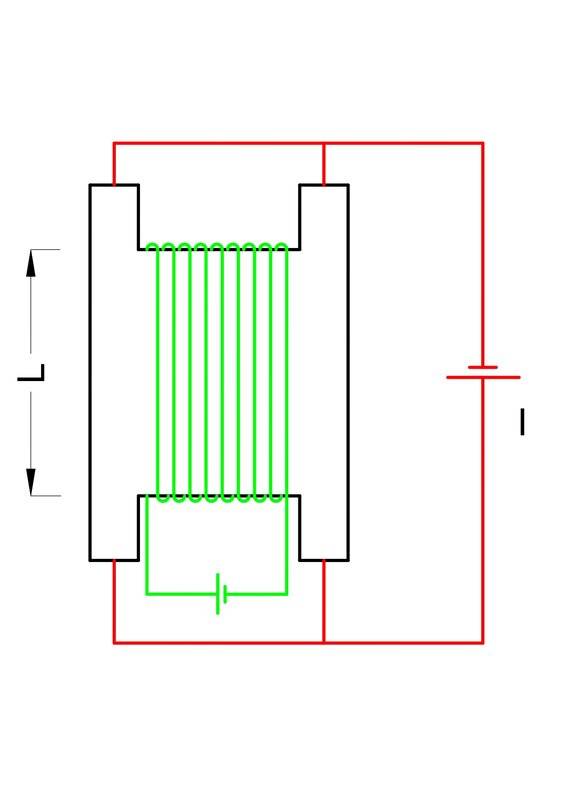
The discussion centers on the force acting on a current-carrying conductor within a magnetic field, specifically involving a coil wrapped around an H-shaped metallic plate. The participants confirm that the force F experienced by the plate can be calculated using the equation F = BIL, where B is the magnetic flux density, I is the current, and L is the length of the conductor. The conversation clarifies that the magnetic field generated by the coil is indeed internal to the conductor, challenging the conventional understanding of external magnetic fields. It is established that a BiL force exists and is perpendicular to the plane of the page, with the coil experiencing a reaction force in the opposite direction.

PREREQUISITES
  • Understanding of electromagnetic theory, specifically the Lorentz force law.
  • Familiarity with the concept of magnetic flux density (B).
  • Knowledge of current-carrying conductors and their behavior in magnetic fields.
  • Basic principles of DC circuits and magnetic fields generated by coils.
NEXT STEPS
  • Study the Lorentz force law in detail to understand the interaction between magnetic fields and electric currents.
  • Explore the concept of magnetic flux density and its implications in various electromagnetic applications.
  • Investigate the behavior of magnetic fields within conductors, particularly in complex geometries like H-shaped plates.
  • Learn about the applications of BiL forces in electromechanical systems and devices.
USEFUL FOR

Students and professionals in electrical engineering, physicists, and anyone interested in the principles of electromagnetism and their applications in current-carrying conductors.

sss
Messages
1
Reaction score
1
I am new to this forum, and this is my first post. Please bear with me if my query has any inaccuracies.

In the attached figure, a coil is wrapped around the central arm of a flat H-shaped thin metallic plate (such as iron). DC current flows through the coil and magnetizes the arm. At the same time, DC current also flows from another source through the plate as shown in the figure. Within the central arm, the directions of flow of the magnetic flux and current are perpendicular to each other.

If B is the magnetic flux density, L is the length along which the current I flows through the arm, does the plate experience a force F according to the equation F = B I L ?

I am asking this question because generally when we read about force acting on a current carrying conductor in a magnetic field, the magnetic field is understood to be external to the conductor. In this case, it is not. Hence, the query.
sss-query_page-0001.jpg
 
Last edited by a moderator:
  • Like
Likes   Reactions: berkeman
Physics news on Phys.org
Yes i think there would be a BiL force and it will be perpendicular to the plane of the page.

But i don't understand why you think that the magnetic field is not external in this case. Because it runs through the interior of the H-shaped conductor? But this happens for all external magnetic fields, they can penetrate through any conductor.
BiL force will not happen if the external magnetic field doesn't penetrate inside the conductor where the charge carriers flow and makeup the current i.
 
  • Like
Likes   Reactions: anuttarasammyak
Delta2 said:
Yes i think there would be a BiL force and it will be perpendicular to the plane of the page.
I would add that the coil gets reaction force of the opposite direction. The conductor sheet and wrapping coil repulse and no perpendicular motion would take place in total apparatus, if no rupture occurs.
 
  • Like
Likes   Reactions: Delta Prime and Delta2

Similar threads

  • · Replies 7 ·
Replies
7
Views
2K
  • · Replies 5 ·
Replies
5
Views
1K
  • · Replies 6 ·
Replies
6
Views
2K
  • · Replies 4 ·
Replies
4
Views
1K
  • · Replies 7 ·
Replies
7
Views
2K
  • · Replies 10 ·
Replies
10
Views
2K
  • · Replies 5 ·
Replies
5
Views
667
  • · Replies 27 ·
Replies
27
Views
3K
  • · Replies 9 ·
Replies
9
Views
4K
  • · Replies 15 ·
Replies
15
Views
2K