Force and Torque Calculation and Observation

Click For Summary

Discussion Overview

The discussion revolves around the calculations and observations related to the force and torque required to move a large bookcase on rolling wheels, utilizing a pulley system. Participants explore the implications of static and rolling friction, motor torque requirements, and acceleration profiles for the system.

Discussion Character

  • Technical explanation
  • Debate/contested
  • Mathematical reasoning

Main Points Raised

  • One participant notes the need for an additional 42 lbs to move the bookcase, questioning the role of static friction in the pulley system despite the presence of rolling wheels.
  • Another participant asks for details about the weight of the bookcase, the type of wheels, and the specifications of the pulleys, suggesting that all components contribute to friction.
  • There is a suggestion that using larger diameter wheels and pulleys could reduce friction, and that the motor could be positioned lower to simplify the system.
  • A participant proposes using a trapezoidal velocity profile for smoother acceleration and deceleration, which may allow for a larger gear reduction and a lower top speed.
  • Another participant inquires about the type and diameter of the wire rope and the groove style of the pulleys, indicating that these factors could influence the system's performance.
  • One participant suggests that bending the wire ropes around the pulleys may consume much of the motor's force, implying a potential inefficiency in the system.

Areas of Agreement / Disagreement

Participants express various viewpoints regarding the factors affecting the movement of the bookcase, including the impact of friction from wheels and pulleys, the design of the motor system, and the calculations for acceleration. No consensus is reached on the best approach or the exact contributions of each factor.

Contextual Notes

Participants mention several assumptions regarding the design and specifications of the components involved, such as the type of wheels, pulley diameters, and the nature of the wire rope. These details are noted as potentially significant but remain unresolved in the discussion.

DPress
Messages
1
Reaction score
0
Something does not make sense. I have built a large bookcase on rolling wheels (on a concrete floor). I have connected it to wire rope and pulleys as shown in "Pulley Question.jpg". I always keep a 10 lb weight on each side so the lines do not go slack and fall off the pulleys.

I need to add an additional 42lbs to one side or another to get it to move.

Alternatively if I push the bookcase with a scale, the scale reads about 20lbs. (now with 10 lb weights on both upper wire ropes).

The only explanation I can think of is that the difference is caused by the delta between rolling and static friction that I am simply not seeing on the scale as I push it? But I thought there was none with the wheels under the bookcase? Could I have that much static friction in my pulley system?

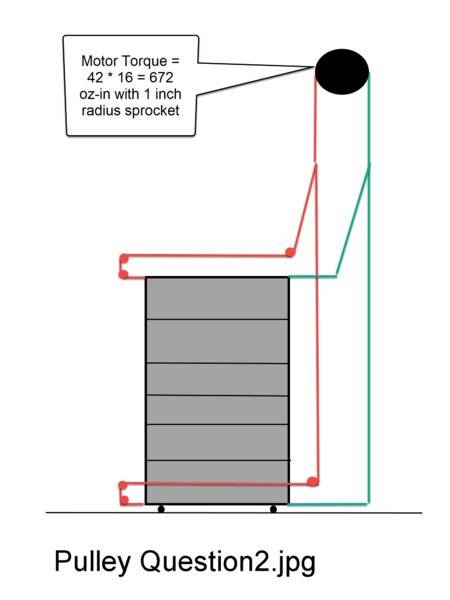
Assuming I have not made some gross error in my thinking, does this imply that I would need a motor capable of suppying 672 oz-in of torque (42 * 16) of torque, as shown in "Pulley Question2.jpg"? Note I will be using a 1" radius chain sprocket on the motor.

Finally, I would like to do this with a stepper motor so I can accelerate and decellerate smoothly. I think I will need a geared motor to get the Torque I need at the fairly low top speed required of 30 inches per second**

Thank you for your time in looking at this.** I want the bookcase to move 45 inches in 3 seconds for an average speed of 15 inches per second. So assuming constant acceleration and deceleration I would need a top speed of 30 inches per second - right?
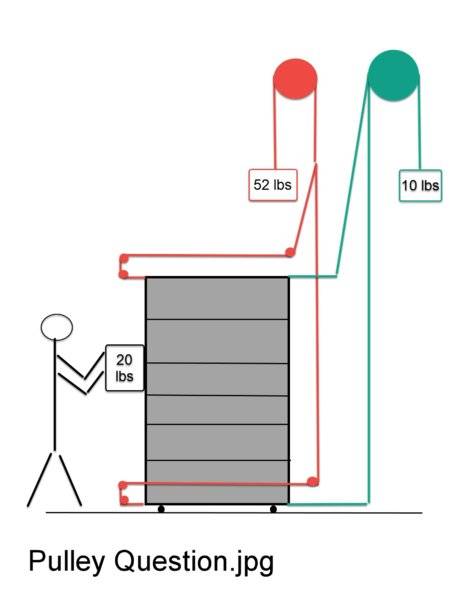
Pulley Question.jpg
Pulley Question2.jpg
 

Attachments

  • Pulley Question.jpg
    Pulley Question.jpg
    17 KB · Views: 623
  • Pulley Question2.jpg
    Pulley Question2.jpg
    17.1 KB · Views: 510
Engineering news on Phys.org
How heavy is your bookcase fully loaded with books? What type of wheels? Do the pulleys have plain or ball bearings? What are the pulley diameters? The wheel diameters? All pulleys add friction, and so do wheels. The top cable and pulleys are not needed to move the bookcase, but add friction. Can you put the motor down low so that the system only has two pulleys? Larger diameter wheels and pulleys have less friction. Harder wheels have less friction.

Your calculation for constant acceleration is correct. At your low speed, you may be better off to use a trapezoidal velocity profile, where you accelerate to a speed, run at constant speed, then decelerate to a stop. That gives you a lower top speed, which allows a larger gear reduction. Gear the motor so that it runs at or near its top speed. Size the motor / reducer to meet your worst case torque (starting plus acceleration) with about a 2:1 safety factor.
 
In addition to the above what is the type and diameter of the wire rope?
Edit: Also what is the style of grooves in or pulleys i.e. "V' or "U"?
 
Sounds like much of the force from the motor is used to bend the wire ropes around the pulleys.
 
  • Like
Likes   Reactions: jim hardy

Similar threads

  • · Replies 2 ·
Replies
2
Views
4K
  • · Replies 10 ·
Replies
10
Views
2K
  • · Replies 9 ·
Replies
9
Views
2K
Replies
24
Views
3K
  • · Replies 5 ·
Replies
5
Views
4K
  • · Replies 17 ·
Replies
17
Views
5K
  • · Replies 14 ·
Replies
14
Views
3K
  • · Replies 5 ·
Replies
5
Views
8K
  • · Replies 2 ·
Replies
2
Views
3K
  • · Replies 8 ·
Replies
8
Views
7K