Force to propel a sliding gate up a 2,4 degree incline?

Click For Summary
SUMMARY

The discussion focuses on calculating the force required to propel a sliding gate up a 2.4-degree incline, specifically using the Centurion D10 opener and the ET Nice Drive 600m. The calculations reveal that the total force needed includes the operating force and the gravitational component due to the gate's weight, which is approximately 16.56 kgf for a 380 kg gate. Confusion arises regarding the D10's weight rating, with conflicting information indicating a maximum of either 10 kgf or 30 kgf. Participants emphasize the importance of accounting for rolling resistance and recommend a safety factor of 2 to 3 times the calculated force to accommodate unforeseen complications.

PREREQUISITES
  • Understanding of basic physics principles, specifically forces and inclines
  • Familiarity with the Centurion D10 and ET Nice Drive 600m gate openers
  • Knowledge of calculating gravitational force components
  • Awareness of rolling resistance factors in mechanical systems
NEXT STEPS
  • Research "Calculating the Force Needed to Move an Object Up a Slope" by Steven Holzner
  • Explore specifications and performance ratings of the Centurion D10 and ET Nice Drive 600m
  • Learn about rolling resistance and its impact on mechanical systems
  • Investigate safety factors in engineering design for moving systems
USEFUL FOR

Engineers, gate installers, and DIY enthusiasts involved in designing and implementing sliding gate systems, particularly those considering weight and incline factors in their projects.
James Nilsen-Misra
Messages
5
Reaction score
1
TL;DR
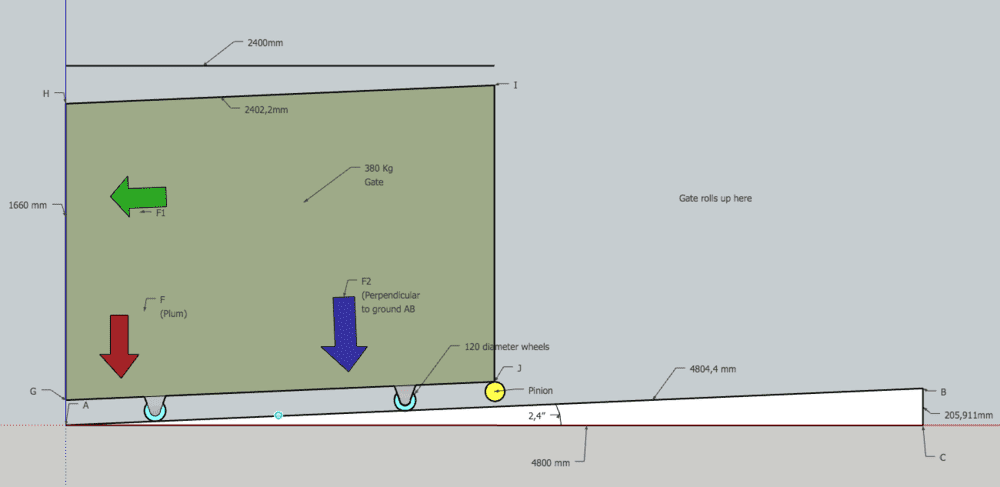
What force is needed to propel a sliding (rolling) gate up a 2.456° degree incline?
The Gate has a mass of 380 Kg.
The wheels have a diameter of 120 mm, Steel UGroove wheels, runing on a 12mm diameter round bar track. (To reduce rolling resistance larger wheels have been included.)

(Wondering what strain this would give a Centurion motor, D5 Evo, rated to be able to work a gate of Max 500kg but its pulling force needs to be 17kg start up and not exceeding 10Kg during running.
Figure A
Screen Shot 2019-08-25 at 02.57.42.png


It slopes up from Left to Right (0.205911m Rise /4,8m run=4.28%)]
 
Engineering news on Phys.org
Total Force = <Operating-Force-If-Level> + (sin(2.5°) * <Weight-Of-Gate>)
= <Operating-Force-If-Level> + (0.0436 * 380kg)
= <Operating-Force-If-Level> + 16.56kG

Looks like you have exceeded the 10kg rating of the opener. :H
 
  • Like
Likes   Reactions: James Nilsen-Misra
Tom.G said:
Total Force = <Operating-Force-If-Level> + (sin(2.5°) * <Weight-Of-Gate>)
= <Operating-Force-If-Level> + (0.0436 * 380kg)
= <Operating-Force-If-Level> + 16.56kG

Looks like you have exceeded the 10kg rating of the opener. :H
Thanks so much Tom.G,

So then to work out the maximum mass the gate could be, would it be thus:

10kg/0.04285216=233.36046537kg?

Total Force = <Operating-Force-If-Level> + (sin(2.456°) * <Weight-Of-Gate>)
= <Operating-Force-If-Level> + (0.04285216 * 233.36046537kg )
= <Operating-Force-If-Level> + 9.99999999kg
<Operating-Force-If-Level> + 10kg
 
Screen Shot 2019-08-26 at 02.14.00.png


Made this comparison of the various models and their power output.
 
Not sure what is going on here.

Your first post stated the Centurion D10 was rated:
...not exceeding 10Kg during running.
The calculation in your post #3, correct as far as it goes, ignores the rolling resistance of <Operating-Force-If-Level>. This calculation could be valid if the rolling resistance is small enough to be ignored (unlikely).

Then the table in your post #4 shows the D10 is rated at 30kg force, not 10kg.
 
Tom.G said:
Not sure what is going on here.

Your first post stated the Centurion D10 was rated:"...not exceeding 10Kg during running."

The calculation in your post #3, correct as far as it goes, ignores the rolling resistance of <Operating-Force-If-Level>. This calculation could be valid if the rolling resistance is small enough to be ignored (unlikely).

Then the table in your post #4 shows the D10 is rated at 30kg force, not 10kg.

Sorry for the confusion. Well spotted, the "...not exceeding 10Kg during running" came in an email from a supplier, but when comparing the specs of different models in the published manuals, I didn't find any reference to 10kgf.

Yeh, was thinking that the force to overcome resistance would be just a pinch more than the force to counter the mass of the gate+the additional weight due to the incline...

How much additional force to set it in motion, and how much force to keep it in motion do you think is reasonable?

I came across Steven Holzner's article on "Calculating the Force Needed to Move an Object Up a Slope" Physics I For Dummies, 2nd Edition. But I've just scanned it and need a bit more time to see and apply it.

Coming back to the table I'm keen on using the ET Nice Drive 600m, well priced and their service centre is close by, which they recommend every 18 months.

I want the gate design mass to comply with the motor's output, a 41kgf initial push to set in motion, and 30kgf to overcome resistance and keep moving! With a little extra for bad weather conditions. :rolleyes:

Your help is greatly appreciated!
 
Just a little bit of gravel or small stones under those wheels could add greatly to the forces needed. Because of unforeseeable complications like that you need a safety factor of x2 or x3.
 
  • Like
Likes   Reactions: James Nilsen-Misra

Similar threads

  • · Replies 12 ·
Replies
12
Views
21K
Replies
2
Views
2K
  • · Replies 12 ·
Replies
12
Views
2K
  • · Replies 7 ·
Replies
7
Views
5K
Replies
4
Views
3K
  • · Replies 29 ·
Replies
29
Views
4K
  • · Replies 1 ·
Replies
1
Views
3K
Replies
5
Views
2K
  • · Replies 2 ·
Replies
2
Views
3K
  • · Replies 24 ·
Replies
24
Views
5K