Forces and reaction forces generated by a linear actuator

Click For Summary
SUMMARY

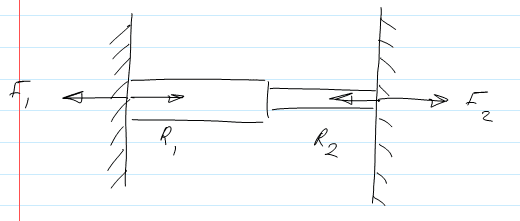
The discussion centers on the forces generated by a linear actuator wedged between two solid walls, exerting an outward force of 10N. Participants concluded that in a state of equilibrium, the forces F1 and F2, as well as the reaction forces R1 and R2, must equal 5N each. This is due to the balance of forces, where the total compressive force (20N) must equal the total expansive force (10N) produced by the actuator. Thus, the correct magnitudes of the forces are established as F1 = F2 = R1 = R2 = 5N.

PREREQUISITES
  • Understanding of Newton's laws of motion
  • Basic principles of static equilibrium
  • Knowledge of force vectors and their components
  • Familiarity with linear actuators and their applications
NEXT STEPS
  • Study the principles of static equilibrium in mechanical systems
  • Learn about force distribution in structures and materials
  • Explore the mechanics of linear actuators and their specifications
  • Investigate real-world applications of linear actuators in engineering
USEFUL FOR

Mechanical engineers, physics students, and anyone involved in the design and analysis of systems utilizing linear actuators will benefit from this discussion.
amrbekhit
Messages
11
Reaction score
1
A linear actuator is wedged between two solid walls as shown in the diagram below. The linear actuator is pushing outwards with a force of 10N. What are the magnitudes of the forces labelled in the diagrams?

linearactuatorfreebodydiagram.png


I reckon that F1 = F2 = R1 = R2. However, I'm not sure if F1 = F2 = 5N or 10N. I'm guessing 10N.

Any thoughts?

--Amr
 
Physics news on Phys.org
If the system is in equilibrium then all the forces are balanced.

Remember, if R1 = 10N and R2 = 10N that implies that there is 20N compressing the system and we know there is only 10N expanding it.

Jared
 
Hi Jared,

Thanks for your reply. Based on that, if the linear actuator produces a 10N force, F1 = F2 = R1 = R2 = 5N.

Amr
 
I'd agree with that conclusion.

Jared
 

Similar threads

Replies
6
Views
1K
  • · Replies 20 ·
Replies
20
Views
3K
  • · Replies 5 ·
Replies
5
Views
3K
Replies
3
Views
2K
  • · Replies 6 ·
Replies
6
Views
2K
  • · Replies 9 ·
Replies
9
Views
3K
  • · Replies 7 ·
Replies
7
Views
3K
Replies
1
Views
1K
  • · Replies 2 ·
Replies
2
Views
4K
  • · Replies 7 ·
Replies
7
Views
2K