Forces applied to a leaning levitating bicycle

Click For Summary
SUMMARY

The discussion centers on the engineering of an electromagnetic bicycle that levitates above its wheels, significantly reducing rolling friction by eliminating bearings. The bicycle's stability is enhanced through strategically placed magnets on both the wheels and frame. A key inquiry involves calculating the forces acting on the axle and side-to-side magnets when the bicycle leans at a 45-degree angle while carrying a 50 kg rider. The net force on the bike is determined using the equation N = √{(mv²/r)² + (mg)²}, where m is the mass, v is velocity, r is the radius of the turn, and g is the acceleration due to gravity.

PREREQUISITES
  • Understanding of basic physics concepts, including centripetal force and torque
  • Familiarity with electromagnetic systems and their applications in transportation
  • Knowledge of vector mathematics for force calculations
  • Experience with bicycle dynamics and stability principles
NEXT STEPS
  • Research the principles of electromagnetic levitation and its applications in transportation
  • Study advanced physics concepts related to torque and centripetal force
  • Explore the effects of rolling resistance and air resistance on bicycle performance
  • Investigate real-world applications of magnetic stabilization in vehicles
USEFUL FOR

Engineers, physics students, and hobbyists interested in innovative bicycle design, electromagnetic systems, and vehicle dynamics will benefit from this discussion.

Qwerty42
Messages
1
Reaction score
0
Hi!

So I'm building an electromagnetic bicycle where the frame is levitating over the wheels, thus reducing the rolling friction to almost zero by removing the bearings. Magnets have also been placed alongside the wheels to provide side to side stability. Black is the frame, red are the magnets on the wheel and yellow are the magnets attached to the frame to stabilize side to side movement from the wheel. Se the attached image. Since the wheel is held in place purely by magnetic forces, it can move if enough force is applied to it.

My question is: How much force would affect the axle magnet and side-to-side magnets when the bike is turning and thus leaning at let's say 45 degrees? Let's assume that the person riding the bike is weighing 50 kg.
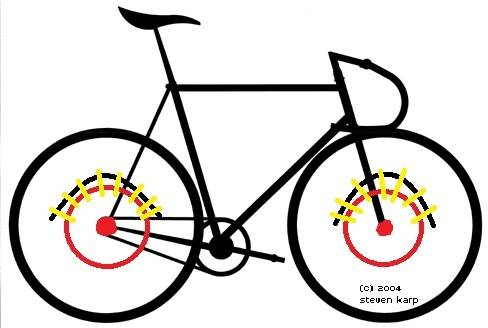
linetrack.500.jpg


Thanks!
 
Last edited:
Physics news on Phys.org
I think bikes lean over so that the net torque on the bike due to the combination of centripetal force and gravity is zero. I think this means the net force on the bike and rider will be directed through the contact point on the ground. So the side to side force is notionally zero.

The load on the axle magnets is the vector sum of the centripetal force and the force due to gravity.

Cyclist.png

Using Pythagoras that gives

N =√{(mv2/r)2 + (mg)2}

where
m is the mass of the rider and bike
v = velocity
r = radius of the turn
g = acceleration due to gravity

Can someone check I have this right as it's been a long day.
 
Obviously the side to side load won't always be zero in reality but in that simplistic model it is. In the real world there is acceleration as the bike leans over not to mention bumps etc etc.
 
Qwerty42 said:
I'm building an electromagnetic bicycle where the frame is levitating over the wheels, thus reducing the rolling friction to almost zero by removing the bearings.
Rolling resistance comes mostly from the deformation of the tires, not from friction at the hub bearings. But most loses come from air resistance anyway.
 
  • Like
Likes   Reactions: jbriggs444 and CWatters

Similar threads

  • · Replies 5 ·
Replies
5
Views
2K
  • · Replies 41 ·
2
Replies
41
Views
13K
  • · Replies 6 ·
Replies
6
Views
7K
  • · Replies 2 ·
Replies
2
Views
5K
Replies
1
Views
2K
  • · Replies 124 ·
5
Replies
124
Views
20K
Replies
29
Views
4K
  • · Replies 2 ·
Replies
2
Views
3K
  • · Replies 8 ·
Replies
8
Views
6K
  • · Replies 11 ·
Replies
11
Views
9K