tomtomtom1
- 160
- 8
- TL;DR
- Forces Involved Of A Moving Train Travelling Around A Curve
Hello all
I am trying to work out the forces involved of a moving train around a curve traveling at a constant speed.
I have the following:-
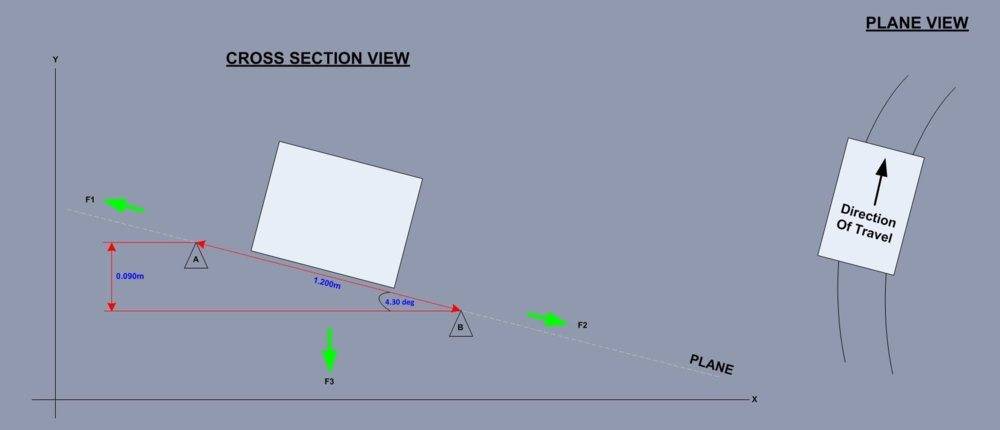
The image on the left is a cross section of a train traveling around a curve, you can think of the train moving away from you.
The image on the right in the same train but in plane view but illustrates the radius.
I am trying to work out the Forces F1, F2 and F3.
I know the following:-
- Speed = 200mph
- Weight = 101605kg
- Radius = 500m
- Gravity = 9.81m/s^2
- Distance between Rails = 1.2m
- Height Difference between Rail A and Rail B = 0.090m
- Angle = 4.30 deg
The first thing that I tried to do was to convert the train weight of 101605 kg into a Mass by dividing by 9.81 m/s^2, however I ended up with some strange units:-
101605kg / 9.81m/s^2 = 10357.28848 (kg s^2)/m - ??
The reason why I wanted to find the Mass was because I wanted to use the F = MA equation to work out Force in Newtons.
Because I didn't get far with this I tried to convert the speed of the train which is 200mph into an acceleration but since the train is traveling around the curve at a constant speed of 200mph there is no acceleration which I am struggling to come to terms with.
Can I ask how would the Forces F1 F2 and F3 be worked out?
Can anyone point me in the right direction?
Thank you.
I am trying to work out the forces involved of a moving train around a curve traveling at a constant speed.
I have the following:-
The image on the left is a cross section of a train traveling around a curve, you can think of the train moving away from you.
The image on the right in the same train but in plane view but illustrates the radius.
I am trying to work out the Forces F1, F2 and F3.
I know the following:-
- Speed = 200mph
- Weight = 101605kg
- Radius = 500m
- Gravity = 9.81m/s^2
- Distance between Rails = 1.2m
- Height Difference between Rail A and Rail B = 0.090m
- Angle = 4.30 deg
The first thing that I tried to do was to convert the train weight of 101605 kg into a Mass by dividing by 9.81 m/s^2, however I ended up with some strange units:-
101605kg / 9.81m/s^2 = 10357.28848 (kg s^2)/m - ??
The reason why I wanted to find the Mass was because I wanted to use the F = MA equation to work out Force in Newtons.
Because I didn't get far with this I tried to convert the speed of the train which is 200mph into an acceleration but since the train is traveling around the curve at a constant speed of 200mph there is no acceleration which I am struggling to come to terms with.
Can I ask how would the Forces F1 F2 and F3 be worked out?
Can anyone point me in the right direction?
Thank you.
Last edited by a moderator: