Shelving Pull Out Force Question

  • Thread starter Thread starter Andrew Gore
  • Start date Start date
  • Tags Tags
    Force Pull
Click For Summary
SUMMARY

The discussion focuses on calculating the pull-out force load for a shelving system with two uprights fixed to the wall and five shelves, each holding a weight of 50kg. The shelves extend 300mm from the uprights, and the user seeks to determine the pull-out forces at points F1 and F2. To achieve this, it is essential to calculate the total counterclockwise (CCW) moment generated by the weights and subsequently derive the reaction forces at F1 and F2 to counteract this moment.

PREREQUISITES
  • Understanding of static equilibrium principles
  • Knowledge of moment calculations in physics
  • Familiarity with load distribution on shelving systems
  • Basic skills in structural analysis
NEXT STEPS
  • Learn about calculating moments in static structures
  • Research methods for determining reaction forces in beam systems
  • Explore adjustable shelving design principles
  • Study load distribution techniques for shelving units
USEFUL FOR

This discussion is beneficial for structural engineers, furniture designers, and anyone involved in the design and analysis of shelving systems requiring load calculations and stability assessments.

Andrew Gore
Messages
1
Reaction score
1
Hi Guys,

I have been trying to figure out how to work out a pull out force load for a shelving issue I have. I have put together a rough sketch of what I have:
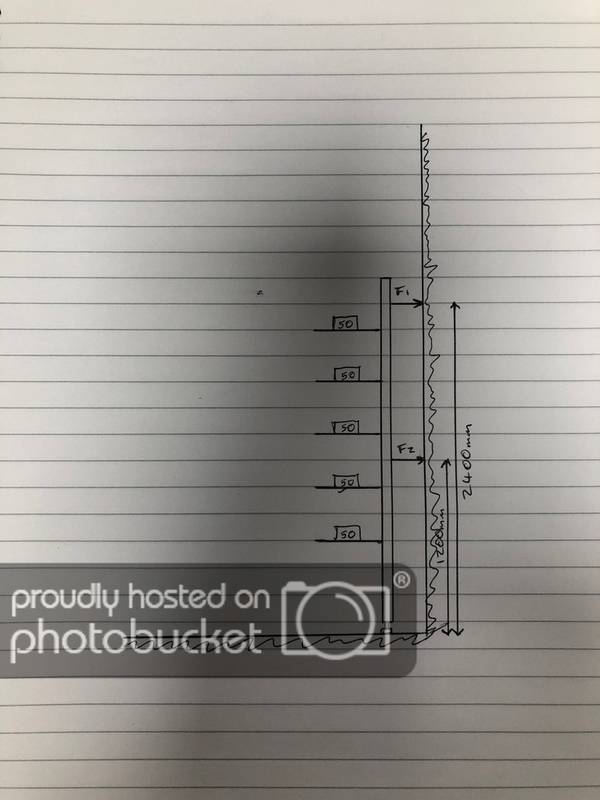
image1_zpsqfyrnkjh.jpg


I have 2 uprights sitting on the floor via adjustable feet and fixed to the wall at 1200mm and 2400mm. There are 5 shelves equally spaced with a 50kg weight on each shelf. The shelf protrudes 300mm from the upright.

I am trying to calculate the pullout force at f1 and and f2 on the diagram.

If anyone could help out I would appreciate this.

Thanks in advance.
 

Attachments

  • image1_zpsqfyrnkjh.jpg
    image1_zpsqfyrnkjh.jpg
    38.8 KB · Views: 860
Engineering news on Phys.org
Calculate the total CCW moment. Use this result to calculate the reaction forces at F1 and F2 needed to resist this CCW moment.
 

Similar threads

  • · Replies 7 ·
Replies
7
Views
3K
Replies
2
Views
2K
  • · Replies 13 ·
Replies
13
Views
2K
  • · Replies 6 ·
Replies
6
Views
4K
  • · Replies 2 ·
Replies
2
Views
6K
  • · Replies 4 ·
Replies
4
Views
3K
  • · Replies 1 ·
Replies
1
Views
2K
  • · Replies 14 ·
Replies
14
Views
2K
  • · Replies 12 ·
Replies
12
Views
3K
  • · Replies 1 ·
Replies
1
Views
2K