Hi there
@Taylor_1989
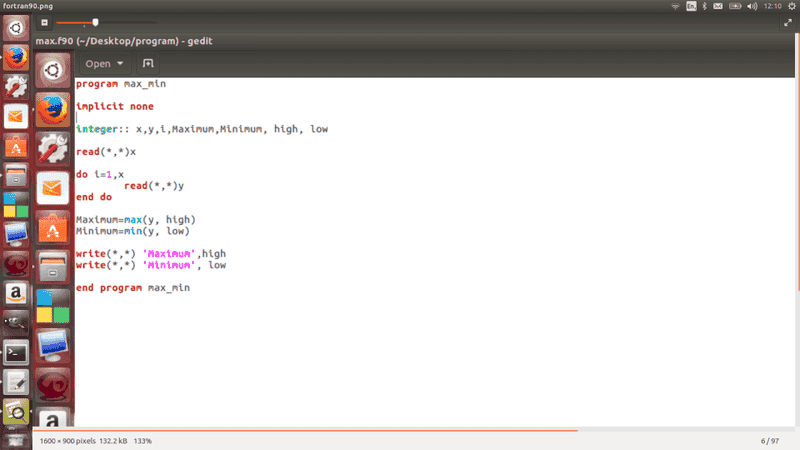
I saw you doing Fortran programming in gedit and winced visibly, so I felt as if it might be a good idea to give you two recommendations for development environments to use.
1)
Geany (should be available in your package manager, also check for "geany-plugins" and "geany-themes", my favourite of which is monokai)
I'd recommend this if you only ever expect to work on small projects without complicated build steps required for all the components. But in those cases, it works wonderfully. Not just syntax highlighting, but also (some) autocompletion, a Symbol (Function/Variable/Type/Etc.) Browser, integrated Terminal pane... and even shortcuts for MAKEing your project (if you've written a Makefile, or cmake, or whatever). No built in debugging tools, and it won't give you tooltips on function argument descriptions (either for Intrinsics or your own), but like I say: if you're working light, this is more than sufficient.
2)
Code::Blocks for Fortran (I don't think there are any "packages" but if you have the necessary dependencies you should be able to run the binaries from its own folder, though I'd recommend putting it in somewhere like /opt)
If you start making larger projects or find yourself using debugging tools like gdb much more frequently I would recommend this. This has all the features of Geany including the ones it lacks (except an integrated terminal window, and multiple built-in highlighting themes), and allows specifying not only Projects but also their relative interdependencies as members of Workspaces, as long as various Build Targets et cetera. I recommend this over vanilla C::B as some of the functionality goes beyond just the FortranProject plugin.
I know there are others who use Eclipse Photran but as I've never used it I can't speak for it one way or the other.
Also as some book recommendations (especially if you're not restricted to F90 or F95): "Modern Fortran Explained" (Metcalfe & Reid), "Modern Fortran in Practice" (Arjen Markus), and "Modern Fortran: Style and Usage" (Norman S. Clerman); and I'd also like to take the opportunity to plug the small ##fortran community over at freenode on IRC.
---
@BvU I wanted also to chip into your comment about Fortran being "close to computer architectures", to say that Fortran has for the most part toed an interesting line between "low level" architecture representation and "high level" mathematical expression convenience, and tried (usually succeeding) to strike a balance between. I suspect that someone with more C experience than I, but also familiar with Fortran, might argue that Fortran is simultaneously "clunkier" and "free-er" than C, declaring it "higher level" but doing so somewhat hesitantly. I'd be interested though to hear others' comments to this regard.