Four Circle Problem

  • Context: High School 
  • Thread starter Thread starter bob012345
  • Start date Start date
bob012345
Gold Member
Messages
2,345
Reaction score
1,071
TL;DR
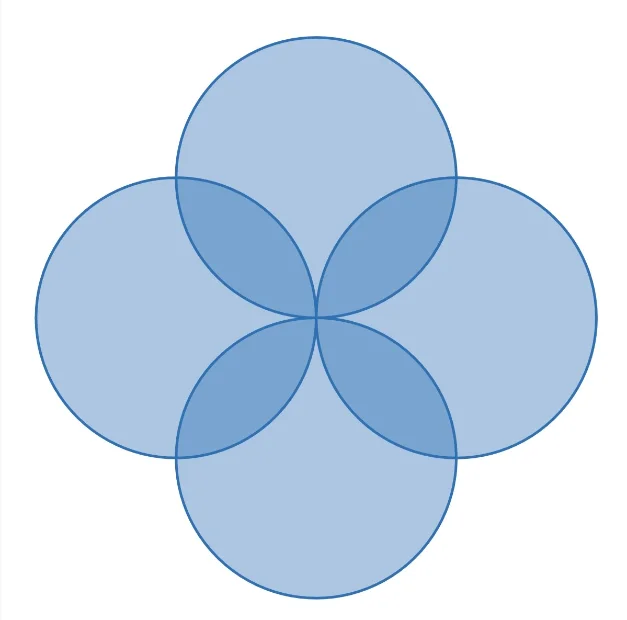
Determine the fraction of the darker area to the total area of the figure.
This is a little exercise for fun. Determine the area of the darker petals to the total area. The four circles are identical. Have fun!
IMG_5538.webp
 
  • Like
Likes   Reactions: DaveE and Lnewqban
Mathematics news on Phys.org

Each half a petal is bounded by a chord and a 90-degree slice of the circle. So the area would (pi (r^2)/4) - (r^2)/2 = (r^2)(pi/4 - 1/2). Since there are 8 of those, the total petal area is 8(r^2)(pi/4 - 1/2)=(2pi-4)(r^2).
The total area is 4 circles minus the overlap: 4pi(r^2)-(2pi-4)(r^2) = (2pi+4)(r^2).
Dark petals to total area is: (2pi-4)(r^2)/(2pi+4)(r^2) = (2pi-4)/(2pi+4) = (pi-2)/(pi+2)
 
  • Like
Likes   Reactions: bob012345 and Lnewqban
I got ##(\pi-2)/(\pi+2)##
 
bob012345 said:
TL;DR: Determine the fraction of the darker area to the total area of the figure.

This is a little exercise for fun. Determine the area of the darker petals to the total area. The four circles are identical. Have fun!View attachment 371094
1776931305066.webp

## \begin{align}
f=&A/(A+B)\nonumber\\
=&(r^2\pi/4-r^2/2)/(r^2\pi/4+r^2/2)\nonumber\\
=&(\pi/4-1/2)/(\pi/4+1/2)\nonumber\\
=&(\pi-2)/(\pi+2)\nonumber\\
\end{align} ##
 
  • Like
Likes   Reactions: Lnewqban and bob012345
If anyone is interested, here is the case of five identical circles with a common point as in this diagram. Notice that there are now two levels of petals, the larger and the smaller. In this case determine the fraction of the figure with any petals to the whole figure.
IMG_5544.webp


I got ##\large \frac{2\pi- \gamma}{3\pi+\gamma}## with ##\gamma=5/4\left(\sqrt{10+2\sqrt{5}}-\sqrt{10-2\sqrt{5}}\right )##
Which is about .4

CORRECTION:
I get ##\large \frac{2\pi- \gamma_1}{2\pi+\gamma_2}## with ##\gamma_1 =5/4\left(\sqrt{10+2\sqrt{5}}-\sqrt{10-2\sqrt{5}}\right)## and ##\gamma_2 =5/4\left(\sqrt{10+2\sqrt{5}}\right)## which gives 0.40466…
 
Last edited:
bob012345 said:
If anyone is interested, here is the case of five identical circles with a common point as in this diagram. Notice that there are now two levels of petals, the larger and the smaller. In this case determine the fraction of the figure with any petals to the whole figure.
1777286104800.webp

1777286268995.webp
 
  • Like
Likes   Reactions: bob012345
My answer was actually <0.4 at about 0.3974 so I am investigating my math…

EDIT: I did the calculation another way and agree with @Gavran.
 
Last edited:
  • Like
Likes   Reactions: Gavran
I worked up the general case for integer ##n## overlapping circles. Here is the Desmos page;


The red circle is the generator of the ##n## overlapping circles.
 
  • Like
Likes   Reactions: Gavran and Lnewqban
bob012345 said:
I worked up the general case for integer ##n## overlapping circles. Here is the Desmos page;


The red circle is the generator of the ##n## overlapping circles.

The formula ## f=(\pi/5+\sin72^\circ/2-2\sin72^\circ\sin^236^\circ)/(\pi/5+\sin72^\circ/2)\\ ## from post #6 can be transformed into a general case.

## \begin{align}
f=&(\pi/n+\sin(2\pi/n)/2-2\sin(2\pi/n)\sin^2(\pi/n))/(\pi/n+\sin(2\pi/n)/2)\nonumber\\
=&(\pi/n+\sin(2\pi/n)/2-\sin(2\pi/n)(1-\cos(2\pi/n))/(\pi/n+\sin(2\pi/n)/2)\nonumber\\
=&(\pi/n-\sin(2\pi/n)/2+\sin(4\pi/n)/2)/(\pi/n+\sin(2\pi/n)/2)\nonumber\\
=&(2\pi-n\sin(2\pi/n)+n\sin(4\pi/n))/(2\pi+n\sin(2\pi/n))\nonumber\\
\end{align} ##

The final result is the same as the one in post #8.

The formula produces the fraction ## f=1 ## for ## n=2 ##; therefore, the formula is not valid for ## n=2 ## because the fraction equals ## 0 ## in this case.
Also, the formula produces the fraction ## f=(4\pi-6\sqrt3)/(4\pi+3\sqrt3) ## for ## n=3 ##; therefore, the formula is not valid for ## n=3 ## because the fraction equals ## (2\pi-3\sqrt3)/(4\pi+3\sqrt3) ## in this case.
The formula holds for ## n\ge4 ##.

It can be shown that the fraction approaches ## 1 ## as ## n ## approaches infinity, which is obvious.
 
  • Like
Likes   Reactions: bob012345
  • #10
Thanks @Gavran for pointing out those cases. In my formulation, I computed the largest petal and the next largest petal which accounts for the overlap of the largest petals. Those overlaps don't exist for ##n=2,3##. The angle of the circular segment making the smaller petal goes as ##\pi-\frac{4\pi}{n}## which becomes negative for ##n<4## yet the formula gives a value that throws things off unless that contribution is zeroed out.

Also obvious is that as ##n## approaches infinity, the total area of the figure approaches ##4\pi R^2##.
 

Similar threads

  • · Replies 14 ·
Replies
14
Views
3K
  • · Replies 5 ·
Replies
5
Views
2K
  • · Replies 59 ·
2
Replies
59
Views
231K
  • · Replies 3 ·
Replies
3
Views
2K
  • · Replies 10 ·
Replies
10
Views
3K
  • · Replies 9 ·
Replies
9
Views
2K
  • · Replies 2 ·
Replies
2
Views
6K
  • · Replies 7 ·
Replies
7
Views
1K
  • · Replies 7 ·
Replies
7
Views
2K
  • · Replies 8 ·
Replies
8
Views
2K