Fourier transform and derivation

Click For Summary
SUMMARY

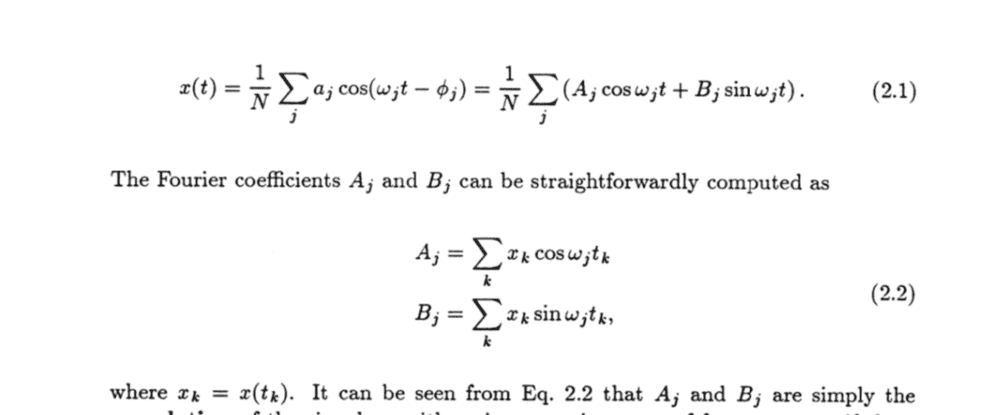
The discussion focuses on the derivation of Equation (2.2) related to Fourier coefficients, specifically addressing the confusion surrounding the definition of ##t_k## and the summation notation Σk. Participants clarify that the derivation involves substituting the solutions for coefficients A_j and B_j into the equation for x_k, leading to a simplification that confirms the relationship. The reference paper provided, which includes these derivations, is titled "Fourier Techniques" and can be accessed for further details.

PREREQUISITES
  • Understanding of Fourier coefficients and their applications
  • Familiarity with trigonometric identities and their use in summation
  • Basic knowledge of mathematical notation and derivation techniques
  • Access to the paper "Fourier Techniques" for reference
NEXT STEPS
  • Review the derivation of Fourier coefficients in the paper "Fourier Techniques"
  • Study the application of trigonometric identities in Fourier analysis
  • Explore advanced topics in Fourier transforms and their implications in signal processing
  • Practice derivations involving summation notation and trigonometric functions
USEFUL FOR

Students and researchers in mathematics, physics, and engineering who are working with Fourier transforms and seeking clarity on derivation techniques related to Fourier coefficients.
arcTomato
Messages
104
Reaction score
27
Homework Statement: I don't know how can I derivation Eq.(2.2)
Homework Equations: Fourier coefficients

Homework Statement: I don't know how can I derivation Eq.(2.2)
Homework Equations: Fourier coefficients

スクリーンショット 2019-10-17 12.18.05.png


Dear all.
I don't know how can I derivation Eq.(2.2).
Where Σk is come from??
 
Physics news on Phys.org
Moved from a HW section.
The derivation, which is described as capable of being "straightforwardly computed," doesn't seem at all obvious to me.
 
How is ##t_k## defined? I feel that more information is needed than the image you posted.

Mark44 said:
Moved from a HW section.
The derivation, which is described as capable of being "straightforwardly computed," doesn't seem at all obvious to me.
On that side note, I think words such as ”straightforwardly” or ”simply” simply do not belong in textbooks.
 
Thank you @Orodruin and I appreciate for your kindness.
This paper doesn’t refer to what ##t_k## is.
That’s is the point I can’t understand.
 
Can you give a reference to the paper?
 
##x_k=x(t_k) = \frac{1}{N}\sum_j A_j \cos \omega_j t_k + B_j \sin \omega_j t_k## , plug the solution:
##A_j = \sum_k x_k \cos \omega_j t_k , \ \ \ B_j = \sum_k x_k \sin \omega_j t_k##, and you get:
##x_k=\frac{1}{N} \sum_j \sum_m x_m \cos \omega_j t_m \cos_j t_k + x_m \sin \omega_j t_m \sin \omega_j t_k ##, if ##m\ne k##, then the term on the RHS will vanish, since on the the LHS there are no terms of this form, so the sum over ##m## becomes ##x_k(\cos^2 \omega_j t_k + \sin^2 \omega_j t_k)=x_k##, the sum over ##j## gives you the ##N## factor that cancels with ##N## in the denominator.
That's all there is to it.
 
  • Like
Likes arcTomato
Thanks for reply @MathematicalPhysicist (I like your name:smile:).
I got it! This is the easy-to-understand explanation.
I appreciate for you all.
 

Similar threads

  • · Replies 4 ·
Replies
4
Views
2K
  • · Replies 7 ·
Replies
7
Views
3K
  • · Replies 4 ·
Replies
4
Views
3K
  • · Replies 3 ·
Replies
3
Views
2K
  • · Replies 4 ·
Replies
4
Views
3K
  • · Replies 4 ·
Replies
4
Views
2K
  • · Replies 4 ·
Replies
4
Views
2K
  • · Replies 14 ·
Replies
14
Views
5K
  • · Replies 1 ·
Replies
1
Views
3K
  • · Replies 4 ·
Replies
4
Views
3K