Fourier transform - why we need it?

Click For Summary

Discussion Overview

The discussion centers around the purpose and applications of the Fourier transform, particularly in relation to Fourier series. Participants explore its significance in transforming signals from the time domain to the frequency domain, as well as its utility in various fields such as electrical engineering and signal processing.

Discussion Character

  • Exploratory
  • Technical explanation
  • Conceptual clarification
  • Debate/contested
  • Mathematical reasoning

Main Points Raised

  • One participant notes their familiarity with Fourier series but struggles with understanding the Fourier transform and its purpose.
  • Another participant explains that Fourier series represent a discrete case of the Fourier transform, emphasizing the periodic nature of the series and its limitations for non-repeating signals.
  • A participant describes the Fourier transform as a method to represent localized signals using continuous arguments rather than discrete ones.
  • Discussion includes the mathematical formulation of the Fourier transform and its relationship to the amplitudes of frequencies present in a signal.
  • One participant suggests a practical application of the Fourier transform in analyzing circuit responses to nonperiodic voltage sources, indicating a method to convert time domain signals to frequency domain for analysis.
  • Another participant acknowledges their lack of experience with Fourier transform applications in electricity but finds the explanation reasonable.
  • A later reply highlights the importance of Fourier analysis in various fields, including digital signal processing and image analysis, and its role in simplifying calculations.

Areas of Agreement / Disagreement

Participants express various viewpoints on the applications and significance of the Fourier transform, with no consensus reached on specific applications or interpretations. Some participants agree on its utility in signal processing, while others focus on its theoretical aspects.

Contextual Notes

Participants mention specific techniques like KVL, KCL, and nodal analysis in the context of circuit analysis, but the discussion does not resolve how these techniques integrate with the Fourier transform.

Who May Find This Useful

This discussion may be useful for individuals interested in signal processing, electrical engineering, and those seeking to understand the theoretical foundations and practical applications of the Fourier transform.

mickonk
Messages
7
Reaction score
0
Hi. I'm familiar with Fourier series but I have some hard times in learning Fourier transform. Why we use it? What's purpose of Fourier transform? Here is one signal and plot of Fourier transform of that signal:
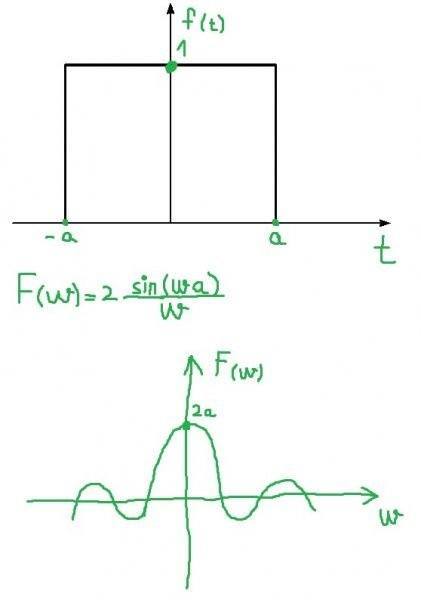
furije.jpg


What this graph tells us? Thanks in advance.
 
Physics news on Phys.org
I'll give you my novice interpretation of it, so be careful:

Fourier series are the discrete case of the Fourier transform. This means that you are constructing a series where the arguments of the trigonometrics in your infinite series are integer multiples of the fundamental frequency. So the series looks like this (where a constant is added) ##f(x)=a_o / 2 + \sum (a_n cos(n\pi x /l) + b_n sin (n\pi x /l)##. To make this more compact we use Eulers formula and say that the series is just ##f(x)=\sum c_n e^{i n \pi x /l}##.

The thing is that this discrete representation is periodic. It will always repeat itself and this is can be in some cases completely useless.

Suppose you want to construct a pulse which represents some signal. You want it to be localized in space (that is, not having an infinite repeating pattern).

Therefore you have to use arguments that are continuous and not discrete. You therefore use the Fourier transform to represent this signal or pulse. There is a mathematical and rigorous way to prove this but look at the similarity of the Fourier transform with the sum of exponentials in this case:

##f(x) = \frac{1}{\sqrt{2\pi}} \int_{-\infty}^{\infty} g(\omega) e^{i\omega x} d\omega##

Its just a continuous sum of infinitesimals where the constant in the beginning is not of crucial importance to see what is happening.

Your question is about the importance of the function ##g(\omega)##. Well if you take the analogy with the sum of exponential terms as far as I take it, well, that function is the amplitudes of your trigonometric functions in the series. So ##g(\omega)## is telling you the distribution of the weights of each frequency present in your pulse.
 
  • Like
Likes   Reactions: mickonk
Thanks for reply.
One more thing. Let's say I have some circuit with nonperiodic voltage source and I want to find response of some component in circuit, for example voltage across component. Using Fourier transform I should "convert" my excitation from time domain to frequency domain, find response in frequency domain using standard techniques (using KVL and KCL, or Nodal analysis etc), and then apply inverse Fourier transform on response I got in frequency domain to get response in time domain, right?
 
I've never done applications of the Fourier transform to electricity, to be honest. What you said makes sense to me though.
 
Fourier analysis transforms time domain signal into the frequency domain. There are several situations where it is invaluable like in digital signal processing for communications or image analysis, simplifying calculations such as transforming a difficult convolution in time into multiplication in frequency. The Fourier transform also provides methods to operate on signals of different classes, continuous, discrete, periodic or not.

If you work with electric circuits, especially filters, or signal processing Fourier is one of your most powerful tools.
 
  • Like
Likes   Reactions: donpacino

Similar threads

  • · Replies 2 ·
Replies
2
Views
2K
  • · Replies 2 ·
Replies
2
Views
2K
Replies
3
Views
3K
  • · Replies 3 ·
Replies
3
Views
2K
  • · Replies 4 ·
Replies
4
Views
2K
Replies
2
Views
2K
  • · Replies 2 ·
Replies
2
Views
3K
  • · Replies 3 ·
Replies
3
Views
1K
  • · Replies 5 ·
Replies
5
Views
2K
  • · Replies 16 ·
Replies
16
Views
2K