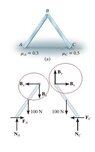
Why does the right member's free body diagram have an upward force component?

Join the discussion
Registration is free. Start your own thread to ask a follow-up.
5 replies · 3K views
Drain Brain
Messages
143
Reaction score
0
Can you explain why the free body diagram of each members are as shown? I kind of understand why the FBD of the member on the left is drawn as shown. But the FBD on the right is confusing, Why does it have a component in Y (upward) direction?
thanks!
 

Attachments

  • statics friction.jpg
    statics friction.jpg
    12 KB · Views: 159
Mathematics news on Phys.org
Drain Brain said:
Can you explain why the free body diagram of each members are as shown? I kind of understand why the FBD of the member on the left is drawn as shown. But the FBD on the right is confusing, Why does it have a component in Y (upward) direction?
thanks!

Hi Drain Brain!

It's Newton's 3rd law: whenever a body pushes against another body, that body pushes back with an equal and opposite force.
For the horizontal forces that should be intuitive.
For the vertical forces we pick one down, meaning the other must be up.
 
I like Serena said:
Hi Drain Brain!

It's Newton's 3rd law: whenever a body pushes against another body, that body pushes back with an equal and opposite force.
For the horizontal forces that should be intuitive.
For the vertical forces we pick one down, meaning the other must be up.

Hi I Like Serena! Now I understand!

There's another thing I want to ask, my book says that there are 3 unknown forces on each member, but I see 4 unknowns. Can you tell me why that is?
 
Drain Brain said:
Hi I Like Serena! Now I understand!

Good!

There's another thing I want to ask, my book says that there are 3 unknown forces on each member, but I see 4 unknowns. Can you tell me why that is?

They're probably jumping a bit ahead.
Since the coefficients of friction are given, that gives us the extra equation $F_A=\mu_A N_A$, effectively eliminating $F_A$ as an unknown.
 
I like Serena said:
Good!
They're probably jumping a bit ahead.
Since the coefficients of friction are given, that gives us the extra equation $F_A=\mu_A N_A$, effectively eliminating $F_A$ as an unknown.

Do you mean to say that the 3 unknown forces my book is referring to are the components bx, by and the normal force Na?
 
Drain Brain said:
Do you mean to say that the 3 unknown forces my book is referring to are the components bx, by and the normal force Na?

That's what I expect yes.