Freezing Water: 100cm³ of Water vs. Ice Cube

Click For Summary

Homework Help Overview

The discussion revolves around two main questions: calculating the speed of an object based on a diagram of dots produced by a vibrating arm, and understanding the behavior of water as it freezes, particularly whether 100cm³ of liquid water results in a 100cm³ ice cube.

Discussion Character

  • Exploratory, Conceptual clarification, Mathematical reasoning

Approaches and Questions Raised

  • Participants discuss calculating speed using the distance between dots and the rate of dot production. There are questions about the counting method for dots and the correct mathematical operations to use. The second question prompts exploration of water's density changes upon freezing, with some participants questioning common assumptions about density and volume.

Discussion Status

Participants have offered guidance on the calculations and clarified the concept of density in relation to water and ice. There is acknowledgment of correct reasoning in the speed calculation, and some participants express understanding of the density concept, though multiple interpretations of the freezing process are still being explored.

Contextual Notes

There is a mention of potential confusion regarding the counting of dots and spaces, as well as assumptions about the behavior of water in the freezing process. The discussion reflects a learning environment where participants are encouraged to clarify their understanding without reaching definitive conclusions.

nyrychvantel
Messages
14
Reaction score
0
1.
352n9l4.jpg

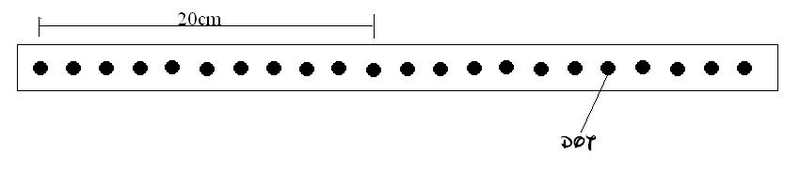
The diagram shows a strip of paper tape that has been pulled under a vibrating arm by an object moving at constant speed. The arm is vibrating regularly, making 50 dots per second.

What was the speed of the object?

A. 2.0cm/s B. 5.0cm/s C. 100cm/s D. 200cm/s


Completely clueless..


2. If you place 100cm³ of liquid water into freezer, will you get a 100cm³ ice cube?
 
Physics news on Phys.org
1/. First you need to calculate the distance between dots. You are given the distance 10 dots covers, so this is easy. Then multiply by dots per second.

2/. What happens to the density of water as it freezes? Surely you know the answer to that.
 
joeyar said:
1/. First you need to calculate the distance between dots. You are given the distance 10 dots covers, so this is easy. Then multiply by dots per second.
Distance btw dots are 2cm, btw, do you count the first dot as zero? because I counted there are 11 dots for the 20cm.
Also, do you mean 'divide' by dots per second instead of multiply, because I could not get the answer if I multiply it.
1 dot = 1/50 s
10 dot = 1/5s
s= d/t
s= 20/(1/5)
s=100cm/s
Am i correct?


2/. What happens to the density of water as it freezes? Surely you know the answer to that.
The volume will decrease since the molecules are closer together, thus higher density?
 
The idea is to actually count the spaces between the dots, not necessarily the dots themselves. 11 dots, 10 spaces.

Your answer is correct, but I did mean multiply: I was actually thinking this:

Distance between dots = 2 cm, so speed = (50 dot/sec)*(2 cm/dot) = 100 cm/sec

2/. For most substances that would be correct, but water is different from most substances. Water actually decreases in density when you freeze it. This is why ice floats on liquid water: the ice has a smaller density than the liquid water.
 
1). Seems correct to me :D
2) What happens to a full bottle of water in the freezer?
 
joeyar said:
The idea is to actually count the spaces between the dots, not necessarily the dots themselves. 11 dots, 10 spaces.

Your answer is correct, but I did mean multiply: I was actually thinking this:

Distance between dots = 2 cm, so speed = (50 dot/sec)*(2 cm/dot) = 100 cm/sec

2/. For most substances that would be correct, but water is different from most substances. Water actually decreases in density when you freeze it. This is why ice floats on liquid water: the ice has a smaller density than the liquid water.
Thank you so much! I understand now.
 

Similar threads

  • · Replies 8 ·
Replies
8
Views
8K
  • · Replies 30 ·
2
Replies
30
Views
4K
  • · Replies 6 ·
Replies
6
Views
3K
  • · Replies 1 ·
Replies
1
Views
3K
Replies
1
Views
6K
  • · Replies 20 ·
Replies
20
Views
8K
  • · Replies 3 ·
Replies
3
Views
4K
  • · Replies 5 ·
Replies
5
Views
10K
  • · Replies 10 ·
Replies
10
Views
7K
  • · Replies 5 ·
Replies
5
Views
3K