How Do Sign Conventions Affect Calculating Net Force on Charges?

Click For Summary
SUMMARY

The discussion centers on the impact of sign conventions in calculating net forces on charges, specifically using the formula F = k(q1*q2)/r². Participants clarify that the placement of charges affects the direction of forces, with attractive forces pulling charges towards each other. The correct interpretation of signs is crucial; a positive force indicates repulsion while a negative force indicates attraction. Additionally, the importance of using unit vectors and considering the vector nature of forces is emphasized for accurate calculations.

PREREQUISITES
  • Understanding of Coulomb's Law and the formula F = k(q1*q2)/r²
  • Familiarity with vector notation and unit vectors in physics
  • Knowledge of charge interactions, specifically attractive and repulsive forces
  • Basic algebra skills for manipulating equations and understanding sign conventions
NEXT STEPS
  • Study the implications of charge placement on net force calculations
  • Learn about vector addition in the context of forces and charge interactions
  • Explore the concept of significant figures and units in physics calculations
  • Investigate advanced topics in electrostatics, such as electric field strength and potential
USEFUL FOR

Students and educators in physics, electrical engineers, and anyone involved in the study of electrostatics and charge interactions will benefit from this discussion.

JoeyBob
Messages
256
Reaction score
29
Homework Statement
See attached
Relevant Equations
F=9E9 *(q1q2/r)
So 0=q1q3/r+q2q3/(13.6-r)

0=-8.5/r-3.63/13.6+3.63/r

0.2669=3.63/r-8.5/r

r=-18.2465, but the answer is supposed to be 8.24
 

Attachments

  • Question.PNG
    Question.PNG
    8.2 KB · Views: 172
Physics news on Phys.org
I think you figured out that the minus charge must be placed between the two positive charges. Both forces are attractive. The first charge pulls charge 3 to the left, giving it a negative sign. The second charge pulls charge 3 to the right=that force is positive.

Meanwhile you need an exponent of 2 on the distances in the denominator.

Your algebra is also incorrect. e.g. ## 6/(4-2) \neq 6/4-6/2 ##.
 
Last edited:
Charles Link said:
I think you figured out that the minus charge must be placed between the two positive charges. Both forces are attractive. The first charge pulls charge 3 to the left, giving it a negative sign. The second charge pulls charge 3 to the right=that force is positive.

Meanwhile you need an exponent of 2 on the distances in the denominator.

Your algebra is also incorrect. e.g. ## 6/(4-2) \neq 6/4-6/2 ##.

Are they not both negative though, because q1*q3 and q2*q3 are both negative?
 
Last edited:
Charles Link said:
I think you figured out that the minus charge must be placed between the two positive charges. Both forces are attractive. The first charge pulls charge 3 to the left, giving it a negative sign. The second charge pulls charge 3 to the right=that force is positive.

Meanwhile you need an exponent of 2 on the distances in the denominator.

Your algebra is also incorrect. e.g. ## 6/(4-2) \neq 6/4-6/2 ##.

I get the right answer as you've said when I make one positive and fix my algebra, but could you explain further why its positive? I understand it pulls the charge to the right, but I was under the impression that, from the equation below, it was the charges that delineated a positive or negative sign.

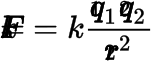
F = k \frac{q_1q_2}{r^2}
 
JoeyBob said:
I get the right answer as you've said when I make one positive and fix my algebra, but could you explain further why its positive? I understand it pulls the charge to the right, but I was under the impression that, from the equation below, it was the charges that delineated a positive or negative sign.

F = k \frac{q_1q_2}{r^2}
That formula only gives the magnitude. The vector form includes r as a vector, e.g. ##\frac{kq_1q_2}{r^3}\vec r##. For the two cases, the r vector is pointing opposite ways.
 
haruspex said:
That formula only gives the magnitude. The vector form includes r as a vector, e.g. ##\frac{kq_1q_2}{r^3}\vec r##. For the two cases, the r vector is pointing opposite ways.

So the vector from the first charge interaction would be r/r i hat and from the second charge interaction (r-13.6)/sqrt(r-13.6)^2 *i hat. The first would remain positive and cancel, but the second would be negative and cancel because we know r is smaller than 13.6 and a negative divided by the absolute value of a positive is negative.

Is this correct?
 
@haruspex wrote it with an ## \vec{r} ## in the numerator, and an ## r^3 ##, in the denominator, but when you are first getting started, you are better to look at it as a unit vector divided by ## r^2 ##. If you got the correct answer, I believe you now have the right idea.

As he pointed out, you only get the amplitude of the force from the formula. You then determine which way the force points, (left or right), and put the sign on there accordingly.
 
JoeyBob said:
Are they not both negative though, because q1*q3 and q2*q3 are both negative?
May I add my two-penn’orth?

The confusion comes from mixing two different sign-conventions and is easily avoided.

When using ##F = \frac{kq_1q_2}{r^2} ##we are using a radial sign-convention. A positive value of F means outwards (repulsion); a negative value of F means inwards (attraction). Positive or negative values of F do not tell us if F acts in the +x or -x directions; that needs a different sign-convention.

When you have charges along a line it's often simplest to consider the magnitudes of the forces. In this question we have the arrangement:
[+q₁] [-q₃] [+q₂]
For zero force on q₃ we need the 2 attractive forces on it to balance:
|F₁₃| = |F₂₃|

Also worth noting is that answers should have units and be rounded to the appropriate number of significant figures.
 
  • Like
Likes   Reactions: Charles Link

Similar threads

Replies
31
Views
1K
  • · Replies 6 ·
Replies
6
Views
983
Replies
12
Views
2K
  • · Replies 9 ·
Replies
9
Views
3K
  • · Replies 10 ·
Replies
10
Views
1K
Replies
9
Views
2K
Replies
9
Views
2K
  • · Replies 17 ·
Replies
17
Views
2K
  • · Replies 21 ·
Replies
21
Views
3K
  • · Replies 7 ·
Replies
7
Views
1K