Galvanic Cell Reactions and Potential Calculation

Click For Summary
SUMMARY

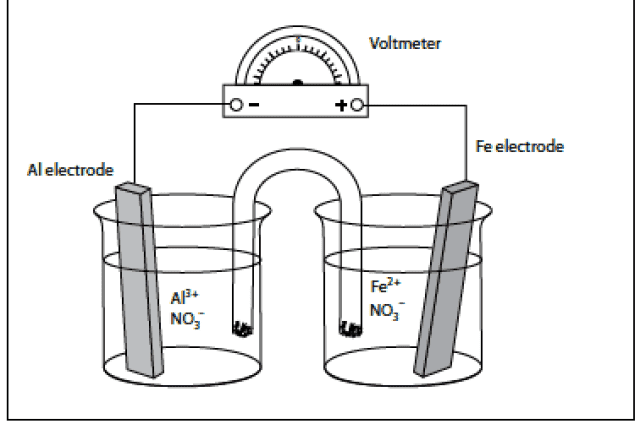
The discussion focuses on the reactions and potential calculations of an Al/Fe galvanic cell. The anode is identified as aluminum (Al), while iron (Fe) serves as the cathode. The overall cell reaction is represented as 2Al + 3Fe^2+ => 2Al^3+ + 3Fe, with a calculated overall cell potential of 1.25 V. Additionally, it is confirmed that electrons flow from the anode to the cathode through the conducting wire, while ions move through the solution and salt bridge.

PREREQUISITES
  • Understanding of galvanic cells and electrochemical reactions
  • Familiarity with oxidation and reduction processes
  • Knowledge of standard electrode potentials
  • Basic concepts of ion and electron flow in electrochemical systems
NEXT STEPS
  • Study the Nernst equation for calculating cell potential under non-standard conditions
  • Explore the concept of electrochemical series and its application in predicting reaction feasibility
  • Learn about the construction and operation of galvanic cells in laboratory settings
  • Investigate the role of salt bridges in maintaining charge balance in electrochemical cells
USEFUL FOR

Chemistry students, educators, and professionals interested in electrochemistry, particularly those studying galvanic cells and their applications in energy conversion and storage.

johnk
Messages
1
Reaction score
0
Hey guys! I'm not sure if I solved this correctly. If you could please take a look at my answers I'd really appreciate it. Thank you in advance!

(I tried using the super subscript option but I started to confuse myself because of all the coding so I just stuck with the up arrow (^) I hope you guys don't mind too much) Thanks again

Homework Statement


The following figure shows a diagram of an Al/Fe galvanic cell. Use the diagram to
answer the questions that follow it.
25zo5ls.png


a) Predict the anode, cathode, and overall cell reactions that occur as this cell operates.
b) Predict the overall cell potential.
c) Describe the direction of ion and electron flow in the diagram.

The Attempt at a Solution


a)
• Fe = Cathode
• Al = Anode
• Al(s) => Al^3+(aq) + 3e^- Fe^2+(aq) + 2e^- => Fe(s)
2(Al => Al^3+ + 3e^-
3(Fe^2+ + 2e^- => Fe)
=2Al + 3Fe^2+ + 6e^- => 2Al^3+ + 6e^- + 3Fe
=2Al + 3Fe^2+ => 2Al^3+ + 3Fe

b)
Al(s) => Al^3+(aq) + 3e^- E=1.66
Fe^2+(aq) + 2e^- => Fe(s) E=-0.41
Overall E= 1.25

c) In an operating galvanic cell, electrons flow through the conducting wire, while ions flow through the solution and salt bridge.
 
Physics news on Phys.org
I couldn't see the picture, but I guess this is right

johnk said:
a)
=2Al + 3Fe^2+ + 6e^- => 2Al^3+ + 6e^- + 3Fe
What is the 6e- for?
The reaction goes like this: 2Al => 2Al3+ + 6e-
then 3Fe2+ + 6e- => 3Fe

johnk said:
c) In an operating galvanic cell, electrons flow through the conducting wire, while ions flow through the solution and salt bridge.
Umm... you forgot to mention the direction of the flow of the electrons and ions. :biggrin:
The electrons flow from the cathode(+) to the anode(-). The positive salt ions go to the anode(-) and the negative to the cathode(+)
 
z.js said:
The electrons flow from the cathode(+) to the anode(-).

You sure? Seems they'd be going "uphill" so to speak.
 
Really? Don't the electrons come from the anode? (I mean... oops sorry:redface:)
 
z.js said:
I couldn't see the picture, but I guess this is right


What is the 6e- for?
The reaction goes like this: 2Al => 2Al3+ + 6e-
then 3Fe2+ + 6e- => 3Fe


Umm... you forgot to mention the direction of the flow of the electrons and ions. :biggrin:
The electrons flow from the anode(-) to the cathode(+). The positive salt ions go to the anode(-) and the negative to the cathode(+)

Yep that's right! thanks a lot!:biggrin:
 

Similar threads

  • · Replies 4 ·
Replies
4
Views
2K
  • · Replies 2 ·
Replies
2
Views
4K
Replies
5
Views
1K
  • · Replies 3 ·
Replies
3
Views
2K
  • · Replies 6 ·
Replies
6
Views
4K
  • · Replies 2 ·
Replies
2
Views
2K
  • · Replies 1 ·
Replies
1
Views
3K
  • · Replies 28 ·
Replies
28
Views
6K
Replies
1
Views
3K
  • · Replies 1 ·
Replies
1
Views
3K