Is this Gas Expansion Problem a Quasi-Static Adiabatic Process?

Click For Summary
SUMMARY

The discussion centers on determining whether a gas expansion process involving an ideal gas and a liquid is a quasi-static adiabatic process. The participants conclude that the process is not adiabatic due to the addition of heat to the gas, despite the absence of sudden changes. The final temperature equation, T2V2γ-1=T1V1γ-1, is deemed applicable only to adiabatic reversible processes. For a monatomic gas, the correct value of γ is established as 5/3, and the pressure dynamics during the expansion are analyzed to derive the final temperature using the ideal gas law.

PREREQUISITES
  • Understanding of ideal gas laws and equations of state
  • Knowledge of thermodynamic processes, specifically adiabatic and quasi-static processes
  • Familiarity with the concept of pressure as a function of elevation in fluid mechanics
  • Basic principles of heat transfer and work done in thermodynamic systems
NEXT STEPS
  • Study the principles of adiabatic processes in thermodynamics
  • Learn about the ideal gas law and its applications in real-world scenarios
  • Explore the derivation and implications of the first law of thermodynamics
  • Investigate the differences between monoatomic and diatomic gases in thermodynamic contexts
USEFUL FOR

Students and professionals in physics, mechanical engineering, and thermodynamics, particularly those focusing on gas behavior and thermodynamic processes.

Terry Bing
Messages
48
Reaction score
6
MODERATOR'S NOTE: Moved from other forum, so no template

@Chestermiller
I am still having trouble figuring out if a given process is Quasi-static or not.
Consider the following case. The cylinder consists of an ideal gas at the bottom and a liquid of density ρ at the top separated by a piston of mass m and area A. Atmospheric pressure is p0. Again, piston and cylinder are insulating. Initially, the piston is at equilibrium. A heater is turned on in the gas. The gas will expand causing the liquid to spill out. Is this process a quasi-static adiabatic process? In this case there are no sudden changes.
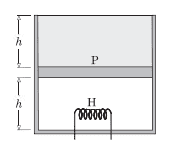
upload_2018-2-22_12-27-6.png

If so then the final temperature T2(when piston reaches the top) should satisfy
T2V2γ-1=T1V1γ-1.
For a monatomic gas, we have γ=5/2, which gives us T2=(0.5)3/2T1, [Since V2=2V1]
Is this correct?
 

Attachments

  • upload_2018-2-22_12-26-50.png
    upload_2018-2-22_12-26-50.png
    941 bytes · Views: 468
  • upload_2018-2-22_12-27-6.png
    upload_2018-2-22_12-27-6.png
    949 bytes · Views: 855
Last edited by a moderator:
Physics news on Phys.org
Terry Bing said:
MODERATOR'S NOTE: Moved from other forum, so no template

@Chestermiller
I am still having trouble figuring out if a given process is Quasi-static or not.
Consider the following case. The cylinder consists of an ideal gas at the bottom and a liquid of density ρ at the top separated by a piston of mass m and area A. Atmospheric pressure is p0. Again, piston and cylinder are insulating. Initially, the piston is at equilibrium. A heater is turned on in the gas. The gas will expand causing the liquid to spill out. Is this process a quasi-static adiabatic process?
It is not adiabatic because heat is being added to the gas. If the heat is added gradually enough, the process is quasi static.
In this case there are no sudden changes.
View attachment 220845
If so then the final temperature T2(when piston reaches the top) should satisfy
T2V2γ-1=T1V1γ-1.
No. As I said, the expansion is not adiabatic, and this equation applies to an adiabatic reversible process.
For a monatomic gas, we have γ=5/2,
No. For a monatomic gas, ##\gamma = 5/3##
Is this correct?
No.

In this problem, you need to start out by determining the pressure as a function of the change in piston elevation x (so that the work can be determined and the final temperature can be determined). What is the pressure on the gas initially? What is the pressure on the gas after the piston has risen by a distance x? What is the pressure on the gas when the piston has risen a distance h?
 
Chestermiller said:
In this problem, you need to start out by determining the pressure as a function of the change in piston elevation x (so that the work can be determined and the final temperature can be determined). What is the pressure on the gas initially? What is the pressure on the gas after the piston has risen by a distance x? What is the pressure on the gas when the piston has risen a distance h?
Thanks, I understand. I got half the answer. A number of hasty mistakes on my part in the attempt above. The process isn't adiabatic. It isn't given whether the gas is mono or diatomic, so we don't know γ.
At any instant of time, external pressure on the gas is Pext=P0+ρgy+mg/A, where y is the depth of the water layer. Work done by the gas
W=\int_{0}^{h} P_{ext} A dy= \int_{0}^{h} (P_0 A+\rho g y A+mg) dy=P_0 A h+\frac{1}{2} \rho g h^2 A+m g h
Now If we know the heat supplied,
Q-W=\Delta U
But Q is not given in the question. Also, we don't know γ to get ΔU in terms of T.
 
Last edited:
I got it. We can use equation of state for an ideal gas. Assuming the process is quasi-static, both initial and final states will be equilibrium states. Then
P_1 V_1 / T_1=P_2 V_2/ T_2 \\<br /> \implies T_2=( \frac{V_2}{V_1}) (\frac{P_2}{P_1}) T_1 \\<br /> \implies T_2=2(\frac{p_0 A+m g}{p_0 A+\rho g h A+m g}) T_1
 
Terry Bing said:
I got it. We can use equation of state for an ideal gas. Assuming the process is quasi-static, both initial and final states will be equilibrium states. Then
P_1 V_1 / T_1=P_2 V_2/ T_2 \\<br /> \implies T_2=( \frac{V_2}{V_1}) (\frac{P_2}{P_1}) T_1 \\<br /> \implies T_2=2(\frac{p_0 A+m g}{p_0 A+\rho g h A+m g}) T_1
Very Good. It's just ##\Delta U=\frac{C_v}{R}\Delta (PV)##
 

Similar threads

Replies
8
Views
2K
Replies
19
Views
3K
Replies
49
Views
3K
  • · Replies 9 ·
Replies
9
Views
2K
  • · Replies 11 ·
Replies
11
Views
2K
  • · Replies 8 ·
Replies
8
Views
2K
  • · Replies 3 ·
Replies
3
Views
3K
  • · Replies 2 ·
Replies
2
Views
3K
Replies
2
Views
5K
  • · Replies 3 ·
Replies
3
Views
2K