Gauge Invariance (QED): How Does the Statement Hold?

Click For Summary

Discussion Overview

The discussion centers around the concept of gauge invariance in quantum electrodynamics (QED), specifically in relation to the process $$e^+e^- \rightarrow \gamma \gamma$$ and the implications of the Ward-Takahashi identities. Participants explore the conditions under which gauge invariance holds and how it relates to current conservation and Feynman diagrams.

Discussion Character

  • Technical explanation
  • Debate/contested
  • Mathematical reasoning

Main Points Raised

  • One participant references a statement from a book regarding gauge invariance and questions how it holds under certain conditions.
  • Another participant explains that the Ward-Takahashi identity arises from current conservation, which is necessary for gauge invariance.
  • A participant challenges the assertion that the conditions are met, noting that the quantities involved are not zero and questioning the author's reasoning.
  • It is mentioned that the Ward-Takahashi identities apply to the proper vertex function and are valid order by order in ##\hbar##, specifically for the complete set of diagrams at a given order.
  • Another participant clarifies that the identities do not apply to individual diagrams but rather to the sum of diagrams relevant for the N-point function at a specific loop order.
  • A participant suggests that explicit calculations of the expressions for ##A^{\mu\nu}## and ##\tilde{A}^{\mu\nu}## will show that the gauge invariance conditions hold true.
  • There is a question about whether the Ward-Takahashi identity applies to the amplitude rather than each individual Feynman diagram.
  • A participant confirms that the identity holds for the amplitude and discusses the implications for other symmetries, such as charge conjugation symmetry, which also applies to the sum of contributions at a given loop order.

Areas of Agreement / Disagreement

Participants express differing views on the application of the Ward-Takahashi identities, particularly regarding whether they apply to individual diagrams or the sum of diagrams. The discussion remains unresolved, with multiple competing perspectives presented.

Contextual Notes

There are limitations regarding the assumptions made about the applicability of the Ward-Takahashi identities and the specific conditions under which gauge invariance is considered. The discussion also highlights the dependence on the definitions of the quantities involved and the order of perturbation theory.

PhyAmateur
Messages
103
Reaction score
2
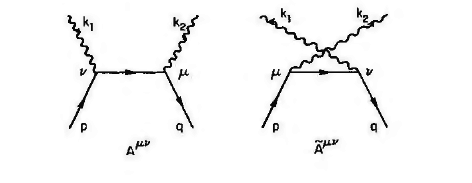
My book says that in this case $$e^+e^- \rightarrow \gamma \gamma $$ gauge invariance requires that $$k_{1\nu}(A^{\mu\nu} + \tilde{A}^{\mu\nu})=0=k_{2\mu}(A^{\mu\nu} + \tilde{A}^{\mu\nu})$$ Please see attachment. My question is how does this statement hold?
Capture.PNG
Capture.PNG
 
Last edited:
Physics news on Phys.org
This is a Ward-Takahashi identity. It comes from current conservation, ##\partial_{\mu} j^{\mu}=0##, which is a necessary condition for gauge invariance.
 
  • Like
Likes   Reactions: bhobba
But the author insisted that these conditions are met although the quantities in the equations k1ν(Aμν+A~μν)=0=k2μ(Aμν+A~μν) each separately are all different from zero. Why would he say that if it is already a consequence of ward identity? @vanhees71
 
  • Like
Likes   Reactions: loopylisa
The Ward-Takahashi identities refer to the proper vertex function and is valid order by order in ##\hbar## (number of loops), i.e., it's valid only for the complete set of diagrams of a given order.
 
How does this have to do with my question? I can't relate.
 
  • Like
Likes   Reactions: loopylisa
It has all to do with your last question, why it doesn't apply to a single diagram but only to the sum of the two diagrams relevant for the N-point function at the given loop order (which here is tree-level).
 
If you write out the expressions for ##A^{\mu\nu}## and ##\tilde{A}^{\mu\nu}## that you get from computing these diagrams, you will find that ##k_{1\nu}(A^{\mu\nu} + \tilde{A}^{\mu\nu})=0## and ##k_{2\mu}(A^{\mu\nu} + \tilde{A}^{\mu\nu})=0##. So, while this can be predicted from gauge invariance, it is also the result of doing the explicit calculation.
 
  • Like
Likes   Reactions: PhyAmateur
Are you telling me that Ward Takashi holds for the amplitude and not necessarily for each of the Feynman diagrams whose sum is the amplitude? @vanhees71
 
Yes, that's it. The same is true for other symmetries, like charge conjugation symmetry, which implies that n-photon vertices with an odd number of photons must vanish. This also holds true only for the sum at a given loop order. Take, e.g., the one-loop triangle diagrams. You need to add both contibutions (which are different only by the orientation of the electron-positron loop making up the triangle).
 

Similar threads

  • · Replies 24 ·
Replies
24
Views
3K
  • · Replies 7 ·
Replies
7
Views
5K
  • · Replies 1 ·
Replies
1
Views
1K
  • · Replies 0 ·
Replies
0
Views
1K
  • · Replies 5 ·
Replies
5
Views
1K
  • · Replies 1 ·
Replies
1
Views
2K
  • · Replies 3 ·
Replies
3
Views
2K
  • · Replies 3 ·
Replies
3
Views
5K
  • · Replies 1 ·
Replies
1
Views
2K
  • · Replies 4 ·
Replies
4
Views
2K