Gear on fixed rack, force analysis

  • Thread starter Thread starter Emilio_2004
  • Start date Start date
  • Tags Tags
    Gear
Click For Summary

Discussion Overview

The discussion revolves around the mechanical analysis of a gear system mounted on a fixed rack, focusing on the forces and torques acting on the gear. Participants explore the implications of ignoring gravity and friction, the dynamics of the system, and the effects of motor control on the forces involved.

Discussion Character

  • Technical explanation
  • Conceptual clarification
  • Debate/contested
  • Mathematical reasoning

Main Points Raised

  • One participant expresses confusion about the net torque on the gear being zero while ignoring gravity and friction.
  • Another participant questions the support mechanism for the gear and how it is driven, seeking clarification on the setup.
  • A participant suggests that the free body diagram is missing accelerations and provides equations relating forces and moments.
  • There is a discussion about the role of resistance, with one participant noting that friction in bearings will affect the system.
  • Participants explore the relationship between motor torque, acceleration, and the normal force on the rack, with one asking how resistance would act in the system.
  • Another participant mentions that if the motor runs at a set speed, the torque needed will only be to overcome friction after acceleration.
  • There is speculation about ideal conditions where a constant torque would lead to constant forces on the gear teeth, with acknowledgment that such conditions are unrealistic.
  • Questions arise regarding the type of motor used and its impact on the load and motion profile of the system.

Areas of Agreement / Disagreement

Participants express various viewpoints on the mechanics involved, with no clear consensus on the implications of ignoring friction or the specifics of motor control. The discussion remains unresolved regarding the exact nature of forces acting on the gear and the effects of different motor types.

Contextual Notes

Limitations include assumptions about ideal conditions, the dependence on specific motor types, and the unresolved nature of how resistance affects the system dynamics.

Emilio_2004
Messages
6
Reaction score
0
TL;DR
I want to build a monorack system but i struggle to understand the mechanical basics. What forces and torques act on a gear on a fixed rack
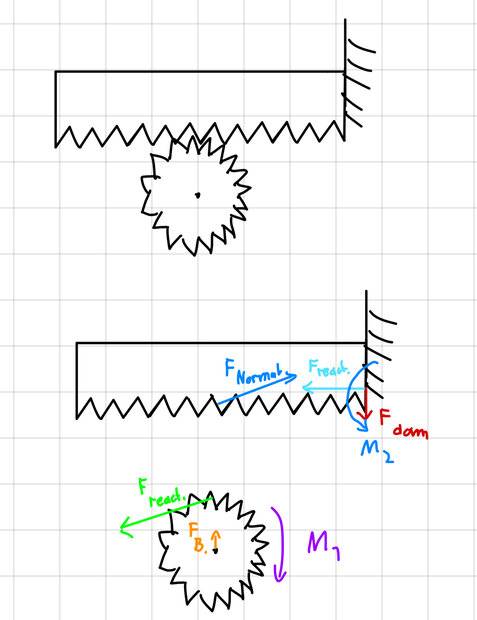
I am confused cause in my diagram for the sake of simplicity i ignore gravity and friction. But the net torque on the gear is zero? How can that be? I am sorry if thats a stupid question but i am just a bit confused and honestly stuck since days on that.

F react. Is the force that causes the gear to move forward cause on the free body diagram of the gear thats the net force. We apply a torque to the gear. This will result in a tangential force at the point of contact. Of course we need to also consider the pressure angle of the mashing, thats why i drew a force pointing upwards on from bearing of the gear to account for that (same for the rack) The force from the gear is the same as the one that will be acting on the rack (actio reactio).

The rack experiences a net force of zero as its fixed into place. But my free body diagram as it is now doesn’t make sense cause of what i already said regarding the net torque. I already was on Reddit and i got a response stating that the normal force on the gear/ the reaction force gets smaller by time, but I honestly dont get it, i hope someone can help me out. I also apologize if i am a bit unclear with what i wrote so far.
IMG_1378.jpeg
 
Engineering news on Phys.org
Welcome to PF.

Emilio_2004 said:
TL;DR Summary: I want to build a monorack system but i struggle to understand the mechanical basics. What forces and torques act on a gear on a fixed rack

But my free body diagram as it is now doesn’t make sense
Yeah, I'm not understanding it either. How is the gear suspended/supported below the beam? How is it driven? Directly by a motor shaft, or indirectly by another gear?

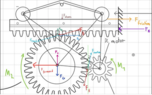
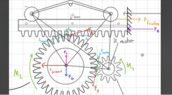
Are you thinking of something like this...?


1715968921849.png
 

Attachments

  • 1715968807331.png
    1715968807331.png
    32 KB · Views: 70
I wrote that haha. But i simplified it and got here to understand it haha. The geer would be suspended by a wheel above the rail, supporting it, but i already accounted for that by drawing in force B. The gear would have an applied torque coming from a motor
 
What is missing from your free body diagram are the accelerations.

So, summation of forces along the x-axis:
$$F_x = ma$$
Summation of moments:
$$M_1 - F_x r = I\alpha$$
And the accelerations are linked together by:
$$a= \alpha r$$
3 equations, 3 unknowns: ##a, \alpha, F_x##

Simplifying, we get:
$$M_1 - m(\alpha r) r = I\alpha$$
$$M_1 = (I + mr^2)\alpha$$
and
$$F_x = \frac{^{M_1} /_r}{\left(1+ \frac{I}{mr^2}\right)}$$
There is a force ##F_x## only if there is an acceleration. If there is a moment ##M_1##, there is an acceleration. Otherwise, the velocity is constant, and ##M_1 = F_x = 0##. This is true because we haven't included any resistance, which has to exist in a real mechanism.

Yep, a wheel - once launched - will never stop rolling if there is nothing to slow it down. Any input force will only accelerate or decelerate it.
 
  • Like
Likes   Reactions: Emilio_2004
Thank you so much, but if there were resistance where and how would it act?
 
Emilio_2004 said:
Thank you so much, but if there were resistance where and how would it act?
The bearings that support the motor shaft, gears and the trolley guide wheels, will have some friction.
 
Baluncore said:
The bearings that support the motor shaft, gears and the trolley guide wheels, will have some friction.
Thank you! This Makes sense. I have one last question. When i asked on reddit a couple of days ago i got a reply: „The forces on the gear are going to accelerate it, and this will mean that the normal force on the rack and the reaction on the gear goes down.“ What did he/she mean by that?
 
Emilio_2004 said:
What did he/she mean by that?
If we assume an electric motor that runs at a set speed. It will take time to accelerate the trolley to match the speed of the motor through the gear train. From that time on, the only torque needed from the motor will be that needed to overcome friction, so the electric motor torque and current will fall when it reaches synchronous speed.

If the motor is supplied with a fixed current, then the motor torque will be constant, so the system will accelerate continuously to the limiting speed of the motor and supply voltage.
 
Baluncore said:
If we assume an electric motor that runs at a set speed. It will take time to accelerate the trolley to match the speed of the motor through the gear train. From that time on, the only torque needed from the motor will be that needed to overcome friction, so the electric motor torque and current will fall when it reaches synchronous speed.

If the motor is supplied with a fixed current, then the motor torque will be constant, so the system will accelerate continuously to the limiting speed of the motor and supply voltage.
Oh i understand. And if we assume no friction or terminal speed there will be always be the same normal/reaction force?
 
  • #10
Emilio_2004 said:
Oh i understand. And if we assume no friction or terminal speed there will be always be the same normal/reaction force?
That will depend on the motor and motor controls.
In reality, it cannot accelerate forever.
 
  • #11
Of course, but if we assume ideal conditions which are impossible in reality, will the resulting force on the teeth be constant if we apply a constant torque to the motor/a constant current, and it will accelerate into infinity?
 
  • #12
If the motor torque could remain constant, the force on the teeth would remain constant. The system will then accelerate towards infinity.
 
  • #13
Emilio_2004 said:
.. The geer would be suspended by a wheel above the rail, supporting it, but i already accounted for that by drawing in force B. The gear would have an applied torque coming from a motor
Welcome, Emilio!

What are you trying to move with that apparatus?

You will need two wheels above the rail, …or two rails and four wheels, if you need to balance the lateral weight of the motor.
 
  • #14
What type of motor are you using to drive the gear? Each of these are controlled differently, and load the gear differently. This would help us to interpret what you were told on Reddit.

1) A small servo typically controlled by an Arduino?
2) An industrial servo motor?
3) An induction motor?

We also need to know about the load and the motion profile:

1) What is the total moving mass?
2) What is the maximum acceleration?
3) What is the maximum velocity during the move?
4) What is the maximum move distance?
 

Similar threads

  • · Replies 18 ·
Replies
18
Views
3K
  • · Replies 18 ·
Replies
18
Views
3K
  • · Replies 24 ·
Replies
24
Views
9K
Replies
10
Views
3K
  • · Replies 8 ·
Replies
8
Views
3K
  • · Replies 21 ·
Replies
21
Views
4K
  • · Replies 8 ·
Replies
8
Views
13K
Replies
4
Views
3K
  • · Replies 8 ·
Replies
8
Views
4K
  • · Replies 4 ·
Replies
4
Views
2K