Generalized mathematical induction

Join the discussion
Registration is free. Ask a follow-up in this thread, or start your own.
8 replies · 3K views
Dog1
Messages
2
Reaction score
0
Recall that the fibonacci sequence is defined as

{ f0=0; f1 = 1 and
{fn = f n - 1 + fn -2 for n 2

Prove by generalized mathematical induction that

fn = 1/sqrt(5)[ϕn - (-ϕ)-n]

where ϕ = [1+sqrt(5)]/2

is the golden ratio.. (This is known as de Moivre's formula.)
So I'm completely lost as to how I should start this and I need someone to point me in the right direction. Thanks.
 
Physics news on Phys.org
First, you want to demonstrate that the base case $P_0$ is true:

$$F_0=\frac{1}{\sqrt{5}}\left(\phi^{0}-\phi^{-0} \right)=0$$

Is this true?

Next, state the induction hypothesis:

$$F_k=\frac{1}{\sqrt{5}}\left(\phi^{k}-(-\phi)^{-k} \right)$$

As your inductive step, the recursive definition of the sequence will be helpful. During this process you will want to demonstrate that:

$$\phi^{k}+\phi^{k-1}=\phi^{k+1}$$

and

$$(-\phi)^{-k}+(-\phi)^{-(k-1)}=(-\phi)^{-(k+1)}$$
 
Hi, and welcome to the forum. Please see the section on strong induction in Wikipedia and possibly other sections of that article.
 
MarkFL said:
First, you want to demonstrate that the base case $P_0$ is true:

$$F_0=\frac{1}{\sqrt{5}}\left(\phi^{0}-\phi^{-0} \right)=0$$

Is this true?

Next, state the induction hypothesis:

$$F_k=\frac{1}{\sqrt{5}}\left(\phi^{k}-\phi^{-k} \right)$$

As your inductive step, the recursive definition of the sequence will be helpful. During this process you will want to demonstrate that:

$$\phi^{k}+\phi^{k-1}=\phi^{k+1}$$

and

$$\phi^{-k}+\phi^{-(k-1)}=\phi^{-(k+1)}$$

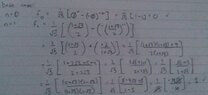
So my base cases check to be true. I've attached my work here.

View attachment 1849

And fn is true for n. But I'm not sure how to prove for n + 1.

fn+1= f(n+1)-1 + f(n+1)-2

=fn+f(n-1)
=1/sqrt(5)[ϕn-n] + 1/sqrt(5) [ϕ(n-1) ϕ-(n-1)

What do I do next? If I'm even going in the right direction.
 

Attachments

  • dog2.jpg
    dog2.jpg
    29.1 KB · Views: 103
Last edited by a moderator:
While it didn't hurt to show it is true for $n=1$, you really only need to show it is true for one case, and demonstration that it is true for $n=0$ is simpler.

Okay, next you want to state the induction hypothesis $P_k$:

$$F_k=\frac{1}{\sqrt{5}}\left(\phi^{k}-(-\phi)^{-k} \right)$$

Now, I suggest adding to this $P_{k-1}$

$$F_{k-1}=\frac{1}{\sqrt{5}}\left(\phi^{k-1}-(-\phi)^{-(k-1)} \right)$$

Aided by the recursion:

$$F_{k+1}=F_{k}+F_{k-1}$$

the left side immediately becomes what you need. And the right side also becomes what you need if you prove the two properties involving $\phi$ I listed in my first post are true.
 
MarkFL said:
$$F_k=\frac{1}{\sqrt{5}}\left(\phi^{k}-\phi^{-k} \right)$$
This should say
\[
F_k=\frac{1}{\sqrt{5}}\left(\phi^{k}-(-\phi)^{-k} \right)
\]
just as the original post says.

MarkFL said:
While it didn't hurt to show it is true for $n=1$, you really only need to show it is true for one case
Hmm...

MarkFL said:
Okay, next you want to state the induction hypothesis $P_k$:

$$F_k=\frac{1}{\sqrt{5}}\left(\phi^{k}-\phi^{-k} \right)$$

Now, I suggest adding to this $P_{k-1}$

$$F_{k-1}=\frac{1}{\sqrt{5}}\left(\phi^{k-1}-\phi^{-(k-1)} \right)$$
Let's set $k=1$. We have proved $P_0$, but what about $P_1$?
 
Evgeny.Makarov said:
This should say
\[
F_k=\frac{1}{\sqrt{5}}\left(\phi^{k}-(-\phi)^{-k} \right)
\]
just as the original post says.

Hmm...

Let's set $k=1$. We have proved $P_0$, but what about $P_1$?

I fixed my posts to correctly state the hypothesis. My mistake also that both given initial values need to be shown are true.
 
As as aside, we can derive the required result. If we write the recursion as the linear homogeneous difference equation:

$$F_{n}-F_{n-1}-F_{n-2}=0$$

We then find the associated characteristic equation is:

$$r^2-r-1=0$$

Application of the quadratic formula yields the characteristic roots:

$$r=\frac{-(-1)\pm\sqrt{(-1)^2-4(1)(-1)}}{2(1)}=\frac{1\pm\sqrt{5}}{2}$$

Now, if we define:

$$\phi=\frac{1+\sqrt{5}}{2}$$

We then see that:

$$\frac{1-\sqrt{5}}{2}\cdot\frac{1+\sqrt{5}}{1+\sqrt{5}}= \frac{1-5}{2\left(1+\sqrt{5} \right)}=- \frac{2}{1+\sqrt{5}}=(-\phi)^{-1}$$

Hence the characteristic roots may be given as:

$$r=\phi,\,(-\phi)^{-1}$$

And thus, we know the closed form for $F_n$ is given by:

$$F_n=A\phi^n+B(-\phi)^{-n}$$

Now, using the initial values of the sequence, we may determine the values of the parameters $A$ and $B$:

$$F_0=A\phi^0+B(-\phi)^{-0}=A+B=0\implies B=-A$$

$$F_1=A\phi^1+B(-\phi)^{-1}=A\frac{1+\sqrt{5}}{2}-A\frac{1-\sqrt{5}}{2}=A\sqrt{5}=1\implies A=\frac{1}{\sqrt{5}}$$

Hence, we find the solution satisfying the difference equation and the initial values is:

$$F_n=\frac{1}{\sqrt{5}}\phi^n-\frac{1}{\sqrt{5}}(-\phi)^{-n}$$

Factoring gives us:

$$F_n=\frac{1}{\sqrt{5}}\left(\phi^n-(-\phi)^{-n} \right)$$
 
Dog said:
fn = 1/sqrt(5)[ϕn - (-ϕ)-n]

where ϕ = [1+sqrt(5)]/2
Prove that this is the same as $$F_n=\frac{\left(\frac{1+\sqrt{5}}{2}\right)^n-\left(\frac{1-\sqrt{5}}{2}\right)^n}{\sqrt{5}}$$.

On induction step calculate $$F_{n+1}=F_{n-1}+F_n$$ by using

$$\left(\frac{1+\sqrt{5}}{2}\right)^2=1+\frac{1+ \sqrt{5}}{2}$$

$$\left(\frac{1-\sqrt{5}}{2}\right)^2=1+\frac{1-\sqrt{5}}{2}$$