Generic Solution of a Coupled System of 2nd Order PDEs

Click For Summary
SUMMARY

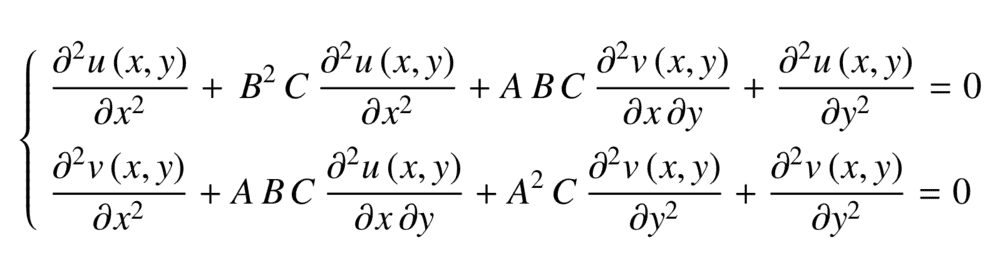
The discussion focuses on solving a set of second-order partial differential equations (PDEs) for the functions u(x,y) and v(x,y), with constants A, B, and C, where A and B are greater than zero. The proposed method involves seeking separable solutions of the form u = Ue^{kx + ly} and v = Ve^{kx + ly}, leading to an eigenvalue problem characterized by the equation k^4(1 + B^2C) + k^2 l^2 (2 + C(A^2 + B^2)) + l^4(1 + A^2C) = 0. This equation can be factored into (k^2 + l^2)(k^2(1 + CB^2) + l^2(1 + CA^2)) = 0, indicating the potential use of Laplace and Fourier transforms for further analysis.

PREREQUISITES
  • Understanding of second-order partial differential equations (PDEs)
  • Familiarity with eigenvalue problems in mathematical physics
  • Knowledge of separation of variables technique
  • Experience with Laplace and Fourier transforms
NEXT STEPS
  • Study the method of separation of variables in depth
  • Learn about eigenvalue problems and their applications in PDEs
  • Explore the use of Laplace transforms in solving differential equations
  • Investigate Fourier transforms and their role in analyzing PDEs
USEFUL FOR

Mathematicians, physicists, and engineers working on mechanical problems involving second-order PDEs, as well as students seeking to deepen their understanding of advanced mathematical techniques in applied contexts.

derya
Messages
2
Reaction score
1
TL;DR
We are looking for the generic solution of this coupled system of 2nd order PDEs.
Hi! I am looking into a mechanical problem which reduces to the set of PDE's below. I would be very happy if you could help me with it.

I have the following set of second order PDE's that I want to solve. I want to solve for the generic solutions of the functions u(x,y) and v(x,y). A, B and C are constants, and (if it helps) A, B > 0.
pde.PNG
 
  • Like
Likes   Reactions: Delta2
Physics news on Phys.org
It's linear, so you can try looking for separable solutions. If you set u = Ue^{kx + ly} and v = Ve^{kx + ly} then you get the following eigenvalue problem for k and l:
<br /> k^4(1 + B^2C) + k^2 l^2 (2 + C(A^2 + B^2)) + l^4(1 + A^2C) = 0.

EDIT: This factorises as <br /> (k^2 + l^2)(k^2(1 + CB^2) + l^2(1 + CA^2)) = 0.
 
Last edited:
  • Informative
Likes   Reactions: etotheipi
Laplace transform; Fourier transform...
 
Last edited:

Similar threads

  • · Replies 2 ·
Replies
2
Views
4K
  • · Replies 0 ·
Replies
0
Views
3K
  • · Replies 5 ·
Replies
5
Views
2K
  • · Replies 3 ·
Replies
3
Views
1K
  • · Replies 2 ·
Replies
2
Views
3K
  • · Replies 3 ·
Replies
3
Views
2K
  • · Replies 2 ·
Replies
2
Views
2K
  • · Replies 4 ·
Replies
4
Views
4K
  • · Replies 5 ·
Replies
5
Views
2K
  • · Replies 2 ·
Replies
2
Views
4K