Geometric Interpretation of k-Forms from H&H's Vector Calculus

Click For Summary
SUMMARY

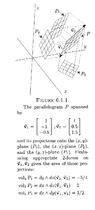
The discussion centers on the geometric interpretation of k-forms as presented in Chapter 6 of "Vector Calculus, Linear Algebra and Differential Forms" (Fourth Edition) by John H. Hubbard and Barbara Burke Hubbard. Participants clarify the significance of the notation $$\text{ vol}_2$$ preceding the parallelogram projections $$P_1, P_2, P_3$$. It is established that $$vol_2(P_3)$$ represents the area of the projection of the parallelogram spanned by vectors $$\vec{v_1}$$ and $$\vec{v_2}$$ onto the $(x,y)$-plane. The notation is deemed essential for understanding the computation of areas in this context.

PREREQUISITES
  • Understanding of k-forms in differential geometry
  • Familiarity with vector calculus concepts
  • Knowledge of projections in three-dimensional space
  • Basic grasp of the notation used in differential forms
NEXT STEPS
  • Study the geometric meaning of k-forms in "Vector Calculus, Linear Algebra and Differential Forms"
  • Learn about the computation of areas using $$vol_2$$ in differential geometry
  • Explore the properties of projections in three-dimensional real space
  • Review the definitions and applications of differential forms in calculus
USEFUL FOR

This discussion is beneficial for students and professionals in mathematics, particularly those studying vector calculus, differential forms, and geometric interpretations in higher dimensions.

Math Amateur
Gold Member
MHB
Messages
3,920
Reaction score
48
I am reading the book: "Vector Calculus, Linear Algebra and Differential Forms" (Fourth Edition) by John H Hubbard and Barbara Burke Hubbard.

I am currently focused on Chapter 6: Forms and Vector Calculus ...

I need some help in order to understand some notes by H&H following Figure 6.1.6 ... ...

Figure 6.1.6 and the notes following it read as follows:
View attachment 8628My question regarding the notes following Figure 6.1.1 is as follows:

What is the meaning/significance of the terms $$\text{ vol}_2$$ preceding $$P_1, P_2$$ and $$P_3$$ ... indeed I can see no need for the terms at all ...

Can someone please clarify this issue ...

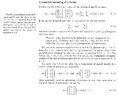
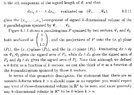
Peter=========================================================================================It may help MHB readers of the above post to have access to H&H's section on the Geometric Meaning of k-forms ... so I am providing the text of the same ... as follows:
View attachment 8629
View attachment 8630Hope that helps ...

Peter
 

Attachments

  • H&H - Notes on Figure 6.1.1 .png
    H&H - Notes on Figure 6.1.1 .png
    15.1 KB · Views: 138
  • H&H - 1 - Geometric Meaning of k-forms ... PART 1 ... .png
    H&H - 1 - Geometric Meaning of k-forms ... PART 1 ... .png
    37.1 KB · Views: 142
  • H&H - 2. - Geometric Meaning of k-forms ... PART 2 ... .png
    H&H - 2. - Geometric Meaning of k-forms ... PART 2 ... .png
    23.5 KB · Views: 142
Physics news on Phys.org
Hi Peter

I do not think that the notation is superfluous, but a better notation would be $vol_2(P_3)$, etc.You have a parallelogram $P$ spanned by $\vec{v_1}$ and $\vec{v_2}$ in three dimensional real space.

$P_3$ is the projection of $P$ on the $(x,y)$-plane.

$vol_2()$ is the action to compute the area of a plane, that is,

$vol_2(P_3)$ is the area of $P_3$
 
steenis said:
Hi Peter

I do not think that the notation is superfluous, but a better notation would be $vol_2(P_3)$, etc.You have a parallelogram $P$ spanned by $\vec{v_1}$ and $\vec{v_2}$ in three dimensional real space.

$P_3$ is the projection of $P$ on the $(x,y)$-plane.

$vol_2()$ is the action to compute the area of a plane, that is,

$vol_2(P_3)$ is the area of $P_3$
Thanks for the insight and help, Hugo ...

Appreciate your help ...

Peter
 

Similar threads

Replies
1
Views
2K
  • · Replies 2 ·
Replies
2
Views
2K
  • · Replies 2 ·
Replies
2
Views
1K
Replies
2
Views
2K
Replies
1
Views
1K
  • · Replies 2 ·
Replies
2
Views
1K
Replies
2
Views
2K
Replies
4
Views
2K
Replies
2
Views
2K
  • · Replies 4 ·
Replies
4
Views
3K