Gerry and Knight solution to single-mode Maxwell equation

  • Context: Graduate 
  • Thread starter Thread starter Kekeedme
  • Start date Start date
Join the discussion
Registration is free. Ask a follow-up in this thread, or start your own.
21 replies · 2K views
Kekeedme
Messages
17
Reaction score
9
TL;DR
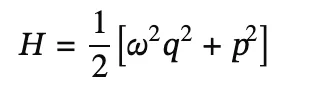
I have two questions concerning treatment of the single-mode solution to Maxwell's equation presented in Gerry and Knight's. Namely, where does the expression for the amplitude of the electric field comes from, and secondly how did they handle the integral over dV in the classical E-M Hamiltonian that contains the V^-1 term, without it blowing up.
In the book, they present the solution to the maxwell equation for a wave propagating in 1-D. My only issue is determining where the specific expression for the amplitude of the electric field comes from. Their solution is:
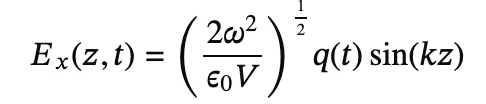
Screenshot 2026-07-08 at 11.04.53 AM.webp

Even if we use the classical energy in the field and equate it to the single-photon energy (ignoring zero point) as such:
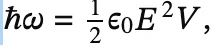
Screenshot 2026-07-08 at 11.05.44 AM.webp
we'd get 𝜔 inside the parentheses not 𝜔^2? Can someone help shed some light please?


Secondly, when we go from:
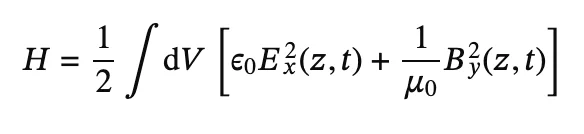
Screenshot 2026-07-08 at 11.06.59 AM.webp


to:
Screenshot 2026-07-08 at 11.07.02 AM.webp


I understand what they are trying to get, the only thing that trips me up is I don't see how they handled the integral, seeing that you have to integrate over d𝑉/𝑉 because of the coefficient in front (mentioned above in the amplitude ). What am I missing please?

Thank you!

 
Physics news on Phys.org
I'll try to answer as best I can.

For the first part, the "missing ω" is effectively hidden inside the definition of q(t). In the quantized theory,
##
q=\sqrt{\frac{\hbar}{2\omega}}(a+a^\dagger),
##
so q already contains a factor ##1/\sqrt{\omega}##.

For the second part, it seems to me that the notation is somewhat unfortunate because the same symbol V is used both for the total volume and in ##dV## for the volume element. Then the factor ##1/V## is not problematic because V is the total cavity (quantization) volume, i.e. a constant, not the integration variable. More explicitly, one could write the quantization volume as ##\mathcal V##, so that
##
\int_{\mathcal V}\frac{dV}{\mathcal V}
=
\frac{1}{\mathcal V}\int_{\mathcal V} dV
=
1.
##
Also, if I'm not mistaken, for the cavity mode
##
\int_V \sin^2(kz)\,dV = \frac{V}{2},
##
which exactly cancels the explicit ##1/V## factor in the field normalization.
 
  • Like
Likes   Reactions: bhobba, Demystifier and renormalize
Thank you so much for the reply.
So at first, does it mean that we should indeed get this expression by ignoring zero-point energy and equation the classical field energy to that of the single-photon?

For the V portion, that is very helpful, and also very unfortunate that they have this confusion in there. But I think I see what you mean. Thank you so much for this! Sorry for the late reply
 
This seems amazing! Thank you so much for this resource
 
bhobba said:
For those interested in the gory details of quantising the EM field, see the paper I often reference:
https://digitalcommons.usu.edu/cgi/viewcontent.cgi?article=3211&context=physics_facpub

Thanks
Bill
Hi Bill, I have been working on this paper for a while, and it is really helpful! Thank you!
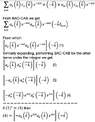
I get stuck on deriving the momentum field operator (equation 5.88 on page 73). I was able to get exactly what he got for the energy operator, but for the momentum part I tried a lot of different things and I get stuck. I have tried using convolution in the fourier space, but maybe I am doing it wrong. I have tried distributing my cross products and using BAC-CAB but no dice, among other things. Can you please help me with the details? I have hard time moving on when I cannot convince myself I understand where one gets certain expressions. Thank you!
 
Kekeedme said:
I have tried using convolution in the fourier space, but maybe I am doing it wrong.
You don't need to do anything fancy, it's basically just a bunch of plug and chug and being very careful with every term.

Take ##\vec{E},\vec{B},\vec{\mathcal{A}}## from 5.74, 5.75, 5.78 and plug and chug. The integral over ##d^3x## combined with the ##e^{i\vec{k}\cdot\vec{x}}## terms in ##\vec{E},\vec{B}## should get you a delta function (make sure to integrate over two different dummy variables) collapsing you to that single ##d^3k## integral. Then use some symmetry properties to get rid of some terms and BAC-CAB and 5.79 to simplify the triple cross products that remain.

It's a lot of algebra admittedly, but nothing more than plug and chug (and a single delta function).
 
  • Like
Likes   Reactions: Kekeedme and bhobba
bhobba said:
After thinking about this for a while and considering that I am in respite care ATM, I think it's better to post this in the Advanced Homework Help.

Thanks
Bill
I am sorry to hear that Bill. But thank you again for all your suggestions.
 
Matterwave said:
You don't need to do anything fancy, it's basically just a bunch of plug and chug and being very careful with every term.

Take ##\vec{E},\vec{B},\vec{\mathcal{A}}## from 5.74, 5.75, 5.78 and plug and chug. The integral over ##d^3x## combined with the ##e^{i\vec{k}\cdot\vec{x}}## terms in ##\vec{E},\vec{B}## should get you a delta function (make sure to integrate over two different dummy variables) collapsing you to that single ##d^3k## integral. Then use some symmetry properties to get rid of some terms and BAC-CAB and 5.79 to simplify the triple cross products that remain.

It's a lot of algebra admittedly, but nothing more than plug and chug (and a single delta function).
Hi Matterwave,
thank you for your reply. This is how I did it at first, plug and chug, used ##dˆ3k## variable for say ##\vec{E}## and ##dˆ3l## variable for ##\vec{B}## and then got an ##e^{i\vec{k}\cdot\vec{x}}## term and also an ##e^{i\vec{k}\cdot\vec{l}}## term, which gives me a delta function over the ##dˆ3x## integral when ##l=-k## and then I took each term did the BAC-CAB with that ##-k## but I get ##e^{=\pm 2i\omega t}## terms I can't get rid of. I am trying to see where I might have gone wrong. What you are saying helps me because it shows my initial attempts were on the right track.
 
Kekeedme said:
but I get ##e^{=\pm 2i\omega t}## terms I can't get rid of. I am trying to see where I might have gone wrong.
Check the symmetry properties of those terms relative to your domain of integration.
 
Matterwave said:
Check the symmetry properties of those terms relative to your domain of integration.
hmm, I will go back and check. I am not sure which symmetry properties are helpful here, but I might be overlooking.
 
  • Like
Likes   Reactions: bhobba and Matterwave
Hi @Matterwave
I am not making any real headway, would you mind taking a look please? I attached the part I am working with now after using the delta function. I have tried to use the fact that the ##\vec{A}(\vec{k},t)^*= \vec{A}(\vec{-k},t)## and see that since I am doing integrals over positive and negative values of k I could get rid of some terms, but I am not sure how to do it properly. Can you please help?
Thank you!
 

Attachments

  • Screenshot 2026-09-15 at 3.05.00 PM.webp
    Screenshot 2026-09-15 at 3.05.00 PM.webp
    7.6 KB · Views: 1
I see you have a single sum over ##\sigma##. You might consider that a bit more. How did you get a single sum?
 
Ah, sorry, in my actual I made it a double sum not to prejudice the fact that the electric and magnetic field would be at same polarization all the time. So I actually had it as a sum of ##\sigma## and a variable ##m##. Sorry I didn't write that
 
Ok, then write out what you actually get. One full term that has two ##a## in it for example. Then do BAC-CAB. After that you should have a term that you can make some symmetry arguments about.
 
Right, and this is where I had gotten confused. I think I am not seeing what the symmetry argument should be, for instance, let us say I distribute the first a term, we'd get something like this: Attached and I would get another one like that with the complex conjugate
 

Attachments

  • Screenshot 2026-09-15 at 7.18.08 PM.webp
    Screenshot 2026-09-15 at 7.18.08 PM.webp
    25.2 KB · Views: 1
Be careful suppressing the ##\vec{k}## arguments (inside ##a## and ##\epsilon##). They are important here.
 
Ok. It is probably starring at me or I am doing something wrong, but unfortunately, I am not seeing what else I can do. Attached you will see when I expand all four terms and do the triple product etc. The first and fourth results are almost complex conjugates of one another except for not being evaluated at the same ##\vec{k}##, but since I am integrating over all possible values of ##k## and if I, in addition, use the property that ##A\left(\vec{k},t\right)^*=A\left(\vec{-k},t\right)## I might get them to cancel (since they are of opposite sign), not sure if that is doable. Then for terms (2) and (3) I might be getting a sign error because they cancel...What do you think?
 

Attachments

  • Screenshot 2026-09-16 at 9.55.16 AM.webp
    Screenshot 2026-09-16 at 9.55.16 AM.webp
    84.2 KB · Views: 1
Two things:

1. You need to be more careful with your algebra. The fourier integral is going to get you a ##\delta^3(\vec{k}+\vec{q})## so actually you should have something like (I'm gonna drop a bunch of scalars) ##a_\sigma(\vec{k})\vec{\epsilon}_\sigma(\vec{k})\times [(-\vec{k})\times a_m(-\vec{k})\vec{\epsilon}_m(-\vec{k})]##. So you gotta do better book keeping. For a calculation like this, even a small error (missed minus sign) changes the argument significantly.
2. Eventually what you'll get out of a term like this is a bunch of scalars that will be even in ##\vec{k}##, some terms which sum to be even in ##\vec{k}## (when you take the ##\sigma,m## sum), and that bare ##-\vec{k}## term which is odd. The integral of an odd function over all of ##d^3k## will be 0.
 
Oh my days! I can't believe I performed an improper book keeping on taking the delta function, that completely changes the signs on the arguments on the "magnetic"side of the product. Thank you! As such, I get this: Attached. From which I see that 1 and 4 will go to zero in the integration because the scalars are even in k but the k out front makes it odd overall. Then for 2 and 3 over all ##k## you get the results for these terms twice right?
 

Attachments

  • Screenshot 2026-09-16 at 12.29.01 PM.webp
    Screenshot 2026-09-16 at 12.29.01 PM.webp
    71.3 KB · Views: 1
Check eqn 5.79 again. Note that now you have ##\epsilon_m(-\vec{k})## you can't apply the rule to get ##\delta_{\sigma m}## anymore.

But the gist of what you're saying is right. You will use symmetry properties to collapse everything down to that one integral and one sum in 5.88.