Getting rid of millipedes that are infesting plants in garden

  • Thread starter Thread starter Wrichik Basu
  • Start date Start date
  • Tags Tags
    garden Plants
Click For Summary
SUMMARY

The discussion focuses on effectively eliminating millipedes or caterpillar larvae infesting terrace garden plants. Participants recommend using neem oil, a natural pesticide, and Bacillus thuringiensis kurstaki (BtK), which is effective against caterpillars. A user reported success after applying neem oil at double the recommended concentration for a week, resulting in the disappearance of the pests. Additionally, setting up a habitat for wasps can serve as a long-term biological control method.

PREREQUISITES
  • Understanding of pest identification, specifically differentiating between millipedes and caterpillar larvae.
  • Knowledge of organic pest control methods, including neem oil and BtK.
  • Familiarity with biological control strategies, such as attracting wasps.
  • Basic gardening skills, particularly in plant care and pest management.
NEXT STEPS
  • Research the application techniques and benefits of neem oil for pest control.
  • Learn about Bacillus thuringiensis kurstaki (BtK) and its effectiveness against various caterpillars.
  • Investigate methods for attracting beneficial insects, such as wasps, to your garden.
  • Explore additional organic pesticides and their application for common garden pests.
USEFUL FOR

Gardeners, horticulturists, and anyone dealing with pest infestations in plants will benefit from this discussion, particularly those interested in organic and biological pest control methods.

Wrichik Basu
Science Advisor
Insights Author
Gold Member
Messages
2,180
Reaction score
2,690
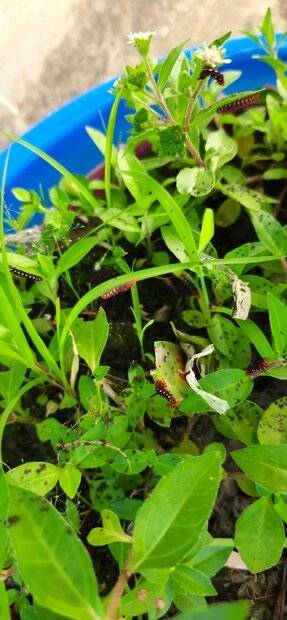
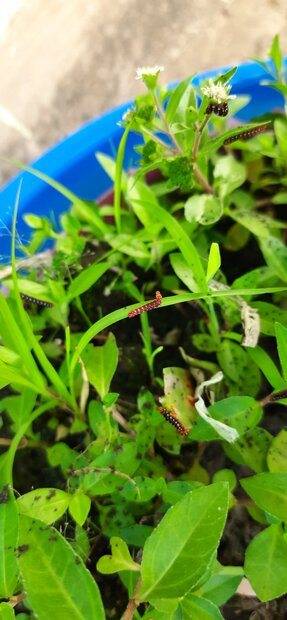
We have a small garden on our terrace. Today, when I went to water the plants, I found that some flower plants had their leaves turned translucent, i.e., they had lost all the chlorophyll. Upon looking closely, I found these millipedes having their lunch off the leaves:

20221008_165038.jpg
20221008_165042.jpg

Till now, only one plant has been affected, and I separated that pot from the others.

How do I get rid of these? Any advice is appreciated.
 
Biology news on Phys.org
Another approach is to use BtK, a commonly found bacillus that is lethal to caterpillars. You dilute it with water and spray it onto the plants. It's pretty safe. It doesn't kill the caterpillers immediately but kill them it does. You can find it in liquid form at garden shops.

Of course as long as their flying mothers have access to your plants you'll have to continue to occasionally reapply the solution.
 
Longer term solution:
If you have a lot of infectable plants in an area, you could set up a place for wasps to make a nest. I have used an old aquarium standing on end which provides a nice dry area for them to build a nest. Many kinds of wasp will predate upon caterpillars near by. This has worked great for my vegetable garden where caterpillars were virtually eliminated.
 
  • Like
  • Wow
Likes   Reactions: Wrichik Basu, jim mcnamara, OmCheeto and 2 others
Some more pictures. My 60x camera was being unable to focus at full zoom on the leaves, though it could easily focus when pointed at the floor of the terrace. This is the closest I could get with Macro:


jim mcnamara said:
If they are larvae (caterpillars) and not millipedes, try neem oil:
Ordered this, anyway. They are eating the hell out of the leaves.
jedishrfu said:
It may be some kind of fly larvae in which case you'll have lots of flies about.
We don't have many flies around.
 
JT Smith said:
Another approach is to use BtK, a commonly found bacillus that is lethal to caterpillars.
I think BTK was a serial murderer in the pacific northwest!
I have used Bt on the green cabbage looper and the tomato hornworm with good result. Those loopers were hard to pick off the broccoli and I believe Bt is completely innocuous (unless perhaps you are Mothra ) I actually don't know whether it bad for butterflies or their larvae.
 
As a first aid: these seems to be the right size for some work with a tweezer.
Fast, efficient.
Check if they are some local breed (likely there will be different sized ones) or they migrated from somewhere nearby.
 
Comparing your latest image to google images tells me they may be Indian Lily Moth caterpillars.
Wiki states the following regarding their control: "They can be controlled using pesticides such as malathion and azadirachtin. Biological control can be used through the fungus Metarhizium and a tachinid fly."
 
  • Like
  • Informative
Likes   Reactions: BillTre and Wrichik Basu
  • #10
Somehow forgot about this thread. Here's the update: I ordered the Neem oil, which I had mentioned in post #6. I mixed it at twice the concentration stated on the packet, and sprayed every day for one week, completely covering the leaves and the soil too. Surprisingly, when I sprayed, the ones that were eating and directly received the oil became somewhat inactive. After one week, I couldn't find them, neither in the soil nor on the leaves. Probably the birds helped in cleaning off the bodies. The plants are doing fine and recovering.
 
  • Like
Likes   Reactions: OmCheeto, berkeman, BillTre and 1 other person
  • #11
Thanks for the update. Neem oil is great.
 
  • Like
Likes   Reactions: Wrichik Basu

Similar threads

  • · Replies 3 ·
Replies
3
Views
2K
  • · Replies 11 ·
Replies
11
Views
2K
  • · Replies 2 ·
Replies
2
Views
679
Replies
10
Views
4K
  • · Replies 8 ·
Replies
8
Views
3K
  • · Replies 3 ·
Replies
3
Views
2K
  • · Replies 7 ·
Replies
7
Views
4K
  • · Replies 10 ·
Replies
10
Views
4K
Replies
15
Views
3K
Replies
64
Views
18K