Giant Swing, Uniform Circular Motion

Click For Summary
SUMMARY

The discussion centers on solving the physics problem related to the "Giant Swing" at a county fair, specifically focusing on uniform circular motion. The key equations utilized include R = Lsin(θ), v = √(gtan(θ)R), and T = 2πR/v. The correct radius (R) was determined to be 5(sin30) = 2.5m, leading to the conclusion that the time for one revolution (T) can be accurately calculated. Furthermore, it was established that the angle of the swing does not depend on the weight of the passenger, as the mass cancels out in the force equations.

PREREQUISITES
  • Understanding of uniform circular motion principles
  • Familiarity with trigonometric functions in physics
  • Knowledge of free body diagrams and Newton's laws
  • Ability to manipulate and solve algebraic equations
NEXT STEPS
  • Study the derivation of centripetal acceleration in circular motion
  • Learn about the applications of free body diagrams in various physics problems
  • Explore the effects of different angles on circular motion dynamics
  • Investigate the relationship between tension and weight in pendulum systems
USEFUL FOR

Students studying physics, particularly those focusing on mechanics and circular motion, as well as educators seeking to clarify concepts related to forces and motion in practical applications.

clope023
Messages
990
Reaction score
130
[SOLVED] Giant Swing, Uniform Circular Motion

Homework Statement


The "Giant Swing" at a county fair consists of a vertical central shaft with a number of horizontal arms attached at its upper end. Each arm supports a seat suspended from a cable 5.00 long, the upper end of the cable being fastened to the arm at a point 3.00 from the central shaft.
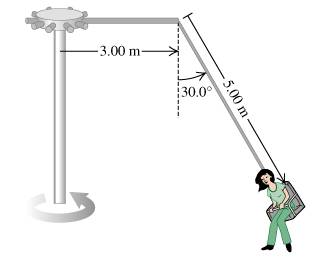
YF-05-57.jpg


A) Find the time of one revolution of the swing if the cable supporting a seat makes an angle of with the vertical.

B) Does the angle depend on the weight of the passenger for a given rate of revolution?


Homework Equations


R = Lsin(\theta)

v = \sqrt{gtan(\theta)R}

T = 2\PiR/v


The Attempt at a Solution


tried using L = 3+5m*sin(\theta)) to get 4m

R then equals = 2m

v then equals = \sqrt{9.8*2*tan\theta} = 11.3m/s

T then equals 2\Pi(2m)/11.3m/s = 1.1s wrong

I tried a few other combinations where I used 3+(5sintheta) as the L and got T=4.4s which was wrong as well.

I'm not sure what I'm doing wrong, I think I have the correct equations and I know I have the right angle and distances, I guess I'm just not sure how to derive the right length and and radius.

I'm also thinking that for part B the weight will determine the angle that the seat swings, but I don't want to risk losing the only chance I have on that part of the problem (masteringphysics).

any and all help is greatly appreciated.
 
Last edited:
Physics news on Phys.org
You might want to go back and look at this bit again:
clope023 said:
L = 3+5m*sin(\theta)) to get 4m

R then equals = 2m
sin(30) = 0.5, so 5*0.5 + 3 = 5.5m, and you don't need to divide it by 2, because that is the radius, not the diameter.
 
  • Like
Likes   Reactions: Clay Marisa
It appears that you are confusing L with R. If L is the length of the cable, then what is R, which is the radius measured from the passenger to the central shaft? Also, if you draw a free body diagram and use Newton's laws, it will help to see whether or not the the mass comes into play. You shouldn't blindly be using a formula..
 
PhanthomJay said:
It appears that you are confusing L with R. If L is the length of the cable, then what is R, which is the radius measured from the passenger to the central shaft? Also, if you draw a free body diagram and use Newton's laws, it will help to see whether or not the the mass comes into play. You shouldn't blindly be using a formula..

I wrote it before, R = Lsin(30)

I was pretty sure it was the length of the cable alone (which would've been 5) I just wasn't sure where the distance of the angle of the seat from the vertical shaft (3m) played in.

if it's only length of cable alone, then R = 5(sin30) so R = 2.5m, does that seem more correct?

on the angle's dependence on the weight, I've drawn a free body diagram and it makes the sum of the forces be

(sigma)Fx = -marad + mgcos30 = 0

(sigma)Fy = T - mgsin30 = 0

so I would imagine the angle is dependent on the weight of the seat.
 
clope023 said:
if it's only length of cable alone, then R = 5(sin30) so R = 2.5m, does that seem more correct?
As I already said:
lavalamp said:
You might want to go back and look at this bit again:
clope023 said:
L = 3+5m*sin(\theta)) to get 4m

R then equals = 2m
sin(30) = 0.5, so 5*0.5 + 3 = 5.5m, and you don't need to divide it by 2, because that is the radius, not the diameter.
 
thanks, I got the answer to the first part using that radius, I wasn't picturing in my head that the swing literally makes a circle when viewed overhead and the distance of 3m + (5sin30) was the radius of that circle.

now fro for the 2nd part, as I said I did a free body diagram and found the forces acting in each direction, but I'm actually still not certain, I believe the mass would cancel out from the 2 equations if I set them equal to each other, so the answer would be that it doesn't depend on the mass?
 
clope023 said:
thanks, I got the answer to the first part using that radius, I wasn't picturing in my head that the swing literally makes a circle when viewed overhead and the distance of 3m + (5sin30) was the radius of that circle.

now fro for the 2nd part, as I said I did a free body diagram and found the forces acting in each direction, but I'm actually still not certain, I believe the mass would cancel out from the 2 equations if I set them equal to each other, so the answer would be that it doesn't depend on the mass?
Your FBD's are not correct. In the y direction, mg acts straight down, and Tcos30 acts straight up. In the x direction, only Tsin30 acts.
 
PhanthomJay said:
Your FBD's are not correct. In the y direction, mg acts straight down, and Tcos30 acts straight up. In the x direction, only Tsin30 acts.

so then in that case Tcos30 = mg

so the angle is proportional to the mass?
 
scracth that the angle is not proportionate to the mass, thanks for the help.
 
  • #10
I have the same problem as well, and I don't quite understand how velocity was derived.
 

Similar threads

  • · Replies 7 ·
Replies
7
Views
3K
Replies
11
Views
3K
Replies
3
Views
1K
  • · Replies 9 ·
Replies
9
Views
2K
  • · Replies 4 ·
Replies
4
Views
2K
  • · Replies 3 ·
Replies
3
Views
2K
  • · Replies 3 ·
Replies
3
Views
3K
  • · Replies 10 ·
Replies
10
Views
3K
  • · Replies 19 ·
Replies
19
Views
2K
Replies
2
Views
2K