lem0ncheezcake
- 3
- 0
I have read in many places that one necessary condition for the existence of a Euler circuit in a directed graph is as follows.
Theorem: "A directed graph has an eulerian circuit if and only if it is connected and each vertex has the same in-degree as out-degree."
However, I don't understand why the state of being connected is a necessary condition. I thought that a Euler circuit is a closed walk where all of the edges are distinct and uses every edge in the graph exactly once. Therefore, the disconnected graph shown below should satisfy the condition of being a Euler circuit. (All the edges in the graph are used exactly once).
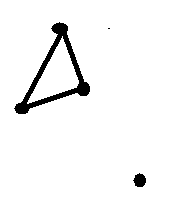
Can anyone explain what I did wrong here? Also it would be greatly appreciated if someone could give a mathematical proof to both parts of the theorem.
Thanks!
Theorem: "A directed graph has an eulerian circuit if and only if it is connected and each vertex has the same in-degree as out-degree."
However, I don't understand why the state of being connected is a necessary condition. I thought that a Euler circuit is a closed walk where all of the edges are distinct and uses every edge in the graph exactly once. Therefore, the disconnected graph shown below should satisfy the condition of being a Euler circuit. (All the edges in the graph are used exactly once).
Can anyone explain what I did wrong here? Also it would be greatly appreciated if someone could give a mathematical proof to both parts of the theorem.
Thanks!