Graphing Elastic Potential Energy

Click For Summary

Homework Help Overview

The discussion revolves around graphing elastic potential energy using the function U = (1/2)kx², where k is the spring constant. The original poster (OP) notes discrepancies between their graph and expected energy values, particularly at the displacement extrema.

Discussion Character

  • Exploratory, Assumption checking, Problem interpretation

Approaches and Questions Raised

  • Participants explore the potential reasons for discrepancies in energy values, questioning the value of the spring constant and the implications of scaling factors in the graphing process.

Discussion Status

There is active engagement with various interpretations of the problem, particularly regarding the range of displacement for the graph and the relationship between potential energy and total mechanical energy. Some participants have provided insights that align with the OP's observations, while others challenge the assumptions made about the graphing task.

Contextual Notes

Participants note that the problem specifies a range for plotting the potential energy function, which may not align with the physical constraints of the oscillator's energy. There is also mention of a potential misunderstanding regarding the interpretation of the task and the expected energy values.

TRB8985
Messages
74
Reaction score
15
Homework Statement
An object with mass 0.200 kg is acted on by an elastic restoring force with force constant 10.0 N/m. Graph the elastic potential energy U as a function of displacement x over a range of x from -0.300 m to +0.300 m. On your graph, let 1 cm = 0.05 J vertically and 1 cm = 0.05 m horizontally. The object is set into oscillation with an initial potential energy of 0.140 J and an initial kinetic energy of 0.060 J.
Relevant Equations
Total mechanical energy = K + U ; U = kx²/2
Good afternoon,

I have a question on graphing this problem. There seems to be something weird going on.

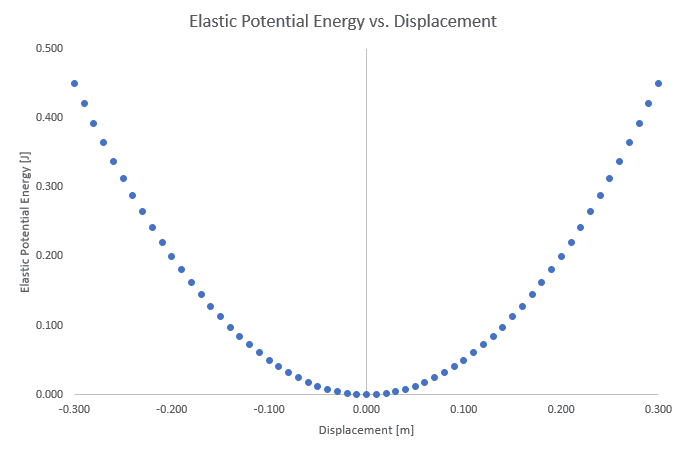
In Excel, I set up the potential energy function (kx²/2) and plotted it from x = -0.300m to 0.300m, which looks like the following:
UntitledPF.png

The overall shape of the graph looks like what's expected, but the energy values at the displacement extrema don't match the total mechanical energy given by the provided initial and final energy values. My graph returns 0.450 J, whereas the total should be 0.200 J (from the given 0.140 J + 0.060 J).

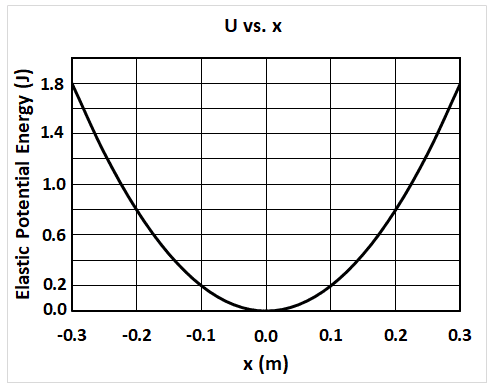
To make matters worse, I've tried looking this up online, and it appears that many different sources have just blatantly copied the graph from the solution manual with zero explanation:
image_scan.png


Why is there such a significant difference between these two graphs in regards to the y-axis?
Further, how is it that the maximal potential energy (which would be equal to the total mechanical energy)
is 1.8 J, instead of 0.200 J?

Thanks!
 
Physics news on Phys.org
What value of k are your, the other graph using/assuming?
 
I haven't seen any force constants other than the provided 10.0 N/m, unfortunately.

My suspicion was that there's some kind of scale factor involved because of the "let 1 cm = 0.05 J vertically and 1 cm = 0.05 m horizontally" part in the problem description, but I'm not entirely sure how it would come about..
 
The result at the extremes should clearly be ##10 \cdot 0.3^2/2 = 0.9/2 = 0.45## J.

The suggested graph is just wrong. Perhaps from erroneously multiplying by 2 instead of dividing by 2?
 
Orodruin said:
The result at the extremes should clearly be ##10 \cdot 0.3^2/2 = 0.9/2 = 0.45## J.

The suggested graph is just wrong. Perhaps from erroneously multiplying by 2 instead of dividing by 2?
That's not the issue. The total energy is E = 0.200 J. This means that the amplitude of oscillations is $$A=\sqrt{\frac{2E}{k}}=\sqrt{\frac{2\times 0.200~(\text{J})}{10.0~(\text{N/m})}}=0.200~\text{m}$$ The oscillator does not have the energy to reach ##\pm 0.300~##m.

OP's plot looks correct but the plotted points should stop at ##\pm 0.200~##m.
 
100% agree with the energy at the extremes being 0.45 J and the amplitude of oscillations being 0.200 m. Totally matches everything I have, thank you for verifying that.

Even within the valid bounds of oscillation, there's some weirdness going on. In the 2nd graph (the one some sites copied from the solution manual), they have the potential energy being equal to 0.800 J at x = +/- 0.200 m.

Using kx²/2, I get 0.2 J. Very strange! I'm at a loss as for how they get a result a factor of 4 larger.
 
kuruman said:
That's not the issue. The total energy is E = 0.200 J. This means that the amplitude of oscillations is $$A=\sqrt{\frac{2E}{k}}=\sqrt{\frac{2\times 0.200~(\text{J})}{10.0~(\text{N/m})}}=0.200~\text{m}$$ The oscillator does not have the energy to reach ##\pm 0.300~##m.

OP's plot looks correct but the plotted points should stop at ##\pm 0.200~##m.
That is irrelevant as the task clearly states to plot the potential in the range x = -0.3 m to 0.3 m. Whether the oscillator in the given state actually reaches that amplitude is irrelevant to the plotting task.

TRB8985 said:
Using kx²/2, I get 0.2 J. Very strange! I'm at a loss as for how they get a result a factor of 4 larger.
As I said, probably by mistakenly multiplying by two instead of dividing.
 
  • Like
Likes   Reactions: TRB8985
Orodruin said:
That is irrelevant as the task clearly states to plot the potential in the range x = -0.3 m to 0.3 m. Whether the oscillator in the given state actually reaches that amplitude is irrelevant to the plotting task.
No, the task clearly says to plot the elastic potential energy function U. Potential energy of what? Obviously the oscillator with total energy 0.200 J. The labels on the abscissa could be as specified by the task but no data points should be plotted past x = ± 0.200 m.
 
TRB8985 said:
Homework Statement: An object with mass 0.200 kg is acted on by an elastic restoring force with force constant 10.0 N/m. Graph the elastic potential energy U as a function of displacement x over a range of x from -0.300 m to +0.300 m. On your graph, let 1 cm = 0.05 J vertically and 1 cm = 0.05 m horizontally. The object is set into oscillation with an initial potential energy of 0.140 J and an initial kinetic energy of 0.060 J.
The way I read the question, there are two parts. In the first part you draw a graph for a given range of the displacements which could occur. This you did correctly, whereas the solution manual and some online solutions overstate the PE by a factor of four.

In the second part, an actual oscillation is described. In this, the total mechanical energy is 0.2J. But what is the question?
 
  • #10
kuruman said:
No, the task clearly says to plot the elastic potential energy function U. Potential energy of what? Obviously the oscillator with total energy 0.200 J. The labels on the abscissa could be as specified by the task but no data points should be plotted past x = ± 0.200 m.
I disagree. This is clearly not what is meant. The potential energy of the oscillator, yes. But as a function of position and that function is independent of whatever total energy state of the oscillator happens to be. The task clearly states

TRB8985 said:
Graph the elastic potential energy U as a function of displacement x over a range of x from -0.300 m to +0.300 m.
not ”graph the potential energy over the range of motion”.
 
  • #11
haruspex said:
The way I read the question, there are two parts. In the first part you draw a graph for a given range of the displacements which could occur. This you did correctly, whereas the solution manual and some online solutions overstate the PE by a factor of four.

In the second part, an actual oscillation is described. In this, the total mechanical energy is 0.2J. But what is the question?
This is what I would infer as well. The second part of the question seems truncated away.
 

Similar threads

  • · Replies 2 ·
Replies
2
Views
1K
Replies
7
Views
4K
Replies
13
Views
18K
Replies
16
Views
4K
  • · Replies 6 ·
Replies
6
Views
2K
Replies
5
Views
3K
Replies
44
Views
7K
Replies
8
Views
2K
  • · Replies 22 ·
Replies
22
Views
4K
  • · Replies 1 ·
Replies
1
Views
6K