Grassmann Integral into Lagrange for scalar superfields

Click For Summary
The discussion centers on the philosophical interpretation of Grassmann integrals and their transformation into Lagrangian form for scalar superfields. Participants debate whether Grassmann directions in superspace should be viewed on the same physical level as spacetime coordinates, with some arguing that superspace is merely a useful structure for constructing supersymmetric theories. The conversation touches on the potential for generating mass through superpotentials in superspace and the implications if supersymmetry (SUSY) is not experimentally confirmed. There is a divergence in perspectives, with some emphasizing the geometric aspects of supersymmetry while others focus on quantum theory interpretations. Ultimately, the conversation raises questions about the future relevance of Lagrangian language in describing the universe.
MacRudi
Messages
98
Reaction score
12
I have a more philosophical question about the interpretation of a mathematical process.
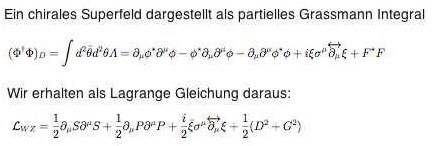
We have a chiral superscalarfield shown as partiell Grassmann Integral and transform it into a lagrange.
chiralsuperfield.jpg


where S and P are real components of a complex scalarfield and D and G are real componentfields of F.
It is a supersymmetric Transformation and covariant. Every Lorentz transformation is supersymmetric and covariant. genius so far.
In the Grassmann equation is not a kinetic term and is only build now with a kinetic term through the lagrangian supersymmetric transformation.
So if we work with Grassmann only and only think in Grassmann mathematic, then we have a complete different view on the world. We have a masseless world. But if we try to make it matching and kommensurable for our QT World, then we have other properties as in origin.
We can interpret it as SUSY or we can say that it is now the nature of the mathematic.

What are you interpreting in this mathematical trick? It is more a philosophical question.
 
Last edited:
Physics news on Phys.org
I am not sure whether you are just asking about the philosophical interpretation of superspace or supersymmetry itself. I don't think that one should try to interpret the Grassmann directions of superspace as being on the same physical footing as the spacetime coordinates. I would interpret superspace as a nice structure to use to construct supersymmetric theories.

I would also add that it is possible to generate masses in the superspace formalism through a superpotential ##W(\Phi)##. The corresponding Lagrangian is the real part of ##\int d^2\theta W(\Phi)##.
 
fzero said:
I am not sure whether you are just asking about the philosophical interpretation of superspace or supersymmetry itself. I don't think that one should try to interpret the Grassmann directions of superspace as being on the same physical footing as the spacetime coordinates. I would interpret superspace as a nice structure to use to construct supersymmetric theories.

I would also add that it is possible to generate masses in the superspace formalism through a superpotential ##W(\Phi)##. The corresponding Lagrangian is the real part of ##\int d^2\theta W(\Phi)##.

There's the rub. Grassmann Geometry is concret. For QT people it is only a nice instrument to establish Supersymmetry for their "Downgrade" into Lagrange.
 
I don’t do philosophy, and I’m not sure I understand your question. However, it is well known that super Lie groups play the same role on super spacetime which ordinary Lie groups play on ordinary spacetime. So, if supersymmetry is confirmed by experiments, one has to accept that the geometry of our spacetime is determined by the behaviour of geometrical object in superspace.
 
samalkhaiat said:
I don’t do philosophy, and I’m not sure I understand your question. However, it is well known that super Lie groups play the same role on super spacetime which ordinary Lie groups play on ordinary spacetime. So, if supersymmetry is confirmed by experiments, one has to accept that the geometry of our spacetime is determined by the behaviour of geometrical object in superspace.

IF supersymmetry is confirmed by experiments, then OK. But it doesn't seem so. (We should have found long before a Top sQuark, if SUSY is correct) What then?

By the way I thought so, that you both argue from complete different views on this. One is arguing from the QT side and the other is argueing from the geometric side, which he hopes to find as reality.

So if SUSY is not confirmed and will never be confirmed. What will you interpret in this kind of mathematical process? Will you go the way like Einstein was going with Tensorproducts and say that one result is imaginary and the other is correct for reality?

Do we need lagrangian language in future for Descriptions of the whole bunch of the universe?
 
Last edited:
  • Like
Likes fresh_42
"Supernovae evidence for foundational change to cosmological models" https://arxiv.org/pdf/2412.15143 The paper claims: We compare the standard homogeneous cosmological model, i.e., spatially flat ΛCDM, and the timescape cosmology which invokes backreaction of inhomogeneities. Timescape, while statistically homogeneous and isotropic, departs from average Friedmann-Lemaître-Robertson-Walker evolution, and replaces dark energy by kinetic gravitational energy and its gradients, in explaining...

Similar threads

  • · Replies 2 ·
Replies
2
Views
4K
Replies
21
Views
26K
  • · Replies 26 ·
Replies
26
Views
5K
  • · Replies 3 ·
Replies
3
Views
3K
  • · Replies 21 ·
Replies
21
Views
6K
  • · Replies 2 ·
Replies
2
Views
5K
  • · Replies 4 ·
Replies
4
Views
2K
  • · Replies 12 ·
Replies
12
Views
2K
  • · Replies 3 ·
Replies
3
Views
2K
  • · Replies 85 ·
3
Replies
85
Views
34K