Gravitational Forces between two masses

Click For Summary

Homework Help Overview

The discussion revolves around calculating the gravitational forces between two masses, specifically focusing on a sphere with a carved-out section. Participants are exploring the implications of Newton's law of gravitation in the context of non-uniform mass distributions.

Discussion Character

  • Conceptual clarification, Assumption checking, Problem interpretation

Approaches and Questions Raised

  • Participants discuss the calculation of the center of mass and the gravitational force between the remaining mass and the carved-out mass. Questions arise about the validity of using Newton's law for non-spherical objects and the concept of negative mass density as a method to simplify the problem.

Discussion Status

The conversation is ongoing, with participants questioning the original poster's approach and suggesting alternative methods. There is a recognition of the complexity introduced by the carved-out section of the sphere, and some participants are exploring the idea of superposition in gravitational effects.

Contextual Notes

Participants note the challenge of applying Newton's law to oddly shaped objects and the potential confusion surrounding the concept of negative mass density. There is an acknowledgment of differing interpretations of the problem and the methods suggested in textbooks.

SpectraPhy09
Messages
23
Reaction score
3
Homework Statement
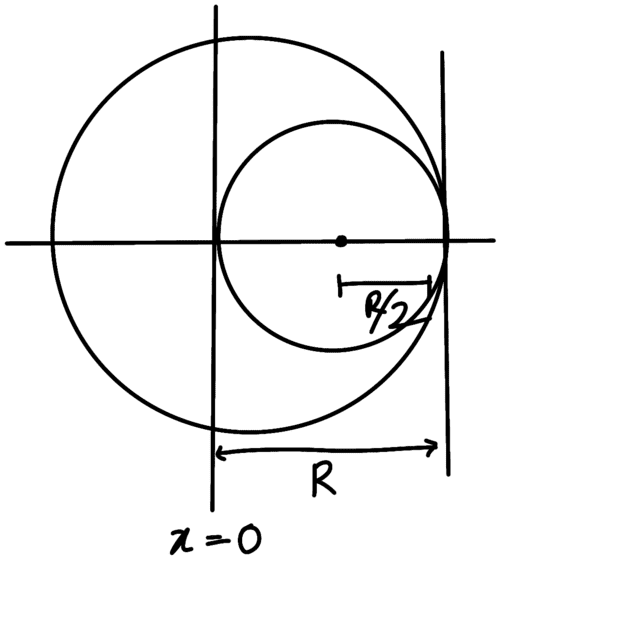
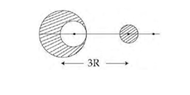
From a sphere of mass M and radius R, a smaller sphere of radius R/2 is carved out such that a cavity made in the original sphere is between its centre and periphery (Plz check the image I have attached). For this configuration in the figure where distance between the centre and the original sphere and the removed sphere is 3R, the gravitational force between the two sphere is?
Relevant Equations
F = GM1M2/r²
Density of the Sphere = 3M/4πR³
Mass of carved out sphere
= density × 4π/3 × R³/8
= M/8
The position of center of mass of The Sphere
Untitled3.png

{M(0) - M/8(R/2)}/M-M/8
-R/14

So total distance between centers of the two bodies is R/14 + 3R = 43R/14

So now I found force between the Mass 7M/8 (left out mass) and M/8
F = (G 7M/8 × M/8)/ (43R/14)²
F = 343GM²/2958R²
But this ans is given incorrect in my textbook
Is my approach wrong, or did I did something wrong?
Also is there any other method to solve this question?
 

Attachments
  • IMG_20211116_174621.png
    IMG_20211116_174621.png
    7.8 KB · Views: 136
  • Like
Likes   Reactions: Delta2
Physics news on Phys.org
The
SpectraPhy09 said:
The position of center of mass of The Sphere
The problem is that you no longer have a sphere.

Newton's universal law of gravitation (##F=\frac{Gm_1m_2}{r^2}##) works for point objects and for spherically symmetric objects. It does not work for oddly shaped objects such as spheres with holes carved out. [Newton's Shell Theorem is how you prove that spheres work]

There is a trick that you are expected to use here. Consider the original sphere with a smaller sphere of negative density super-imposed within it. This is the same thing as a hole, but is easier to calculate with.

Note that I have not checked your math for errors. Only your approach.
 
  • Like
Likes   Reactions: Steve4Physics and Delta2
jbriggs444 said:
Consider the original sphere with a smaller sphere of negative density super-imposed within it
But how can there be a negative Mass density?
This same approach is there in my textbook also But I didn't get it
 
  • Like
Likes   Reactions: Delta2
SpectraPhy09 said:
But how can there be a negative Mass density?
This same approach is there in my textbook also But I didn't get it
The gravitational effect of a sphere with a hole is the same as the gravitational effect of the whole sphere minus the effect of the material that once filled the hole, do you agree?

If so, work the problem that way.

The math does not care whether you subtract positive mass or add negative mass.
 
  • Like
  • Informative
  • Love
Likes   Reactions: PhDeezNutz, gmax137, SpectraPhy09 and 1 other person
Think superposition. If the sphere were solid and you calculated the force between it and the smaller sphere, that would be too much. You have to subtract something. See figure below.

Hollow sphere.png
 
Last edited:
  • Like
Likes   Reactions: PhDeezNutz
SpectraPhy09 said:
But how can there be a negative Mass density?
This same approach is there in my textbook also But I didn't get it
I don't get it either! Instead:

Gravity of big sphere = Gravity of big sphere with little sphere missing + Gravity of little sphere

Hence:

Gravity of big sphere with little sphere missing = Gravity of big sphere - Gravity of little sphere

No need for negative mass density!
 

Similar threads

  • · Replies 4 ·
Replies
4
Views
2K
Replies
16
Views
2K
Replies
8
Views
2K
  • · Replies 42 ·
2
Replies
42
Views
4K
Replies
33
Views
4K
  • · Replies 25 ·
Replies
25
Views
2K
  • · Replies 21 ·
Replies
21
Views
2K
  • · Replies 3 ·
Replies
3
Views
2K
Replies
11
Views
3K
Replies
5
Views
2K