Gravitational lensing: deriving magnification of lensed image

Click For Summary
SUMMARY

In gravitational lensing, image magnification is defined as the ratio of the image area to the source area. This is mathematically represented by the determinant of the Jacobian matrix, A, derived from the lens equation β=θ-α(Dlens-source)/(Dlens). The relationship between magnification (μ) and the Jacobian determinant is expressed as μ=1/det[A]. The discussion highlights the need for a clear derivation of this equivalence, particularly from the perspective of the second derivative of the angle with respect to the source position.

PREREQUISITES
  • Understanding of gravitational lensing concepts
  • Familiarity with Jacobian matrices in mathematical physics
  • Knowledge of the lens equation and its components
  • Basic calculus, particularly derivatives and determinants
NEXT STEPS
  • Study the derivation of magnification in gravitational lensing from "Gravitational Lensing" by Scott Dodelson
  • Explore the mathematical properties of Jacobian matrices in lensing contexts
  • Research the implications of the determinant of the Jacobian in optical systems
  • Investigate the relationship between image area and source area in gravitational lensing
USEFUL FOR

Astrophysicists, cosmologists, and students studying gravitational lensing and its mathematical foundations.

astrostudent21
Messages
2
Reaction score
0
TL;DR
In gravitational lensing, the image magnification is defined as the image size over the source size. But many texts also give it as the determinant of the jacobian of the of the lens equation. How are these equivalent?
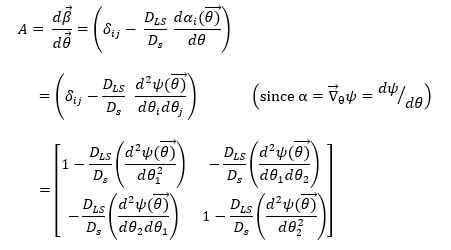
In gravitational lensing, the image magnification is defined as the image area over the source area. But many texts also give it as the inverse of the determinant of the jacobian, A, of the of the lens equation. My question is how these are equivalent.

The lens equation is β=θ-α(Dlens-source)/(Dlens)
The jacobian that describes it is then
Screenshot 2020-12-03 164231.png

many texts say that we can calculate the magnification as μ=1/det[A], but I have not found one that actually derives this relation from the initial definition of the magnification as the ratio of the image and source areas. I would really appreciate help from anyone who has experience with this topic!
 
Astronomy news on Phys.org
astrostudent21 said:
Summary:: In gravitational lensing, the image magnification is defined as the image size over the source size. But many texts also give it as the determinant of the jacobian of the of the lens equation. How are these equivalent?

Have you looked at pages 63 - 65 in the book "Gravitational Lensing" by scott Dodelson? I was able to use the LOOK INSIDE! feature of Amazon to look at these pages.
 
George Jones said:
Have you looked at pages 63 - 65 in the book "Gravitational Lensing" by scott Dodelson? I was able to use the LOOK INSIDE! feature of Amazon to look at these pages.
Thank you so much for pointing me towards that book. I suppose what I was overlooking was that the image area over the source area is really the same thing as d^2(θ)/(dβ)^2 . I think I am on the right track now.

EDIT: Hmmm... actually I am not quite following the logic here. If mu = d^2(θ)/(dβ)^2, and dβ/dθ given by the matrix A, it seems to me that mu = (A^-1)^2, not det(A)^-1. I am not seeing where the determinant comes in. Am I missing something?
 
Last edited:

Similar threads

  • · Replies 8 ·
Replies
8
Views
3K
  • · Replies 10 ·
Replies
10
Views
2K
  • · Replies 24 ·
Replies
24
Views
1K
  • · Replies 12 ·
Replies
12
Views
3K
  • · Replies 2 ·
Replies
2
Views
3K
  • · Replies 5 ·
Replies
5
Views
21K
  • · Replies 14 ·
Replies
14
Views
4K
Replies
1
Views
12K
  • · Replies 15 ·
Replies
15
Views
6K
  • · Replies 12 ·
Replies
12
Views
2K