Green's theorem with a scalar function

Join the discussion
Ask a follow-up here, or get your own question answered by working scientists, mathematicians and engineers — people, not an autocomplete.
Real named experts · corrections over time · the nuance an AI answer skips
2 replies · 2K views
Amaelle
Messages
318
Reaction score
55
Homework Statement
Look at the image
Relevant Equations
Green theorem
circuitation
Greetings!
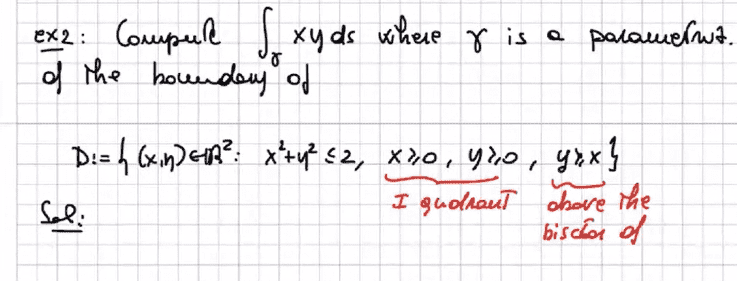
My question is: is it possible to use the green theorem to compute the circulation while in presence of a scalar function ? I know how to solve by parametrising each part but just in case we can go faster? thank you!
1644760912541.png
 
Physics news on Phys.org
I might b
Amaelle said:
Homework Statement:: Look at the image
Relevant Equations:: Green theorem
circuitation

Greetings!
My question is: is it possible to use the green theorem to compute the circulation while in presence of a scalar function ? I know how to solve by parametrising each part but just in case we can go faster? thank you!
View attachment 297061
I could be wrong, but I don't believe that Green's Theorem is a reasonable approach here. It seems much more straightforward to parameterize the boundary into three curves, and then evaluate the integral of each.

Going counterclockwise along ##\gamma##, we have
1. ##x = t, y = t, 0 \le t \le 2##
2. ##x = 2\cos(t), y= 2\sin(t), \pi/4 \le t \le \pi/2##
3. ##x = 0, y = t, 2 \ge t \ge 0##

BTW, your handwriting is not the easiest to read, particularly your shorthand abbreviations. Everything you wrote in longhand could be done using LaTeX, which would make it easier for us to understand.

For example:
Ex. 2: Compute ##\int_\gamma xy ds## where ##\gamma## is the parameterization of the boundary of
##D = \{(x, y) : x^2 + y^2 \le 2, x \ge 0, y \ge 0, y \ge x\}##
 
Reply
  • Love
Likes   Reactions: Amaelle
Mark44 said:
I might b

I could be wrong, but I don't believe that Green's Theorem is a reasonable approach here. It seems much more straightforward to parameterize the boundary into three curves, and then evaluate the integral of each.

Going counterclockwise along ##\gamma##, we have
1. ##x = t, y = t, 0 \le t \le 2##
2. ##x = 2\cos(t), y= 2\sin(t), \pi/4 \le t \le \pi/2##
3. ##x = 0, y = t, 2 \ge t \ge 0##

BTW, your handwriting is not the easiest to read, particularly your shorthand abbreviations. Everything you wrote in longhand could be done using LaTeX, which would make it easier for us to understand.

For example:
Ex. 2: Compute ##\int_\gamma xy ds## where ##\gamma## is the parameterization of the boundary of
##D = \{(x, y) : x^2 + y^2 \le 2, x \ge 0, y \ge 0, y \ge x\}##
Thank you so much!