Gun sound -- frequency analysis

Click For Summary
SUMMARY

The discussion centers on the frequency analysis of gun sounds, specifically comparing small caliber guns like the 9MM with larger caliber firearms. Participants noted that small caliber guns exhibit higher magnitudes at higher frequencies, while larger caliber guns show higher magnitudes at lower frequencies. The use of tools like Audacity for FFT analysis and the importance of RMS settings were highlighted. Additionally, factors such as microphone positioning and projectile velocity significantly influence the sound spectrum produced by firearms.

PREREQUISITES
  • Understanding of FFT (Fast Fourier Transform) analysis
  • Familiarity with RMS (Root Mean Square) calculations
  • Knowledge of sound frequency ranges and their classifications
  • Experience with audio analysis software, specifically Audacity
NEXT STEPS
  • Learn how to perform FFT analysis using Audacity
  • Research the effects of microphone positioning on sound frequency capture
  • Explore the differences between linear and logarithmic frequency plotting
  • Investigate the impact of projectile velocity on sound spectrum characteristics
USEFUL FOR

Audio engineers, firearms enthusiasts, sound analysts, and anyone interested in the acoustic properties of gunfire.

btb4198
Messages
570
Reaction score
10
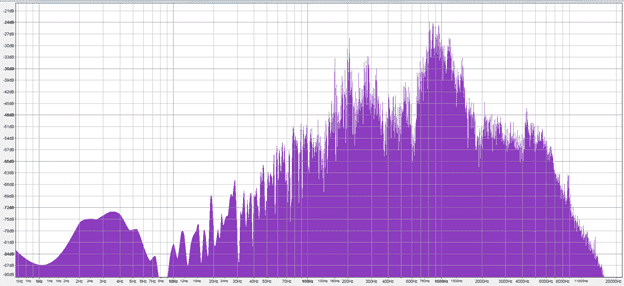
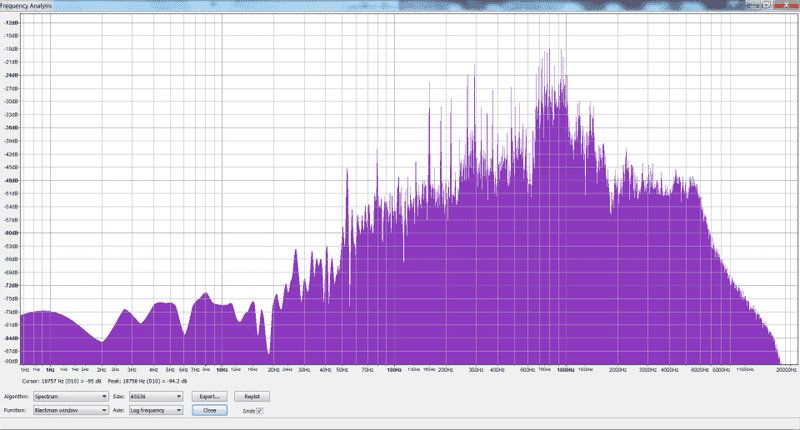
Small caliber guns have higher magnitude at higher frequencies and larger caliber guns have higher
magnitude at lower frequencies. is this true ? because I am not see this in my test:
upload_2017-1-1_13-41-32.png


that is the fft of a 9MM gun,
As one can see there are low magnitudes at low frequencies and higher magnitudes at higher frequencies.
Also the peck frequencies are around 807 Hz. A 9MM handgun is a Small caliber gun.
upload_2017-1-1_13-55-44.png


that is an fft of a larger caliber gun and the magnitudes are higher at high frequencies ...
am I missing something ?
 

Attachments

  • upload_2017-1-1_13-46-6.png
    upload_2017-1-1_13-46-6.png
    26.7 KB · Views: 2,006
Engineering news on Phys.org
Can you set you software to RMS and then integrate on both sides of what you might call "low frequency"? That will get you the total energy at "high" and "low" frequencies. You can compare these pairs for different types of guns.

Scale all of them so one side is 1. The other number will give the answer you seek.

BoB
 
I am using audacity, but I am not sure what you mean by RMS

also is 804 not a low frequency ?
 
The spectrum can be scaled as dB which is a relative measure and also as RMS (yes Root Mean Square) which is an absolute value. There should be a setting somewhere in your software. You may need a different plugin.

As to 804Hz being low or high frequency that depends on what you are doing. My human perception would put it at middle or high frequency. (YouTube 804Hz for a sample)

BoB
 
ok there is this :
upload_2017-1-1_14-42-16.png


this is Linear frequency .
so what are the different between plotting it as Linear frequency vs Log frequency ?
 
this is the 9MM one again :
upload_2017-1-1_14-50-19.png


but with Linear frequency
it looks the same as the other one
 
dB is a logarithmic scale so plotting both axes at the same scaling gives a better representation of the data. I don't know of the use of plotting X at a linear scale and Y and a logarithmic scale.

BoB
 
ok but do you know why it is not working ?
do you know another program I should try ?
 
  • #10
Your program is working just fine. There is probably a way of analyzing the data as dB to get the answer you want. I just select the parameters I need on my oscilloscope and use the cursors for the frequency range needed. I am not familiar with using PC software for this work.

I'm afraid that is about all I know about this subject. Hopefully someone with more knowledge will come along to help further.

BoB
 
  • #11
It is not the bore of the gun that decides the spectrum. It is the position of the microphone and the exit velocity of the projectile.

Supersonic ammunition will generate a shockwave that is a step function with relatively little low frequency energy. Lower velocity ammunition, or a muzzle brake, will generate a broad low frequency spectrum typical of a trapezoidal waveform.

High frequencies are steeply attenuated in air. The distance to the microphone will be critical.

Any echo will generate a frequency dependent interference pattern. How do you eliminate echoes from the microphone. Do not forget echoes from the ground.
 
  • Like
Likes   Reactions: davenn and sophiecentaur

Similar threads

  • · Replies 8 ·
Replies
8
Views
2K
  • · Replies 73 ·
3
Replies
73
Views
9K
  • · Replies 11 ·
Replies
11
Views
6K
Replies
3
Views
1K
Replies
38
Views
5K
  • · Replies 6 ·
Replies
6
Views
2K
  • · Replies 4 ·
Replies
4
Views
2K
Replies
4
Views
3K
  • · Replies 4 ·
Replies
4
Views
2K
  • · Replies 10 ·
Replies
10
Views
3K