Gusset Plate Problem: Solving the Force on MN

  • Thread starter Thread starter cwill53
  • Start date Start date
  • Tags Tags
    Plate
Click For Summary
SUMMARY

The force on member MN is determined to be 100 lbs due to P2, as the components P1 and P3 acting along MN are equal in magnitude but opposite in direction. The confusion arises from the direction of the force, which acts opposite to the vector of P2. A critical observation is that the other components of P1 and P3 contribute an additional force of approximately 200 lbs, directly opposing P2. This analysis clarifies the overall force dynamics acting on member MN.

PREREQUISITES
  • Understanding of static equilibrium in structural analysis
  • Familiarity with vector components and their resolution
  • Knowledge of force interactions in truss systems
  • Basic principles of mechanics, specifically Newton's laws
NEXT STEPS
  • Study the principles of static equilibrium in structural engineering
  • Learn about vector resolution techniques in force analysis
  • Explore truss analysis methods, focusing on member forces
  • Investigate the effects of opposing forces in mechanical systems
USEFUL FOR

Structural engineers, mechanical engineers, students studying statics, and professionals involved in force analysis and structural integrity assessments.

cwill53
Messages
220
Reaction score
40
Homework Statement
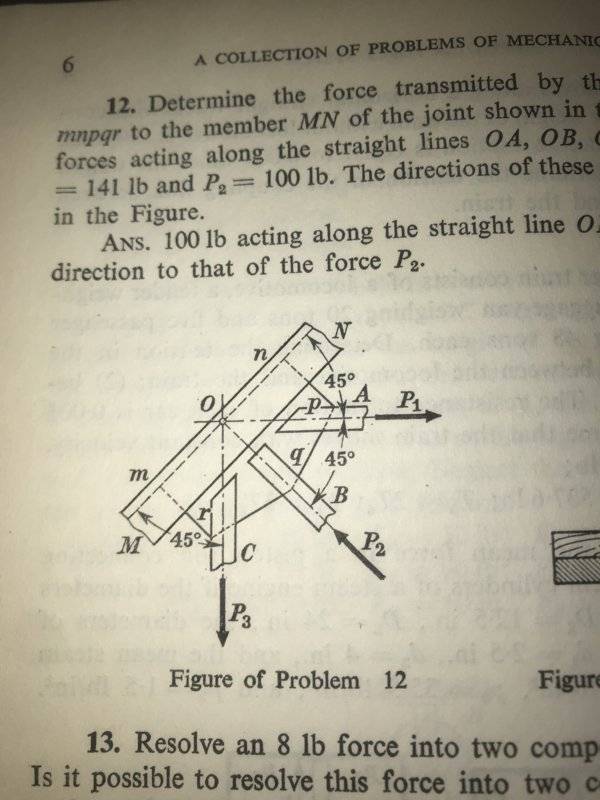
Determine the force transmitted by the gusset late mnpqr to the member MN of the joint shown in the figure if the forces acting along the straight lines OA, OB, OC are $$P_{1}=P_{3}=141 lbs$$ and $$P_{2}= 100 lbs$$. The directions of these forces are shown in the figure.
Relevant Equations
$$F_{x}= \left \| \vec{F} \right \|cos\phi$$
$$F_{y}= \left \| \vec{F} \right \|sin\phi$$
Here is the image of the problem.
IMG_6864.jpg

I arrived at the solution that the force on MN is in fact 100lbs due to P2 because the components P1 and P3 acting along MN are equal in magnitude but opposite in direction. What I don't understand is why the force is acting in the direction OPPOSITE to $$\vec{P_{2}}$$. That doesn't make sense to me.
 
Physics news on Phys.org
You did not solve the problem correctly. You noted that the components of P1 and P3 cancel out when looking at the forces on the member along its length axis. correct. But what about the other components?
 
  • Like
Likes   Reactions: cwill53
PhanthomJay said:
You did not solve the problem correctly. You noted that the components of P1 and P3 cancel out when looking at the forces on the member along its length axis. correct. But what about the other components?
I see now. The other components of P1 and P3 add up to approximately 200lbs which opposes the force of P2 directly.
 

Similar threads

Replies
21
Views
2K
Replies
19
Views
4K
Replies
14
Views
1K
  • · Replies 21 ·
Replies
21
Views
1K
  • · Replies 8 ·
Replies
8
Views
1K
Replies
2
Views
1K
  • · Replies 10 ·
Replies
10
Views
5K
Replies
17
Views
2K
Replies
30
Views
4K
  • · Replies 7 ·
Replies
7
Views
2K