Gust Load Factor & Wing Bending Explained

  • Thread starter Thread starter TEST65
  • Start date Start date
  • Tags Tags
    Bending Load
Join the discussion
Ask a follow-up here, or get your own question answered by working scientists, mathematicians and engineers — people, not an autocomplete.
Real named experts · corrections over time · the nuance an AI answer skips
14 replies · 5K views
TEST65
Messages
4
Reaction score
0
TL;DR
Hi All, Negative Gust (what is the sign of Gust Load Factor , is it for example +6.3 or -6.3)
Hi All

Negative Gust (what is the sign of Gust Load Factor , is it for example +6.3 or -6.3). And does that mean the tips of the wings is going up or down ( if going up does that termed in "English" as Up-Bending of Wing. ?Also, in this case (Negative Gust), if we call inner flange of the top most stringer, is the one closer to the center of Fuselage, Does That Flange under compression of tension.

I will be thankful if somebody help me with this.
Cheers!
 
Physics news on Phys.org
Welcome, @TEST65 !

The gust load factor is defined as the Lift/Weight ratio of an airplane while subjected to a gust.
Therefore, positive factors are applicable to cases in which the gust increases the normal lift of the airplane (example: nose to tail horizontal gust).

Following the same reasoning, could you describe one condition leading to a negative gust load factor?
Would the wings make a happy or a sad face in that case?
 
Reply
  • Like
Likes   Reactions: berkeman
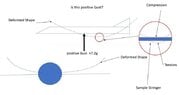
Thank you Lnewqban for your reply. To follow up on your question. I mean in FAA terms and lingo, when we talk about positive gust ( for example FAA says that we have +7.2g Gust (is this a positive Gust or Negative Gust)

1) In Case if this is called positive gust, what is the direction of the air flow of Gust is it : UP d or DOWN?

In Case if the answer is UP : Does that mean the a "FRONTAL" view of airplane makes smiling face?
In This case does that mean that the "SIDE" view of airplane makes smiling view as well?
Which means for any stringer on the belly of the airplane we have compression for inner flange and tension for outer flange if all the above is true then for negative gust (let's say -6.3g from FAA) everything is reversed it that correct?

I attached a picture to clarify more

Thank you in advance,

Cheers!
 

Attachments

  • Positive-GUST.JPG
    Positive-GUST.JPG
    20.2 KB · Views: 228
From FAR (Federal Air Regulation) 23.333(c)(1)(i): Positive (up) and negative (down) gusts of 50 f.p.s. at V C must be considered at altitudes...

This assumes that the airplane is in straight and level flight, and right side up (no aerobatics). A positive gust pushes the airplane up. The wing tips bend upward when this happens. There is a famous photo on the internet showing a static test of the Boeing 787 wing simulating a positive load factor:
787 wing test.jpg

The wings bend up under positive loads. Counterintuitively, the horizontal tail bends in the opposite direction in order to get positive pitch stability.
 
Reply
  • Wow
Likes   Reactions: FactChecker
jrmichler said:
The wing tips bend upward when this happens. There is a famous photo on the internet showing a static test of the Boeing 787 wing simulating a positive load factor:
Holy crapolski! If I were in a window seat (wearing my seatbelt) and looked out the window to see that, I would KMAGB!
 
It would take a VERY strong gust from the back or above to cause any significant "load factor". Most gusts in that direction would just reduce the positive load factor. That being said, it can happen that the downward gust is so strong that passengers are thrown against the roof.
There are military standard models for wind and turbulence that are used in airplane design.
 
FactChecker said:
It would take a VERY strong gust from the back
A gust from the back would only slightly reduce airspeed, no? And would not be considered positive?
 
berkeman said:
A gust from the back would only slightly reduce airspeed, no?
Yes.
berkeman said:
And would not be considered positive?
I always used a Mil-Std gust and turbulence model. If I remember right, we just added its (X,Y,Z) velocities to the steady wind ground velocities.
The full set of models is described here
 
Reply
  • Informative
  • Like
Likes   Reactions: Lnewqban and berkeman
That particular B-52 is low on fuel. With full tanks, the wingtip wheels on both wings would be on the ground. B-52s wings are designed so that they generate lift when the fuselage is level with the ground. When they take off, the wings lift first, after which the rest of the airplane lifts off, after which the pilot rotates.
 
Reply
  • Like
Likes   Reactions: Lnewqban
jrmichler said:
That particular B-52 is low on fuel. With full tanks, the wingtip wheels on both wings would be on the ground. B-52s wings are designed so that they generate lift when the fuselage is level with the ground. When they take off, the wings lift first, after which the rest of the airplane lifts off, after which the pilot rotates.
Yes, exactly right. You can see clearly in this video.


I was privileged to once experience takeoff in an airliner simultaneous with takeoff of a B52 on a parallel runway. It was the perfect vantage point to see the wing flex.
 
Reply
  • Like
Likes   Reactions: Lnewqban
jrmichler said:
From FAR (Federal Air Regulation) 23.333(c)(1)(i): Positive (up) and negative (down) gusts of 50 f.p.s. at V C must be considered at altitudes...

This assumes that the airplane is in straight and level flight, and right side up (no aerobatics). A positive gust pushes the airplane up. The wing tips bend upward when this happens. There is a famous photo on the internet showing a static test of the Boeing 787 wing simulating a positive load factor:
View attachment 318694
The wings bend up under positive loads. Counterintuitively, the horizontal tail bends in the opposite direction in order to get positive pitch stability.
Thank you jrmichler for your reply. I get a hold of the book. As a follow up for a positive Gust (lets say what FAA defines as +7.2) meaning:

1) the gust wind air flow direction is UPWARD
2) Wing tips are going up (smiley face)

Now, are 1) and 2) correct?

If YES, Does this mean also that the nose and tail are going up resulting in fuselage making a smiley face as well:
if the above is correct, does that mean the inner flange ( the flange closer to the center of the fuselage) of a stringer at the lowest part of fuselage (at the belly) going through COMPRESSION, or I am wrong.

Mind you the last conclusion was based on previous stated (assumed) comments.

Thank you in advance and looking to more conversations.

Cheers!
 
FactChecker said:
It would take a VERY strong gust from the back or above to cause any significant "load factor". Most gusts in that direction would just reduce the positive load factor. That being said, it can happen that the downward gust is so strong that passengers are thrown against the roof.
There are military standard models for wind and turbulence that are used in airplane design.
Thank you FactChecker for your reply. I get a hold of the book. As a follow up for a positive Gust (lets say what FAA defines as +7.2) meaning:

1) the gust wind air flow direction is UPWARD
2) Wing tips are going up (smiley face)

Now, are 1) and 2) correct?

If YES, Does this mean also that the nose and tail are going up resulting in fuselage making a smiley face as well:
if the above is correct, does that mean the inner flange ( the flange closer to the center of the fuselage) of a stringer at the lowest part of fuselage (at the belly) going through COMPRESSION, or I am wrong.

Mind you the last conclusion was based on previous stated (assumed) comments.

Thank you in advance and looking to more conversations.

Cheers!
 
TEST65 said:
Thank you FactChecker for your reply. I get a hold of the book. As a follow up for a positive Gust (lets say what FAA defines as +7.2) meaning:
I don't have the FAR book if that is what you are referring to. Perhaps you are confusing me with @jrmichler .
TEST65 said:
1) the gust wind air flow direction is UPWARD
2) Wing tips are going up (smiley face)

Now, are 1) and 2) correct?

If YES, Does this mean also that the nose and tail are going up resulting in fuselage making a smiley face as well:
Keep in mind that the force from the tail is not usually what people expect. To counteract the nose-down rotational force from the wing, the tail usually provides a downward aerodynamic force.
TEST65 said:
if the above is correct, does that mean the inner flange ( the flange closer to the center of the fuselage) of a stringer at the lowest part of fuselage (at the belly) going through COMPRESSION, or I am wrong.
I have no knowledge of structural forces on an airplane.