Hanging Object: Achieving Stability with 10 Newton Force and 1 kg Mass

  • Context: High School 
  • Thread starter Thread starter Vigant
  • Start date Start date
Click For Summary
SUMMARY

The discussion centers on the relationship between force, power, and motion, specifically regarding a 1 kg mass requiring a force of 10 Newtons to remain stationary. It is established that maintaining an object's position does not necessitate energy expenditure, as demonstrated by a bookshelf supporting an object without an energy source. The conversation highlights that while force is essential, the power required to generate that force depends on the method of propulsion, such as using a rocket motor or helicopter blades. The key takeaway is that there is no direct conversion from force to power without considering the object's velocity and the system's dynamics.

PREREQUISITES
  • Understanding of Newton's Second Law (F = m × a)
  • Basic principles of mechanics and energy
  • Knowledge of power calculations (Watts and Joules)
  • Familiarity with propulsion systems (e.g., rocket motors, helicopters)
NEXT STEPS
  • Explore the relationship between force and power in mechanical systems
  • Study the dynamics of helicopter lift and drag forces
  • Investigate the principles of rocket propulsion and mass flow rates
  • Learn about energy conservation in static and dynamic systems
USEFUL FOR

Physics students, engineers, and anyone interested in the principles of mechanics and propulsion systems will benefit from this discussion.
Vigant
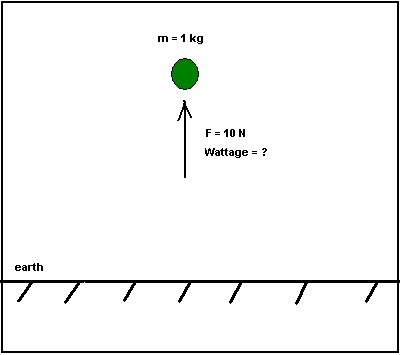
We want an object to hang in some height.
The mass is 1 kg so we need a force of 10 Newton to keep the object in the place.
I cannot find what wattage we need for this. (Say we use a rocket motor to produce the force.)
a1.PNG
 
Physics news on Phys.org
To keep the object stationary you do not need to do any work at all. (Did you ever see a bookshelf with an internal engine?)
 
So when I place a bookshelf 10 meters above ground, it will stay there forever?
 
You are reading but not understanding. Nobody said anything about placing the bookshelf above the ground. I am talking about placing an object on the bookshelf and the bookshelf will happily support the object without an energy source.

The point is that you need force, not energy to keep something up. Whether or not you need to spend energy to provide that force is a matter of how the force is generated, not of the object being held. Therefore your question is ill defined.
 
  • Like
Likes   Reactions: Asymptotic
Vigant said:
Say we use a rocket motor to produce the force
If you use a rocket motor with a small mass flow rate and a high exhaust velocity it can take an extremely large amount of power. In the limit, it would be like trying to support the object with the thrust from a flashlight. The flashlight has to be very VERY bright and draws a fiendishly large amount of power.

If you use a rocket motor with a large mass flow rate and a small exhaust velocity, it can take an extremely low amount of energy. In the limit, the exhaust velocity goes to zero, the mass flow rate goes to infinity and the required power goes to zero. Of course, now you have to worry about supporting the reaction mass as well. So that approach can't go very far.

But what if the reaction mass were supplied externally... That is the working principle behind a helicopter. In principle, with big enough, strong enough and light enough blades, it takes negligible energy to support the weight this way.
 
  • Like
Likes   Reactions: Asymptotic
Thanks for answers.
I can put my question in a simplier way:

What power [Watt] we need for a mass of 1 kg to move with acceleration 10 m / sec^2 . (in vacuum and far from gravitation)

jbriggs444:
Do you mean this question has no definite solution?
 
Vigant said:
Thanks for answers.
I can put my question in a simplier way:

What power [Watt] we need for a mass of 1 kg to move with acceleration 10 m / sec^2 . (in vacuum and far from gravitation)

jbriggs444:
Do you mean this question has no definite solution?

This is a totally different Q to what you originally asked

have you heard of the formula F (force) = m (mass) x a ( acceleration)

work out the force and then on the net find a conversion to power (Watts) and it will probably be via Joules

time for you to do an exercise :smile:
 
There is no such thing as ”converting force to power”. You can find the power dissipated by a force, but it depends on the object’s velocity and will therefore not be invariant under changes of inertial system.
 
  • Like
Likes   Reactions: Vigant and davenn
Orodruin said:
You can find the power dissipated by a force, but it depends on the object’s velocity and will therefore not be invariant under changes of inertial system.

Thanks, that explains it to me.

I can count the increment of energy in the 1st second (W = F * d) and calculate an average power.
In the 2nd second the distance d is higher than in the first one, so the average power comes higher than in the first second.
So the power is not constant.
Right?

But what about the post #1 ?
The potential energy of the object does not change there ( as d=0 and v=0).
Still we need some power to keep the object on the place.
Can we do some calculations there?
 
  • #10
Vigant said:
The potential energy of the object does not change there ( as d=0 and v=0).
Still we need some power to keep the object on the place.
No, we don't. We can support it without power (put it on a table, hang it from the ceiling).

If we choose to support it with some engine, then it will depend on the engine how much power it uses.
 
  • #11
A.T. said:
If we choose to support it with some engine, then it will depend on the engine how much power it uses.
That is what I meant.
Intuitively I was convinced that there must be some exact relationship between the force we need and the engine power.
Now it proved it was not true.
I will try to live on with it.

Thank you again. I learned a lot.
 
  • #12
Vigant said:
relationship between the force we need and the engine power
The relationship is between force, engine power and relative velocity of whatever the mechanism is pushing against. There is an exact relationship there.
 
  • #13
Consider a helicopter. The forces on the blades can be resolved into the wanted vertical force (lift) and the unwanted horizontal force (drag). The lift component acts at 90 degrees to the motion of the blades so the work done producing lift is zero. However the drag force is in the direction of motion so power is required to overcome it.

If the helicopter was "ideal" the blades would have no drag or any other losses and the power required to hover would be zero. Unfortunately there is no such thing as an ideal helicopter.
 

Similar threads

  • · Replies 6 ·
Replies
6
Views
1K
  • · Replies 29 ·
Replies
29
Views
4K
  • · Replies 29 ·
Replies
29
Views
3K
  • · Replies 21 ·
Replies
21
Views
1K
  • · Replies 17 ·
Replies
17
Views
3K
Replies
8
Views
2K
  • · Replies 6 ·
Replies
6
Views
3K
  • · Replies 138 ·
5
Replies
138
Views
8K
  • · Replies 35 ·
2
Replies
35
Views
4K
  • · Replies 3 ·
Replies
3
Views
2K