Harmonic Crystal and Bogoliubov trasformation

  • Thread starter Thread starter Satana
  • Start date Start date
  • Tags Tags
    Crystal Harmonic
Click For Summary
SUMMARY

The discussion centers on the application of the Bogoliubov transformation in quantum mechanics, specifically in the context of harmonic crystals. The transformation is expressed through the operator $\hat{U}(q)$, which acts on the vacuum state $|0\rangle$. By utilizing the derivative operator $\hat{a}_q' = \frac{\mathrm{d}}{\mathrm{d}q}\hat{a}_q$ and applying the chain rule, the relationship $\hat{a}_q'|0\rangle = 0$ is established, indicating that the transformed annihilation operator annihilates the vacuum state. This conclusion is derived from the properties of the unitary operator $\hat{U}(q)$ and its action on the vacuum state.

PREREQUISITES
  • Understanding of quantum mechanics and operator theory
  • Familiarity with Bogoliubov transformations
  • Knowledge of harmonic oscillators in quantum field theory
  • Proficiency in calculus, particularly differentiation of operators
NEXT STEPS
  • Study the derivation and applications of Bogoliubov transformations in quantum field theory
  • Explore the properties and implications of unitary operators in quantum mechanics
  • Learn about harmonic oscillators and their role in quantum systems
  • Investigate the mathematical techniques for differentiating operator-valued functions
USEFUL FOR

Physicists, quantum mechanics students, and researchers interested in quantum field theory and the mathematical foundations of particle physics.

Satana
Messages
3
Reaction score
0
Homework Statement
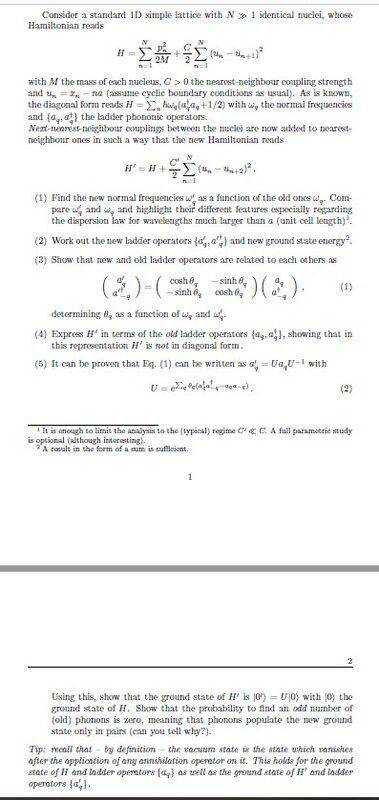
I just need a hint to solve the fifth question of this exercise. I have already solved the others
Relevant Equations
$$a_q'=\frac{1}{\sqrt {2}}\left(u_q\sqrt{\frac{M\omega_q'}{\hbar}}+ip_{-q}\frac{1}{\sqrt{M\omega_q'\hbar}}\right)
\,\,\,\,\,\,\,\,\,\,

a_q'^\dagger=\frac{1}{\sqrt {2}}\left(u_-q\sqrt{\frac{M\omega_q'}{\hbar}}-ip_q\frac{1}{\sqrt{M\omega_q'\hbar}}\right) $$
I thought about writing $$a_q'|0'> =0$$ then develop the U operator in series, after I don't know how to proceed
Dex.jpg
 
Last edited:
Physics news on Phys.org
.One approach is to use the definition of the derivative operator, $\hat{a}_q' = \frac{\mathrm{d}}{\mathrm{d}q}\hat{a}_q$. Then, by applying the chain rule, we can write $$\hat{a}_q'|0\rangle = \frac{\mathrm{d}}{\mathrm{d}q}\left(\hat{U}^\dagger(q)\hat{a}_0\hat{U}(q)|0\rangle\right) = \hat{U}^\dagger(q)\frac{\mathrm{d}}{\mathrm{d}q}\left(\hat{a}_0\hat{U}(q)|0\rangle\right).$$Using the fact that $\frac{\mathrm{d}}{\mathrm{d}q}\hat{U}(q)=\dot{\hat{U}}(q)\hat{U}^{-1}(q)$, and the fact that $\hat{U}|0\rangle=|0\rangle$ for all $q$, we can then rewrite the above equation as$$\hat{a}_q'|0\rangle = \hat{U}^\dagger(q)\dot{\hat{U}}(q)\hat{U}^{-1}(q)\hat{a}_0|0\rangle.$$Now, since $\hat{U}|0\rangle=|0\rangle$, we have $\hat{U}^{-1}|0\rangle=|0\rangle$ as well, which means that $\hat{a}_0|0\rangle=0$. Thus, we can conclude that$$\hat{a}_q'|0\rangle = 0.$$
 

Similar threads

  • · Replies 5 ·
Replies
5
Views
2K
  • · Replies 16 ·
Replies
16
Views
3K
  • · Replies 2 ·
Replies
2
Views
2K
  • · Replies 5 ·
Replies
5
Views
3K
  • · Replies 1 ·
Replies
1
Views
2K
  • · Replies 3 ·
Replies
3
Views
3K
Replies
6
Views
4K
  • · Replies 5 ·
Replies
5
Views
2K
  • · Replies 1 ·
Replies
1
Views
2K
  • · Replies 1 ·
Replies
1
Views
1K