Harmonic damper on break barrel air rifle?

Click For Summary
SUMMARY

The discussion centers on the potential application of the Mathews Harmonic Stabilizer, designed for bows, to reduce vibrations in break barrel air rifles. Users express skepticism about the effectiveness of this dampening solution due to the differing materials and dynamics between bows and air rifles. The conversation highlights the importance of understanding the specific recoil characteristics of air rifles, which involve dual recoils that can affect accuracy. Ultimately, the consensus suggests that while the stabilizer may work for bows, its benefits on air rifles are uncertain due to differing mass and stiffness.

PREREQUISITES
  • Understanding of break barrel air rifle mechanics
  • Knowledge of vibration dampening principles
  • Familiarity with materials used in archery and firearms
  • Experience with accuracy testing methods for air rifles
NEXT STEPS
  • Research the physics of dual recoil in break barrel air rifles
  • Investigate alternative vibration dampening solutions for firearms
  • Learn about the design and tuning of vibration dampers in archery equipment
  • Explore methods for bench testing air rifle accuracy
USEFUL FOR

Air rifle enthusiasts, gunsmiths, and anyone interested in improving the accuracy and performance of break barrel air rifles through vibration reduction techniques.

viper2788
Messages
3
Reaction score
0
basically, I am trying to reduce vibrations from my break barrel air rifle which has dual recoils in either direction. they happen almost simultaneously, but it still throws off my accuracy as one occurs just before the pellet leaves the barrel. the kick isn't strong but rather sharp. here's a pic so you may get a better idea:
http://www.airgunsofarizona.com/Crosman/Nitro/NitroVsSpring.jpg

and then i came across this:
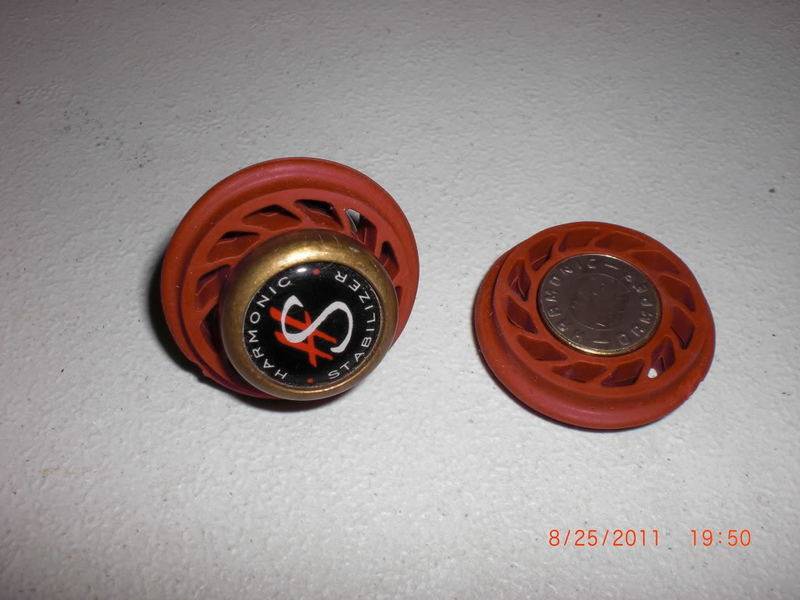
CIMG2169.jpg


The Mathews Harmonic Stabilizer dampens residual bow vibration by 75 percent and significantly improves bow balance and aiming.

what if i were to mount these onto the stock of my rifle? the gun is about twice as heavy as a bow, but it should still make a difference, right? what concerns me is that the bow is uniformly made of aluminum alloy, whereas for the gun, the initial vibrating part is the metal internals, which are held tightly to the wooden stock by screws. would i gain noticeable benfits from this?
 
Last edited by a moderator:
Engineering news on Phys.org
Have you tried benching your air rifle? You should be able to spot accuracy problems that way. You need to be able to divorce any early experience with .22 target programs, because those rimfire rifles have negligible forward recoil {very light firing pins}) and a small but not insignificant rear recoil. Even differences between .22 target loads have to be adjusted for, if you switch, brands, bullet weights, etc.

I was a top cross-country skier in my HS in the '60s and would have loved to have had a biathalon program here.
 
Last edited:
viper2788 said:
what if i were to mount these onto the stock of my rifle? the gun is about twice as heavy as a bow, but it should still make a difference, right? what concerns me is that the bow is uniformly made of aluminum alloy, whereas for the gun, the initial vibrating part is the metal internals, which are held tightly to the wooden stock by screws. would i gain noticeable benfits from this?

I looked at the Mathews website but it doesn't seem to have much real description of how these dampers work. But assuming they do work for bows, the design will probably be accurately "tuned" to match the dynamics of the bow. Whether that was done by a lot of trial and error, computer modelling of the dynamics, or they just got lucky, doesn't really matter.

If you put the same damper on a something with different mass and stiffness, and a different pattens of load against time causing the recoil, most likely it won't do anything useful.
 

Similar threads

  • · Replies 30 ·
2
Replies
30
Views
15K