Has anyone seen this logarithmic spiral creation before?

Click For Summary
SUMMARY

The discussion centers on the mathematical properties of a logarithmic spiral, specifically how it can be approximated using a series of unitary line segments with a deviation angle defined by the harmonic series, γn=2π/n. This method relates to the polar equation r=eθ/2π. The conversation also explores the application of this spiral in a problem involving N mice positioned at the vertices of a regular N-gon, demonstrating that as N approaches infinity, the mice converge in a circular path. The key takeaway is the relationship between the angular harmonic series and the resulting spiral formation.

PREREQUISITES
  • Understanding of polar equations and their applications
  • Familiarity with the harmonic series and its properties
  • Basic knowledge of geometric shapes, specifically regular polygons
  • Concept of convergence in mathematical sequences
NEXT STEPS
  • Research the properties of logarithmic spirals and their equations
  • Explore the applications of the harmonic series in physics and mathematics
  • Study the dynamics of motion in geometric configurations, particularly in relation to N-gon problems
  • Investigate the mathematical implications of convergence in sequences and series
USEFUL FOR

Mathematicians, physicists, and students interested in geometric properties and their applications in real-world scenarios, particularly those exploring motion dynamics and spiral formations.

dave202
Messages
1
Reaction score
1
<Moderator's note: Image added because otherwise the thread might once become unreadable.>

I have reason to believe this could have applications in physics, but right now it's just a mathematical result I came across recently. Either way, I think it is very interesting and fun to look at.

This is my best attempt at explaining it in words:

The curve generated by a series of unitary line segments placed end to end with a deviation angle given by the harmonic series, γn=2π/n, approximates a logarithmic spiral given by the polar equation r=eθ/2π. This “angular harmonic” series (γn=2π/n) is the series of external angles of all regular polygons, where n is the number of sides.

More generally, the deflection angle can be given by any scalar multiple of the harmonic series, i.e. γn=x/n, for any real (or imaginary?) number x. In this general case, the curve approximates a spiral given by the equation r=eθ/x.

Figures:
https://imgur.com/a/ZBAF2
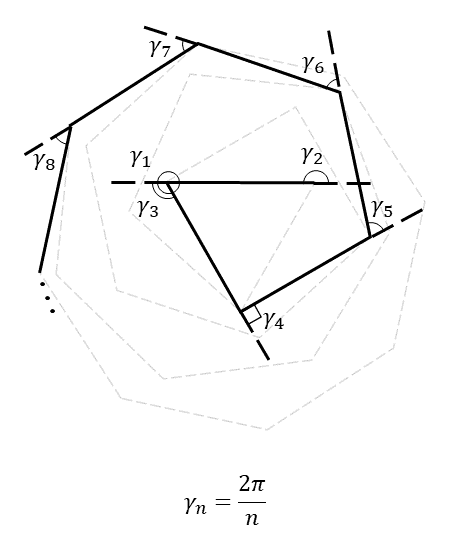
FvNYVkJ.png
 

Attachments

  • FvNYVkJ.png
    FvNYVkJ.png
    8.4 KB · Views: 741
  • Like
Likes   Reactions: Janosh89
Mathematics news on Phys.org
I have seen this spiral as a solution to the following problem.
Imagine N mice on the vertices of a regular N-gon of side ##a##. Each mouse moves straight towards the mouse in front of it at constant speed v. Eventually the mice converge to a point (they are point mice). Find the distance covered by one mouse from start to finish.

If you draw the path of all the mice, you get N spirals of the kind you show. You can also show that in the limit N → ∞, the mice run around in a circle as expected. The secret to solving this problem is to notice that, by symmetry, the shape of the N-gon is preserved which means that the radial velocity of the mice is constant and vr = v*cosθN, where θN is the angle between side ##a## and the radius. You can fill in the rest of the details if you are interested.
 

Similar threads

  • · Replies 14 ·
Replies
14
Views
3K
  • · Replies 2 ·
Replies
2
Views
3K
  • · Replies 3 ·
Replies
3
Views
3K
  • · Replies 12 ·
Replies
12
Views
3K
  • · Replies 13 ·
Replies
13
Views
5K
  • · Replies 25 ·
Replies
25
Views
3K
  • · Replies 1 ·
Replies
1
Views
3K
  • · Replies 1 ·
Replies
1
Views
1K
  • · Replies 125 ·
5
Replies
125
Views
20K
  • · Replies 1 ·
Replies
1
Views
2K