Undergrad Heat Equation: Solve with Non-Homogeneous Boundary Conditions

Click For Summary
The discussion focuses on solving the heat equation for a plane wall with non-homogeneous boundary conditions, specifically involving a wall in contact with two thermal reservoirs. The left boundary is maintained at a constant temperature, while the right boundary involves a convective heat transfer condition. The participants explore the challenges of using separation of variables due to the non-zero boundary conditions and suggest using Laplace transforms as an alternative method. The conversation also touches on the determination of the air temperature, T_air, which is influenced by the heat transfer from the wall. Overall, the complexity of the problem stems from the non-homogeneous nature of the boundary conditions and the need for advanced mathematical techniques to solve it.
erobz
Gold Member
Messages
4,459
Reaction score
1,846
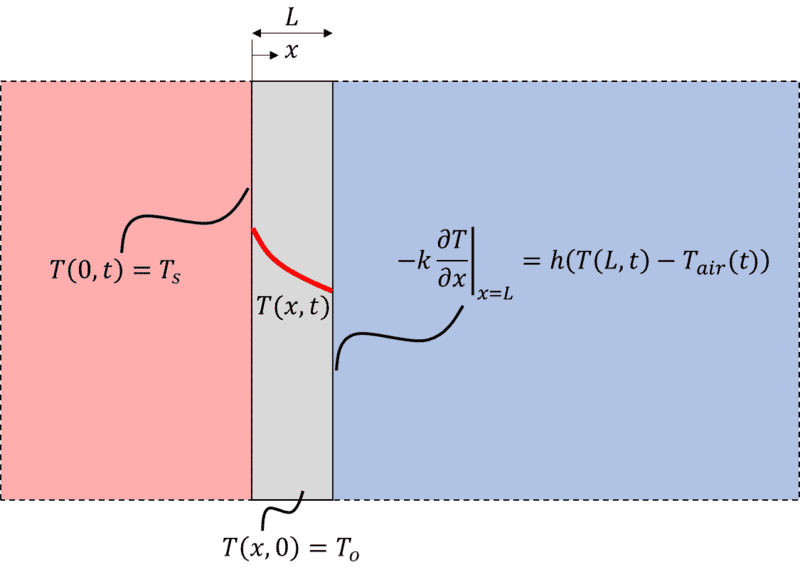
Imagine you have a plane wall with constant thermal conductivity, that is the intermediate between two thermal reservoirs:
1690309465801.png


The reservoir on the left is being kept at temp ##T_s##, and it is a fluid that has very high convective coefficient ##h##. As a result, the boundary condition at the LHS wall is given by:

$$ T(0,t) = T_s $$

at time ##t=0## the wall and the cold reservoir are brought into thermal contact with the warm reservoir. The wall and the blue reservoir are both initially at the same uniform temperature ##T(x,0) = T_o##.

The blue reservoir and the wall start to heat up. The boundary condition on the RHS wall is given by:

$$ -k \left. \frac{\partial T}{ \partial x} \right|_{L} = h \left( T(L,t) - T_{air}(t) \right) $$

The heat equation for the plane wall is given by:

$$ \frac{\partial^2 T}{\partial x ^2} = \rho c_p \frac{\partial T}{\partial t}$$

So we have three non-homogenous boundary conditions, what is the idea to solve the PDE? Apparently, separation of variables does not work because of the non-zero boundary conditions.

The only thing I know (almost nothing) about solving PDE's I've learned from YouTube videos... Why does having non-zero boundary conditions throw a fork in it, and how big of a fork is it?

Thanks for any guidance!
 
Physics news on Phys.org
What do we know about T_{\mathrm{air}}?

Have you tried a Laplace transform in time? That gives <br /> \kappa(p\hat T - T_0) = \frac{\partial^2 \hat T}{\partial x^2} where \kappa= \rho c_p subject to <br /> \hat T(0,p) = \frac{T_s}{p}, \quad \left.-k\frac{\partial \hat T}{\partial x}\right|_{x=L} = h(\hat T(L,p) - \hat T_{air}(p)). That does leave you with <br /> \hat T(x,p) = \frac{T_0}{p} + A(p)\cosh(\sqrt{\kappa p}x) + B(p)\sinh(\sqrt{\kappa p}x) which is not easy to invert.
 
Last edited:
pasmith said:
What do we know about T_{\mathrm{air}}?
It's going to be found via the following ODE:

$$ m_{air} c_{air} \frac{dT_{air}}{dt} = h A ( T(L,t) - T_{air}(t) ) + \dot q \tag{2}$$

The first term on the RHS is basically the boundary condition on the right wall. The ##\dot q ## is just a constant term.
pasmith said:
Have you tried a Laplace transform in time? That gives <br /> \kappa(p\hat T - T_0) = \frac{\partial^2 \hat T}{\partial x^2} where \kappa= \rho c_p subject to <br /> \hat T(0,p) = \frac{T_s}{p}, \quad \left.-k\frac{\partial \hat T}{\partial x}\right|_{x=L} = h(\hat T(L,p) - \hat T_{air}(p)). That does leave you with <br /> \hat T(x,p) = \frac{T_0}{p} + A(p)\cosh(\sqrt{\kappa p}x) + B(p)\sinh(\sqrt{\kappa p}x) which is not easy to invert.
I'm not lying when I said the only thing I know about PDE methods is from YouTube. Heck, I have very little formal understanding of ODE's for that matter. Am I understanding correctly that separation of variables simply does not work. Or is it that it takes extra massaging?

I was hoping that if I could find ##T(x,t) = F(x)G(t)##, then I could use:

$$ \left. \frac{\partial T}{ \partial x} \right|_{x=L} = \left. \frac{\partial F}{ \partial x} \right|_{x=L} G(t) $$

subbing into (2) to get some kind of system.

I'm likely just getting all tangled up in stuff that won't work.
 
Last edited:
pasmith said:
Have you tried a Laplace transform in time? That gives <br /> \kappa(p\hat T - T_0) = \frac{\partial^2 \hat T}{\partial x^2} where \kappa= \rho c_p subject to <br />
<br /> How does this work? I see you have introduced ##p## and the partial w.r.t. time disappears? I’m obviously oblivious to something.
 
Last edited:
pasmith said:
What do we know about T_{\mathrm{air}}?
In this context, ##T_{air}## is considered the bulk air temperature outside the thermal boundary layer.
 
Last edited:

Similar threads

  • · Replies 3 ·
Replies
3
Views
4K
  • · Replies 36 ·
2
Replies
36
Views
5K
  • · Replies 2 ·
Replies
2
Views
2K
  • · Replies 5 ·
Replies
5
Views
3K
  • · Replies 2 ·
Replies
2
Views
3K
  • · Replies 1 ·
Replies
1
Views
3K
  • · Replies 3 ·
Replies
3
Views
3K
  • · Replies 8 ·
Replies
8
Views
3K
  • · Replies 2 ·
Replies
2
Views
3K
  • · Replies 5 ·
Replies
5
Views
2K