DjDriftX
- 2
- 0
I am struggling a bit with this problem:
I have a pipe with a constant surface temperature of 1100F.
I also have a tank which cannot reach a temperature higher than 258F.
I am trying to figure out the minimum distance between the two (in 80F air, which will be moving at a minimum of 5 ft/sec) to keep the tank below 258F.
I remember a little from my previous thermo class, but I haven't taken heat transfer yet.
Im assuming that the pipe to air heat transfer is convective defined by:
\stackrel{.}{Q} = h * A(Tenv - T(t))
However I'm not sure how the heat transfer from the pipe to the air will relate to the heat transfer from the air to the tank.
Any guidance would be really helpfulEDIT:
So i conferred with a fire protection friend who led me to these equations:
http://imgur.com/EvQPF.png
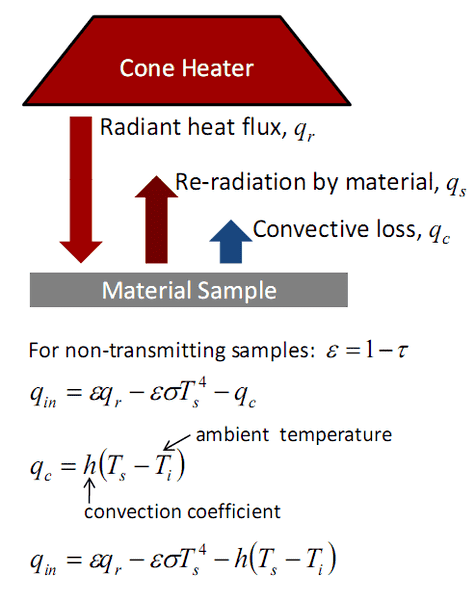
However I'm not sure how to involve the distance between the objects, or if its even possible.Relevant Information
Air (80 Deg F)--------------- 300 K
Thermal Conductivity (k)------0.025 W/(m*K)
Density----------------------1.1839 kg/m^3
Thickness (2in)---------------0.0508 m
R-value----------------------2.032
heat transfer coefficient (h)---50 W/(m2K)
(Range 10 - 100)
Surface Area-----------------0.00064516 m^2
Pipe Surface (1100 Deg F)-----866 K
I have a pipe with a constant surface temperature of 1100F.
I also have a tank which cannot reach a temperature higher than 258F.
I am trying to figure out the minimum distance between the two (in 80F air, which will be moving at a minimum of 5 ft/sec) to keep the tank below 258F.
I remember a little from my previous thermo class, but I haven't taken heat transfer yet.
Im assuming that the pipe to air heat transfer is convective defined by:
\stackrel{.}{Q} = h * A(Tenv - T(t))
However I'm not sure how the heat transfer from the pipe to the air will relate to the heat transfer from the air to the tank.
Any guidance would be really helpfulEDIT:
So i conferred with a fire protection friend who led me to these equations:
http://imgur.com/EvQPF.png
However I'm not sure how to involve the distance between the objects, or if its even possible.Relevant Information
Air (80 Deg F)--------------- 300 K
Thermal Conductivity (k)------0.025 W/(m*K)
Density----------------------1.1839 kg/m^3
Thickness (2in)---------------0.0508 m
R-value----------------------2.032
heat transfer coefficient (h)---50 W/(m2K)
(Range 10 - 100)
Surface Area-----------------0.00064516 m^2
Pipe Surface (1100 Deg F)-----866 K
Last edited: