Help finding instantaneous velocity graphically

Click For Summary
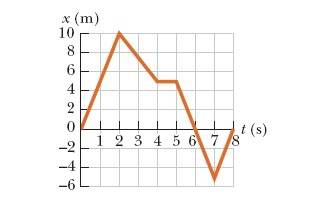
To find instantaneous velocity from a position versus time graph, it's essential to draw the tangent line at the specific time points. For t = 3.00 s, the slope of the tangent line should be calculated using the entire segment from t = 2 s to t = 4 s, rather than just two points. The correct slope will yield the instantaneous velocity, which remains constant if the average velocity does not change over that interval. The participant confirmed that using the entire segment provided the correct answers for the velocities at the specified times. Accurate reading of the graph is crucial for determining the position at t = 3 s.
murrayk91
Messages
2
Reaction score
0
A graph of position versus time for a certain particle moving along the x-axis is shown in the figure below. Find the instantaneous velocity at the following instants.
Untitled22.jpg


(a) t = 1.00 s

(b) t = 3.00 s

(c) t = 4.50 s

(d) t = 7.50 s

I know that a) is 5 m/s and c) is 0 m/s, but I need help figuring out b) and d). I don't understand how to draw the tangent line to find the instantaneous velocity.

For 3.00 s the answers I've come up with are wrong. I though using the slope of two points on the line, (7-10)/(3-2) should give me the answer. Any help?
 
Last edited:
Physics news on Phys.org
murrayk91 said:
A graph of position versus time for a certain particle moving along the x-axis is shown in the figure below. Find the instantaneous velocity at the following instants.
Untitled22.jpg


(a) t = 1.00 s

(b) t = 3.00 s

(c) t = 4.50 s

(d) t = 7.50 s

I know that a) is 5 m/s and c) is 0 m/s, but I need help figuring out b) and d). I don't understand how to draw the tangent line to find the instantaneous velocity.

For 3.00 s the answers I've come up with are wrong. I though using the slope of two points on the line, (7-10)/(3-2) should give me the answer. Any help?
Since each of those times corresponds to a position at which the graph is a straight-line segment, and not where two segments meet, the slope of the tangent line is equal to the slope of the line segment.

You have the right idea with (7-10)/(3-2), it's just that the position at t = 3 s, is a bit in excess of 7 m. Use the whole segment from t = 2s to t = 4 s.
 
When the average velocity doesn't change over a certain period of time, the instantaneous velocity is going to be the same.

It's like trying to find the average grade of five students who all got a 95 on the test
 
Thanks so much! I didn't realize I should take the slope of the whole line. I worked them out and they're correct.
 
Good!

If you use the slope you got and go back to find what x is at t=3s, I think you'll find that x = 7.5m. It's hard to read the graph that accurately.
 
The book claims the answer is that all the magnitudes are the same because "the gravitational force on the penguin is the same". I'm having trouble understanding this. I thought the buoyant force was equal to the weight of the fluid displaced. Weight depends on mass which depends on density. Therefore, due to the differing densities the buoyant force will be different in each case? Is this incorrect?

Similar threads

  • · Replies 9 ·
Replies
9
Views
1K
Replies
5
Views
2K
Replies
7
Views
3K
  • · Replies 23 ·
Replies
23
Views
5K
  • · Replies 20 ·
Replies
20
Views
3K
  • · Replies 15 ·
Replies
15
Views
3K
  • · Replies 5 ·
Replies
5
Views
3K
  • · Replies 6 ·
Replies
6
Views
1K
  • · Replies 8 ·
Replies
8
Views
6K
  • · Replies 16 ·
Replies
16
Views
1K