High School Help Interpreting SR Animation: Human-Scale Story

  • Thread starter Thread starter Grinkle
  • Start date Start date
  • Tags Tags
    Animation Sr
Click For Summary
The discussion centers on interpreting a Minkowski diagram animation that illustrates events moving in and out of an observer's past light cone. Participants clarify that events do not actually leave the past light cone or re-enter the future light cone once they have passed through, as these properties are invariant across reference frames. The animation is noted to be confusing but educational, as it depicts how events appear to change position relative to the observer's momentarily comoving inertial frame. There is a consensus that while events can appear to enter the past light cone as the observer moves along their worldline, they do not actually move back out once they have entered. Overall, the conversation emphasizes the importance of understanding light cones and reference frames in the context of spacetime diagrams.
Grinkle
Gold Member
Messages
822
Reaction score
240
TL;DR
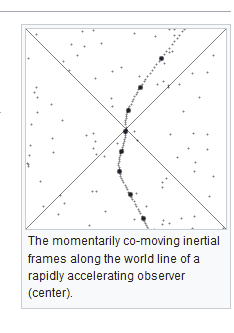
This animation shows events moving in and out of an observers past light cone. I am not sure how to interpret that.
At the very bottom of this page -

https://en.wikipedia.org/wiki/Minkowski_diagram

is the below animation. My understanding is that events in the lower triangle are events that can have had an influence on my present, they are in my past-lightcone. I understand that events must move in and out of my past and future light cones as I change my reference frame. I am not sure how interpret an event that was not previously in my past light cone moving into my past light cone and then moving back out of my past light cone.
Can someone offer a human-scale story to describe such an event? EG - I am traveling along in my rocket ship ... etc.
1598482705165.png
 
Physics news on Phys.org
My best attempt -

Any single snapshot of the future cone allows the spacetime graph analyst to assess how long the observer needs to stay within the snapshot reference frame in order to observe the future event.

Any single snapshot of the past cone allows the spacetime graph analyst to assess how long the observer needed to have been in the snapshot reference frame for that event to have actually been observed.

As a streaming animation, its fun to look at but doesn't really tell the spacetime graph analyst much unless it is combined with full information on the acceleration profile, future and past.
 
Grinkle said:
Summary:: This animation shows events moving in and out of an observers past light cone. I am not sure how to interpret that.

I am not sure how interpret an event that was not previously in my past light cone moving into my past light cone and then moving back out of my past light cone
Does that happen? I couldn’t see any, but it is hard to watch
 
Dale said:
Does that happen?

I can definitely see events entering the past cone, I am not sure I can see any events leaving the past cone, now that you mention it.
 
Grinkle said:
I understand that events must move in and out of my past and future light cones as I change my reference frame.

No, they don't. The light cones at any given event are invariant; they are the same in all frames.

What is true that, if you consider an event B on your worldline that is to the future of another event A, B's past light cone will be a superset of A's past light cone (i.e., all events in A's past light cone are in B's, but not vice versa), and A's future light cone will be a superset of B's future light cone. So in that sense events might be said to move into your past light cone, and other events might be said to move out of your future light cone, as you "move" along your worldline. But "moving" along your worldline is not the same as changing your reference frame.
 
  • Like
Likes Grinkle
Grinkle said:
I am not sure I can see any events leaving the past cone, now that you mention it.

They don't, if we are talking about any particular observer's worldline. See my previous post just now.
 
DrGreg said:
For convenience, here is the animation.
And as we can see, the worldline of the observer in question looks rather like the GPS track resulting from my first attempt to navigate a boat by compass in a dense fog. This isn’t inertial motion, and it isn’t an example of the constant acceleration that makes Rindler coordinates easy to work with.

The animation isn’t even drawn using the egregiously non-inertial coordinates in which our observer is at rest. In fact, it’s not drawn using any coordinate system at all (because events are moving around). It’s plotting every interesting event (the dots flying around, every point on the observer’s worldline, every point on the lightlike edges of the observer’s past and future light cones) using the observer’s momentarily comoving inertial frame - and then as that frame changes, showing the effect of the change by moving everything else around to its new coordinate position. That’s why the observer is fixed at the center and the light cone lines don’t move - those events always have the same coordinates in the various MCIFs. Conversely, as the MCIF changes, so do the coordinates of all the events represented by the dots, and the motion of the dots shows the coordinate changes.

This might be the most confusing spacetime diagram I’ve ever seen... but I have to admit that figuring what it’s really showing is somewhat educational.
 
Grinkle said:
I can definitely see events entering the past cone, I am not sure I can see any events leaving the past cone, now that you mention it.
Having looked at it three times now I am pretty sure that no event ever goes backwards through the light cones. That is correct. Each subsequent past light cone contains the previous.
 
  • #10
Nugatory said:
it’s not drawn using any coordinate system at all

Not a single one, no. I agree that what is being done is what you describe: as each event on the observer worldline passes through the center (simulating the observer "moving" along the worldline, from the observer's "point of view"--they stay "in the same place" while the worldline, and spacetime with it, "moves" past them from future to past), the coordinate system is shifted to be the momentarily comoving inertial frame of the observer at that event.
 
  • #11
Dale said:
Having looked at it three times now I am pretty sure that no event ever goes backwards through the light cones.

Both light cones (future and past), yes. No event ever re-enters the future light cone once it leaves it, and no event ever leaves the past light cone once it enters it. Both of these properties are in accordance with the physics.
 
  • #12
PeterDonis said:
"moving" along your worldline is not the same as changing your reference frame.

Does accelerating change an observers inertial reference frame? I have always thought that by definition that is so.
 
  • #13
Grinkle said:
Does accelerating change an observers inertial reference frame?

There is no such thing as "an observer's inertial reference frame". Anyone can use whatever inertial frame they want.

Accelerating does change which inertial frame an observer is momentarily at rest in, but there is no requirement that an observer must use an inertial frame they are momentarily at rest in. Inertial frames are human constructs used for calculations and models.
 
  • Like
Likes cianfa72, vanhees71 and Dale

Similar threads

  • · Replies 8 ·
Replies
8
Views
2K
  • · Replies 3 ·
Replies
3
Views
2K
  • · Replies 20 ·
Replies
20
Views
3K
  • · Replies 6 ·
Replies
6
Views
1K
  • · Replies 20 ·
Replies
20
Views
2K
  • · Replies 40 ·
2
Replies
40
Views
5K
  • · Replies 6 ·
Replies
6
Views
3K
  • · Replies 17 ·
Replies
17
Views
3K
  • · Replies 2 ·
Replies
2
Views
1K
  • · Replies 40 ·
2
Replies
40
Views
4K