Help solving Conditioning problem

  • Context:
  • Thread starter Thread starter natalia
  • Start date Start date
Join the discussion
Registration is free. Ask a follow-up in this thread, or start your own.
4 replies · 2K views
natalia
Messages
6
Reaction score
0
Hi,
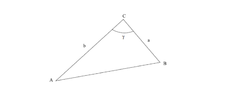
I have the following problem : Area of a triangle is given by S = 1/2 ab sin(γ) (See figure).
Discuss numeric conditioning of S. Any tips appreciated :D
View attachment 2493
 

Attachments

  • triangle.png
    triangle.png
    2.8 KB · Views: 117
Physics news on Phys.org
natalia said:
Hi,
I have the following problem : Area of a triangle is given by S = 1/2 ab sin(γ) (See figure).
Discuss numeric conditioning of S. Any tips appreciated :D
https://www.physicsforums.com/attachments/2493

Hi natalia! ;)

I'm not quite sure what is intended with numeric conditioning...
Can you clarify?

What I can imagine is that we'd like to know how errors in $a, b, γ$ propagate.
The general formula for the absolute error is:
$$\Delta y \approx \frac{dy}{dx} \Delta x$$
For the relative error (as you might deduce) it is:
$$\frac{\Delta y}{y} \approx \frac x y \frac{dy}{dx} \frac{\Delta x} x$$

In your problem you would get:
For the contribution of $\Delta a$: $\frac{\Delta S}S = \frac{\Delta a}a$
For the contribution of $\Delta b$: $\frac{\Delta S}S = \frac{\Delta b}b$
For the contribution of $\Delta γ$: $\Delta S = \frac 1 2 a b \cos γ \Delta γ$
 
Yes, it refers to amplification of the relative error.
 
natalia said:
Yes, it refers to amplification of the relative error.

Aha! :D

Then, to complete it, we have for $Δγ$:

$$\frac{ΔS}{S}
= \frac{\frac 12 ab \cos γΔγ}{\frac 12 ab \sin γ}
= γ\cot γ \cdot \frac{Δγ}{γ}
$$

For small angles $γ$ this is approximately $\frac{Δγ}{γ}$.
 
Thank you again, I like Serena :)