Help with Geometry of Vectors Questions

  • Context: MHB 
  • Thread starter Thread starter Guest2
  • Start date Start date
  • Tags Tags
    Geometry Vectors
Click For Summary
SUMMARY

The forum discussion focuses on solving geometry problems involving vectors, specifically the perpendicular bisector of a line segment, cross products, and vector equations of planes. Key calculations include finding the midpoint of points A and B, determining the normal vector, and using the cross product to find the area of a triangle formed by vectors. The answers to the problems are derived using established vector operations, with specific answers provided for parts (i) through (v).

PREREQUISITES
  • Understanding of vector operations, including cross products and dot products.
  • Familiarity with the geometric interpretation of vectors in three-dimensional space.
  • Knowledge of the equation of a plane in vector form.
  • Ability to calculate midpoints and direction vectors between points.
NEXT STEPS
  • Study the properties of the cross product and its applications in geometry.
  • Learn how to derive the equation of a plane given a point and a normal vector.
  • Explore the concept of vector projections and their geometric significance.
  • Investigate the relationship between vectors and geometric shapes, such as triangles and parallelograms.
USEFUL FOR

Students and educators in mathematics, particularly those focusing on geometry and vector calculus, as well as anyone preparing for exams involving vector analysis.

Guest2
Messages
192
Reaction score
0
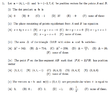
View attachment 5379

I would appreciate any help with this questions because I truly horrid at geometry questions.

I've only done (i) to which I've found the answer to be (E). I can't do from from part (ii) on.
 

Attachments

  • Screen Shot 2016-03-10 at 20.54.57.png
    Screen Shot 2016-03-10 at 20.54.57.png
    43.2 KB · Views: 107
Mathematics news on Phys.org
A couple of hints to get you started:

For (ii), this plane is the perpendicular bisector of the line $AB$.

For (iii), use the cross product $\mathbf{a} \times \mathbf{b}$. This has magnitude $|\mathbf{a}|\,|\mathbf{b}|\sin\theta$, where $\theta$ is the angle between $OA$ and $OB$.
 
Opalg said:
A couple of hints to get you started:

For (ii), this plane is the perpendicular bisector of the line $AB$.

For (iii), use the cross product $\mathbf{a} \times \mathbf{b}$. This has magnitude $|\mathbf{a}|\,|\mathbf{b}|\sin\theta$, where $\theta$ is the angle between $OA$ and $OB$.
Thank you.

The midpoint between the two points will be a point on the plane. This point is $\left(\frac{4-2}{2}, \frac{1+7}{2}, \frac{4-2}{2} \right) = (1,4,1)$.

The direction vector between the two points, which is also a normal to the plane, is $(-2-4, 7-1, 4+6) = (-6, 6, 6)$

The general equation for a plane is $\mathbf{n} \cdot <x-x_0, y-y_0, z-z_0> =0 $, we have $\mathbf{n} = (-6,6,6)$ and $(x_0, y_0, z_0) =(1,4,1)$

So we have $<1,4,1><-6, 6, 6> = 0 \implies x-y-z = -4$ and so the answer is (B).

I just have a question that's due to my ignorance. I calculated the direction vector as the difference $\mathbf{b}-\mathbf{a}$. But how do we know which to subtract from which vector when finding the direction vector? I imagine I would have got a different answer if I calculated the direction vector as $\mathbf{a}-\mathbf{b}$.
 
For (iii) we have $\mathbf{a} \times \mathbf{b} = (18, -12, 30) \implies ||\mathbf{a} \times \mathbf{b}|| = \sqrt{1368} \implies \frac{1}{2}||\mathbf{a} \times \mathbf{b}|| = \sqrt{342} \implies \triangle ^2 = 342$.

The reason being the area of the triangle is half the area of the parallelogram formed which is $||\mathbf{a} \times \mathbf{b}||$. (Happy)

So the answer to $(iii)$ is $(A)$. If anyone could give me a hint or suggestion for part $(iv)$ I'd appreciate it.
 
For $(v)$ we have $ (\mathbf{a}-\mathbf{b}) \cdot \mathbf{w}(t) = 0 \implies <6,-6,-6><2, t, 1> = 0\implies 6t = 6 \implies t = 1$, so the answer to (v) is $(C)$.

For $(iv)$ let $P = (a, b, c)$ now $|PA| = 2|PB| \iff [(4,1,2)-(a, b, c)] = 2[(-2,7,4) -(a, b, c)] \iff (a, b, c) = (-8, 13, 10).$

So is the answer to $(iv) ~(F)$ none of these, or am I getting something wrong (more likely)? Only this remains now! (Happy)
 
Last edited:
Guest said:
For $(v)$ we have $ (\mathbf{a}-\mathbf{b}) \cdot \mathbf{w}(t) = 0 \implies <6,-6,-6><2, t, 1> = 0\implies 6t = 6 \implies t = 1$, so the answer to (v) is $(C)$.

For $(iv)$ let $P = (a, b, c)$ now $|PA| = 2|PB| \iff [(4,1,2)-(a, b, c)] = 2[(-2,7,4) -(a, b, c)] \iff (a, b, c) = (-8, 13, 10).$

So is the answer to $(iv) ~(F)$ none of these, or am I getting something wrong (more likely)? Only this remains now! (Happy)
For (iv), $P$ is two-thirds of the way from $A$ to $B$. So its position vector will be $\frac23\mathbf{b} + \frac13\mathbf{a}.$ Your answer $(-8,13,10)$ satisfies the condition $|PA| = 2|PB|$, but it does not lie on the line segment $AB$. In fact is lies beyond $B$, in the opposite direction from $A$.
 
Part (i) should be easy; 4(-2) + 1(7) + -2(4) = -9.
 

Similar threads

  • · Replies 6 ·
Replies
6
Views
2K
Replies
1
Views
1K
Replies
1
Views
2K
  • · Replies 8 ·
Replies
8
Views
3K
  • · Replies 14 ·
Replies
14
Views
3K
  • · Replies 1 ·
Replies
1
Views
2K
  • · Replies 17 ·
Replies
17
Views
2K
  • · Replies 12 ·
Replies
12
Views
2K
  • · Replies 12 ·
Replies
12
Views
3K
  • · Replies 10 ·
Replies
10
Views
2K