Help with Magnetic Clutch design

Click For Summary
SUMMARY

The forum discussion focuses on designing a magnetic clutch with adjustable break-away force by manipulating the air gap between diametric magnets. Key insights reveal that while N52 neodymium magnets exhibit higher flux density, N28 magnets can generate greater force at a given distance, challenging the assumption that stronger magnets always yield better performance. To enhance torque, it is recommended to complete the magnetic circuit with iron segments and ensure the magnet mount is non-magnetic. Additionally, using a spacer like paper can improve gap control and reduce slip under varying loads.

PREREQUISITES
  • Understanding of magnetic properties, specifically flux density and field strength.
  • Familiarity with neodymium magnet grades, particularly N28 and N52.
  • Knowledge of magnetic circuit design and its impact on torque.
  • Experience with materials that influence magnetic performance, such as iron and non-magnetic mounts.
NEXT STEPS
  • Research the impact of magnetic circuit completion on torque enhancement.
  • Explore the properties and applications of N28 and N52 neodymium magnets.
  • Investigate the use of non-magnetic materials in magnetic clutch designs.
  • Learn about the effects of air gaps and spacers on magnetic coupling efficiency.
USEFUL FOR

Engineers, product designers, and hobbyists involved in magnetic clutch design and optimization, particularly those interested in enhancing torque and performance through material and design choices.

LilEngineer
Messages
1
Reaction score
0
I'm just designing a simple magnetic clutch that i can can alter the Break-away force by changing the air gap between the two diametric magnets.

I guess I'm having a hard time understanding the practical difference between flux density, field strength and Force at a given distance of magnets… and how i apply the figures to my design.

As far as i understand, the flux density is measured from the cross sectional area through the magnet, and so an N52 will have a higher flux density than an N28 for neodymium magnets… but this is just relevant inside if the magnet.

However, when i look at data sheets for these magnets, the N28 appears to generate a greater force Fr for a given distance S than an Equivalent N52 magnet.

So if i want the strongest magnetic coupling and so the highest Break-away toque, am i right in saying that i should use N28 magnets?

thanks
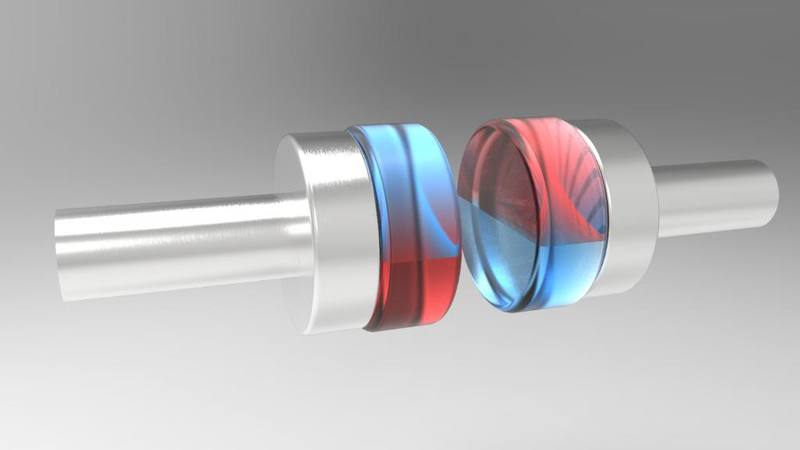
MagCouple_zpsd2b415a5.jpg
 
Engineering news on Phys.org
Welcome.
Using N28 magnets, if you can still get them, will not give the strongest break-away torque.

The best way to improve torque will be to complete the magnetic circuit by placing two iron segments outside each magnet. That magnetic path will prevent saturation of the contacting surface, increase the radius and so the torque.

It is also important that the magnet mount be non-magnetic. That way the flux will flow through the coupling and not through the mount.

Rather than an air gap between the magnets you might consider a spacer such as paper or card. That will give better control of the gap. When not broken, the magnetic clutch will have a significant rotational phase difference for small loads. The friction component of paper may also be an advantage there as it will reduce slip of the magnet faces under low varying loads.
 

Similar threads

  • · Replies 5 ·
Replies
5
Views
2K
  • · Replies 24 ·
Replies
24
Views
2K
  • · Replies 6 ·
Replies
6
Views
2K
  • · Replies 7 ·
Replies
7
Views
2K
  • · Replies 2 ·
Replies
2
Views
2K
  • · Replies 27 ·
Replies
27
Views
3K
  • · Replies 10 ·
Replies
10
Views
2K
  • · Replies 6 ·
Replies
6
Views
2K
  • · Replies 12 ·
Replies
12
Views
4K