Help with triple piston circuit

  • Context: Engineering 
  • Thread starter Thread starter Noob of the Maths
  • Start date Start date
  • Tags Tags
    Circuit Piston
Click For Summary

Discussion Overview

The discussion revolves around the design and implementation of a simultaneous circuit for three pistons using ladder language in a PLC context. Participants explore the operational sequence of the pistons, their expansion and retraction mechanisms, and the challenges faced in achieving the desired cyclic operation.

Discussion Character

  • Technical explanation
  • Debate/contested
  • Homework-related
  • Mathematical reasoning

Main Points Raised

  • One participant describes the requirement for the pistons to expand sequentially from A to C and then retract in the same order, but notes issues with piston C not fully retracting.
  • Another participant points out a conceptual misunderstanding, clarifying that pistons do not expand or retract by themselves but are moved by mechanical components like cranks and connecting rods.
  • There is a discussion about the need for a logical state management system to control the sequence of piston movements, including the possibility of a continuous cycle versus a one-time sequence.
  • A participant proposes a symbolic representation of the control signals needed for extending and retracting the pistons, outlining the phases of operation and the necessary limit switches.
  • Concerns are raised about system behavior during power loss and the implications for the control states upon restart.

Areas of Agreement / Disagreement

Participants express differing views on the mechanics of piston operation and the appropriate control logic. There is no consensus on the best approach to implement the ladder logic or resolve the issues with the pistons' movement.

Contextual Notes

Participants acknowledge limitations in their understanding of ladder language and the specific mechanics involved in the operation of the pistons, which may affect their proposed solutions.

Who May Find This Useful

This discussion may be useful for students and practitioners interested in PLC programming, pneumatic or hydraulic systems, and those facing similar challenges in circuit design and control logic.

Noob of the Maths
Messages
52
Reaction score
6
Homework Statement
cyclic
Relevant Equations
ladder lenguage
HI! everyone :)

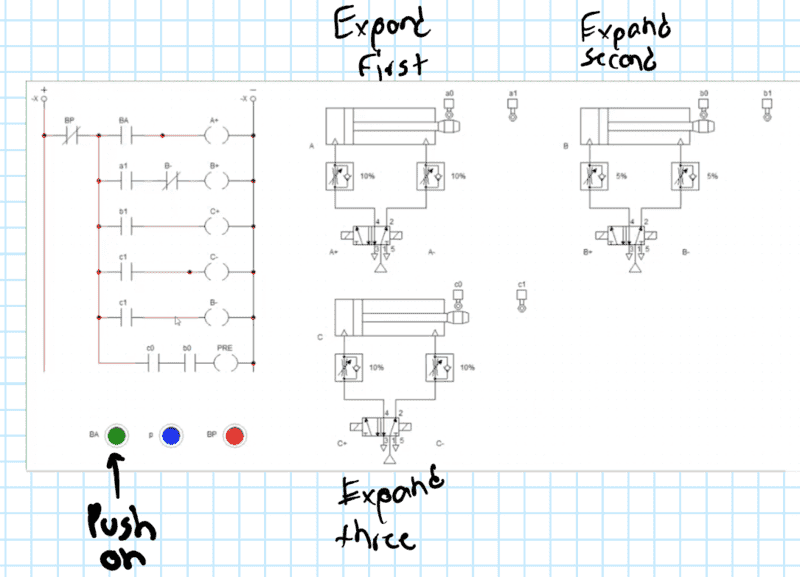
in today's electronics class the teacher asked us to make a simultaneous circuit of 3 pistons, with ladder language.

What am I supposed to do:
Upon energizing the circuit, they should expand one piston after the other; from A to C.

When piston C expands, it should return to its position by itself, and consecutively B and A in the same way.

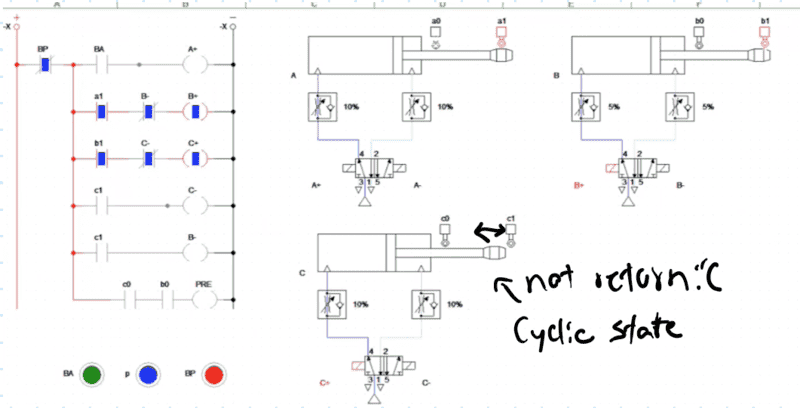
At first the circuit works by expanding, but when piston C retracts, it does not contract completely and returns to its position again and again. The circuit is in a cyclic state of no return.
Captura de Pantalla 2021-10-26 a la(s) 17.33.09.png
Captura de Pantalla 2021-10-26 a la(s) 17.33.13.png

Thanks for read:)
 
Physics news on Phys.org
There seems to be some very fuzzy thinking in the problem statement. Pistons do not expand; cylinder volumes do expand. Pistons do not return to the max volume condition by themselves; they are dragged there by the action of the crank and connecting rod. This looks like a case of confusion by analogy.
 
Noob of the Maths said:
Homework Statement:: cyclic
Relevant Equations:: ladder lenguage

in today's electronics class the teacher asked us to make a simultaneous circuit of 3 pistons, with ladder language.

What am I supposed to do:
Upon energizing the circuit, they should expand one piston after the other; from A to C.
Am I missing seeing your ladder language solution? I'm not very familiar with ladder language control of PLCs, but maybe you have shown your work in the figures somewhere?
 
Dr.D said:
There seems to be some very fuzzy thinking in the problem statement. Pistons do not expand; cylinder volumes do expand. Pistons do not return to the max volume condition by themselves; they are dragged there by the action of the crank and connecting rod. This looks like a case of confusion by analogy.
Yes, I think it is a bit confusing.

The circuit is energized, then the pistons come out of the cylinder until they activate the sensors ahead of them. They come out one after the other, from A to C. However, piston C does not return to the cylinder, because it remains in a cyclic state; therefore, pistons A and B do not return either.
 
You speak of pistons coming out of cylinders and also returning to the cylinders, but in a real engine, the pistons always remain in the cylinders. The pistons move from one extreme position in the cylinder to a second extreme position (again, in the cylinder). What causes your piston to cycle unless you model the action of the crank and connecting rods?
 
Dr.D said:
You speak of pistons coming out of cylinders and also returning to the cylinders, but in a real engine, the pistons always remain in the cylinders. The pistons move from one extreme position in the cylinder to a second extreme position (again, in the cylinder). What causes your piston to cycle unless you model the action of the crank and connecting rods?
Yes, I understand that the piston does not come out of the cylinder. It just moves from position to position, language error.

The green button allows the pistons to reach their expansion position in the cylinder, but as I could not get them to return automatically, I put a new coil related to the blue button to press it and return them to the original position.
 
berkeman said:
Am I missing seeing your ladder language solution? I'm not very familiar with ladder language control of PLCs, but maybe you have shown your work in the figures somewhere?
Its not really a solution, coils and interrupters are related by name literally
 
Do you want to exercise A, B, C then stop, or do you want a continuous repeating cycle ABCAB... ?
You will need to remember the last logical state, so you can steer the next activity. That needs three logical states.
If it is a once only sequence you will also need a logical “idle state” that prevents C repeating, while waiting for a trigger, that will enable A.
 
Baluncore said:
Do you want to exercise A, B, C then stop, or do you want a continuous repeating cycle ABCAB... ?
You will need to remember the last logical state, so you can steer the next activity. That needs three logical states.
If it is a once only sequence you will also need a logical “idle state” that prevents C repeating, while waiting for a trigger, that will enable A.
When A is in the maximum position to the right, it activates the sensor "a1", which in turn activates "B-". Thanks to this, piston B moves to the right, activating sensor "b1" and allowing piston C to move.

The movement of the piston allows to activate the sensor of the next piston allowing it to move.

When all 3 pistons are in the maximum outward position, piston C returns to its original state, activating sensor "c0". This allows sensors B and A to contract.

It is a cycle: A expands and activates B, B activates C.
C contracts and deactivates B, B deactivates A.
 
  • #10
We have three hydraulic or pneumatic cylinders. A, B and C.
What follows is hopefully a symbolic way to define and think about the problem.
I leave it to you to find my errors and draw up the ladder diagram.
language warning: I confuse; Off, reset, 0 and false. Also; On, set, 1, true and asserted.

Note that only one thing will actually be happening at the time.

We define the six control signals that will extend or retract each cylinder.
Those signals must occur in the following phases and order, then repeat cyclically.
Extension phase.
Xa extends A.
Xb extends B.
Xc extends C.
Retraction phase.
Rc retracts C.
Rb retracts B.
Ra retracts A.

We have six limit switches that are true when a cylinder is at the 'r' or 'x' limit.
Ar when A is retracted.
Ax when A is extended.
Br when B is retracted.
Bx when B is extended.
Cr when C is retracted.
Cx when C is extended.

Now we invent a direction bit, an RS flip-flop or latch called D, with it's invert ND.
The state of D controls the direction phase of all cylinders.
While in extension phase, D is on; ND is off.
While in retraction phase, D is off; ND is on.
There are only two turning points where the phase of D, ND changes.
D is set true, ND false, by momentary limit switch Ar.
D is reset to false, ND true, by momentary limit switch Cx.

The equations that determine the control signals are then as follows.
They are asynchronous, but listed here in the order they will be asserted.
Ax = Br & Cr & D;
Bx = Ax & Cr & D;
Cx = Ax & Bx & D;
Cr = Ax & Bx & ND;
Br = Ax & Cr & ND;
Ar = Br & Cr & ND;

I think that does it, except for the perennial questions.
What will happen if power is lost and then returns ?
Think also the state of D at restart ?
How can you reverse direction during testing or service ?
How can the system be started after construction or maintenance ?
 
  • Like
Likes   Reactions: Tom.G

Similar threads

  • · Replies 2 ·
Replies
2
Views
9K
  • · Replies 5 ·
Replies
5
Views
2K
  • · Replies 4 ·
Replies
4
Views
2K
  • · Replies 19 ·
Replies
19
Views
798
  • · Replies 26 ·
Replies
26
Views
7K
Replies
14
Views
750
  • · Replies 2 ·
Replies
2
Views
3K
  • · Replies 12 ·
Replies
12
Views
2K
  • · Replies 3 ·
Replies
3
Views
6K
  • · Replies 9 ·
Replies
9
Views
4K