Help With Understanding Resultant Forces By Connecting Vectors

tomtomtom1
Messages
160
Reaction score
8
Homework Statement
Using Resultant Forces By Connecting Vectors Head To Tail
Relevant Equations
NA
Hi all

I am trying to get my head around resultant forces.

I am happy that if I have a vector diagram with 2 forces I can work out graphically the resultant forces by connecting the head of one of the vectors to the tail of the second vector.

The confusion comes in when I have 3 or more vectors, for example the vector diagram has 3 forces and I am trying to figure our the resultant for graphically.
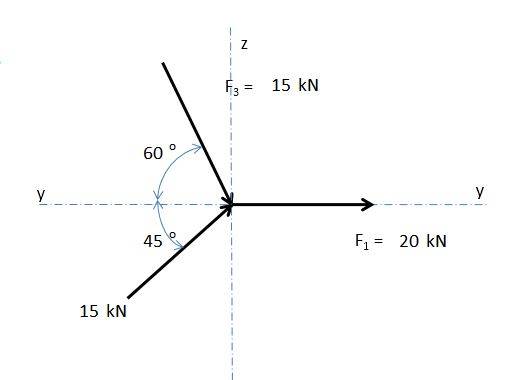
vectors.JPG


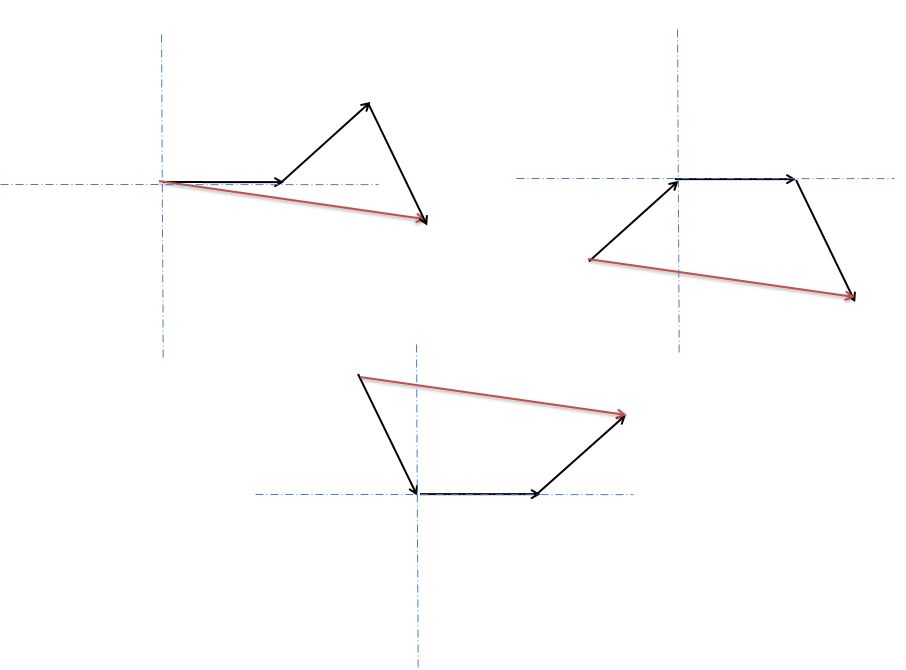
My resultant force changes depending on the order I connected the 3 vectors, the different shapes I get when I connect the vectors is as follows:-
vectorsssssss.JPG


Is there a set convention that is used when connecting vectors head to tail to determine the resultant?

Can you help?

Thank you.
 
Physics news on Phys.org
Welcome to PF.

tomtomtom1 said:
Homework Statement: Using Resultant Forces By Connecting Vectors Head To Tail
Homework Equations: NA

Hi all

I am trying to get my head around resultant forces.

My resultant force changes depending on the order I connected the 3 vectors, the different shapes I get when I connect the vectors is as follows:-View attachment 251675

Is there a set convention that is used when connecting vectors head to tail to determine the resultant?

Can you help?

Thank you.
Actually, you get the same resultant vector no matter which order you add the vectors. Your resultant is the red vector. For the three cases in your figure, the red vectors are all equal to one another.

1571793021973.png
The red vectors have the same magnitude and the same direction.
 
What matters is the length and direction of the resultant. Not where it starts and ends.

Always put the tail of the first vector at the origin if you want to avoid ambiguity and have the end point of the resultant give you the components. As you have not done this, this seems to be the source of your confusion.
 
Hi all

Thank you for your help.All the vectors I drew were all the same I just did not realize it so thank you for clearing up the confusion.I was able to work out the magnatuide & direction of the resultant force but I wanted to ask a follow on question which is given that I started with the diagram:-

vectors.JPG


If we assume that these forces were acting on an object and the resultant force is:-

resultant.JPG


Then would I be correct in thinking that after the forces are applied the object would move along the red arrows (my resultant force)?

Is this correct?

Thanks
 
tomtomtom1 said:
Then would I be correct in thinking that after the forces are applied the object would move along the red arrows (my resultant force)?

Is this correct?
If the object is initially at rest and the three given forces are the only forces acting on the object, then the object would begin moving in the direction of the resultant force. If the forces remain constant, then the object would continue to move in that direction with constant acceleration.

[To be picky, this assumes that you are working in an inertial reference frame. But, that would be the natural assumption.]
 
  • Like
Likes WWGD
thanks
 

Similar threads

Replies
14
Views
2K
  • · Replies 18 ·
Replies
18
Views
1K
  • · Replies 21 ·
Replies
21
Views
1K
  • · Replies 12 ·
Replies
12
Views
976
Replies
1
Views
1K
Replies
8
Views
1K
  • · Replies 3 ·
Replies
3
Views
1K
  • · Replies 5 ·
Replies
5
Views
2K
Replies
4
Views
842
  • · Replies 9 ·
Replies
9
Views
2K