SUMMARY
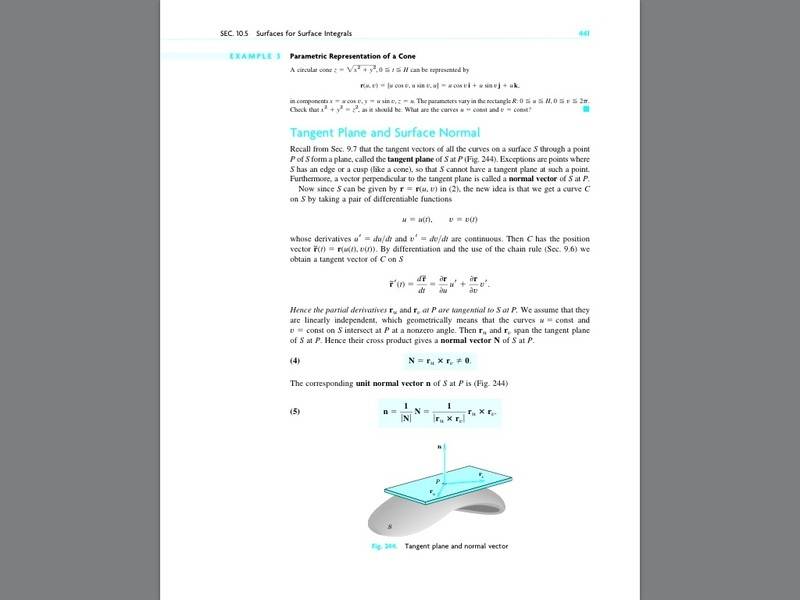
The discussion centers on the concept of partial derivatives ru and rv in the context of a parametrized surface defined by the position function r = r(u, v). It is established that varying u or v independently results in movement along the surface, making the partial derivatives tangential to the surface at point P. The relationship between the partial derivatives and the tangent plane is clarified through the vector cross product, which yields a normal vector to the tangent plane at P. This understanding is crucial for visualizing how surfaces behave in multivariable calculus.
PREREQUISITES
- Understanding of multivariable calculus concepts, specifically partial derivatives.
- Familiarity with parametrization of surfaces in three-dimensional space.
- Knowledge of vector calculus, including cross products and normal vectors.
- Basic comprehension of tangent planes and their geometric significance.
NEXT STEPS
- Study the concept of parametrization of surfaces in depth, focusing on examples of r = r(u, v).
- Learn about the geometric interpretation of partial derivatives and their role in defining tangent planes.
- Explore vector calculus techniques, particularly the computation of cross products and their applications.
- Investigate the implications of tangent vectors and normal vectors in higher-dimensional calculus.
USEFUL FOR
Students and professionals in mathematics, particularly those studying multivariable calculus, as well as educators seeking to clarify the geometric interpretation of partial derivatives and tangent planes.