Not sure what square brackets indicate when dealing with partial derivates

  • Context: Undergrad 
  • Thread starter Thread starter Kushwoho44
  • Start date Start date
  • Tags Tags
    Partial Square
Click For Summary
SUMMARY

The discussion clarifies the use of square brackets in the context of partial derivatives, specifically regarding the notation ∇φ[r(t)]. It establishes that ∇φ represents the gradient of the scalar function φ, which involves taking partial derivatives with respect to each coordinate axis. The notation φ[vec{r}(t)] indicates that φ is a function of vec{r}, which is parameterized by t. The square brackets are used to avoid confusion with parentheses already in use for vec{r}(t), and there is no difference in meaning between using square brackets and parentheses.

PREREQUISITES
  • Understanding of gradient notation in vector calculus
  • Familiarity with scalar functions and their partial derivatives
  • Knowledge of parameterization in mathematical functions
  • Basic comprehension of vector functions and their representations
NEXT STEPS
  • Study the concept of gradients in vector calculus
  • Learn about parameterization of curves and their implications
  • Explore the differences between various notations in mathematical expressions
  • Investigate the applications of partial derivatives in physics and engineering
USEFUL FOR

Students and professionals in mathematics, physics, and engineering who are working with vector calculus and need clarity on notation involving partial derivatives and gradients.

Kushwoho44
Messages
25
Reaction score
1
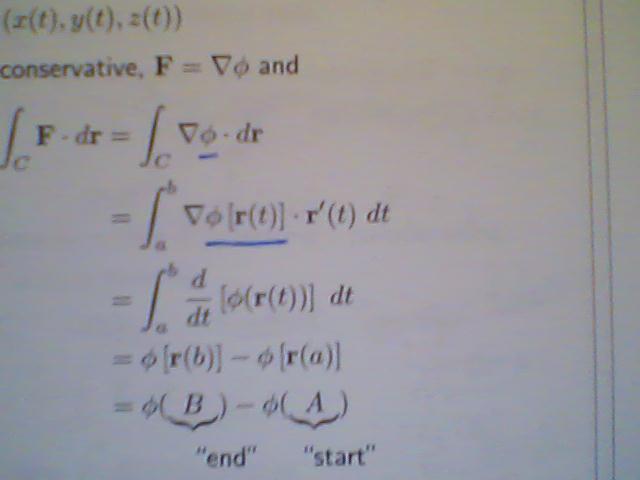
Hi guys, attached is a picture of my problem and it is also underlined.
5zil9k.jpg


I've been reading through this theory and I just don't understand what the square brackets indicate.

I understand that ∇phi is the partial derivative with respect to the scalar function phi.

But what is ∇phi [r(t)] ?

I feel ashamed asking this like I'm going to be laughed at.
 
Physics news on Phys.org
##\nabla\phi## is the the gradient of ##\phi##: it is read "grad phi" or "del phi".
So it involved taking the partial derivative of phi with respect to each coordinate axis.
http://en.wikipedia.org/wiki/Gradient

##\phi[\vec{r}(t)]## is just telling you that ##\phi## is a function of ##\vec{r}## which, in turn, is a function of ##t##. What they've done is parameterized the path represented by the C. Having turned ##\phi## into a function of just one variable, the gradient is much simplified.
 
They are just using "[ ]" in place of "( )" because they are already using "( )" for the "[itex]\vec{r}(t)[/itex]" and don't want to have "))". There is no difference in meaning.
 

Similar threads

  • · Replies 2 ·
Replies
2
Views
3K
  • · Replies 4 ·
Replies
4
Views
3K
  • · Replies 3 ·
Replies
3
Views
2K
  • · Replies 14 ·
Replies
14
Views
10K
  • · Replies 6 ·
Replies
6
Views
2K
  • · Replies 1 ·
Replies
1
Views
1K
  • · Replies 6 ·
Replies
6
Views
2K
  • · Replies 1 ·
Replies
1
Views
2K
  • · Replies 5 ·
Replies
5
Views
3K
  • · Replies 11 ·
Replies
11
Views
3K