Hilbert space transformation under Poincaré translation

Click For Summary

Discussion Overview

The discussion revolves around the transformation of Hilbert spaces under Poincaré translations, particularly in the context of quantum mechanics. Participants explore the implications of these transformations for both relativistic and non-relativistic quantum mechanics, questioning the physical interpretation of states in Hilbert space and the nature of translations.

Discussion Character

  • Exploratory
  • Technical explanation
  • Conceptual clarification
  • Debate/contested

Main Points Raised

  • One participant expresses doubt about the physical interpretation of a translated particle corresponding to the same state in Hilbert space, questioning how this is possible.
  • Another participant argues that a translated particle can be distinguished from its original position, suggesting that they do not have to correspond to the same ray in Hilbert space.
  • There is a suggestion that a unitary irreducible representation of the Poincaré group is desired for the Hilbert space to accommodate all transformations.
  • A participant notes that the phase factor applied to a single plane wave component does not affect its delocalized nature, and that localization arises from the superposition of all plane wave components.
  • Another participant introduces the concept of "rigged Hilbert space" as a potentially more suitable framework than standard Hilbert space for addressing these issues.

Areas of Agreement / Disagreement

Participants express differing views on the interpretation of states in Hilbert space under translations, with some questioning the physicality of the same state being used for translated particles. The discussion remains unresolved, with multiple competing perspectives presented.

Contextual Notes

Participants reference specific chapters from texts like Ballentine to support their arguments, indicating that understanding the non-relativistic case may provide insights into the relativistic case. There is an acknowledgment of the need for a more general framework than standard Hilbert space.

ddd123
Messages
481
Reaction score
55
This is one of those "existential doubts" that most likely have a trivial solution which I can't see.

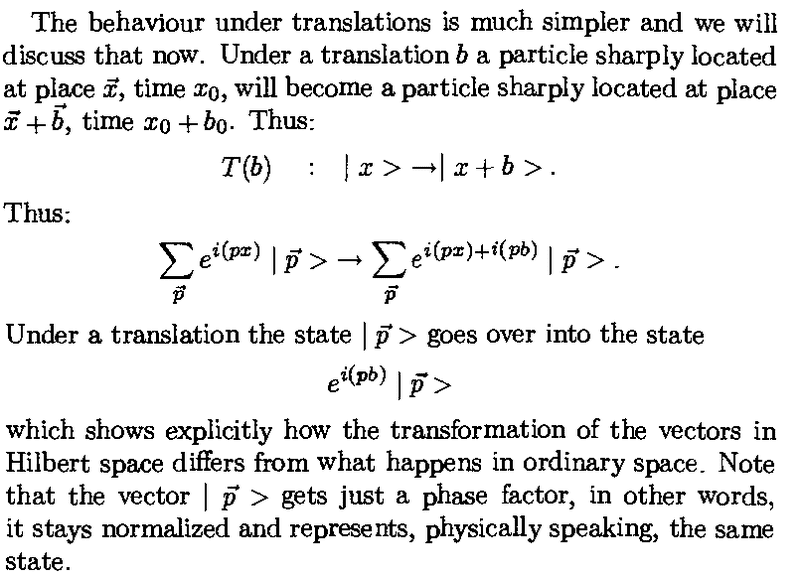
Veltman says in the Diagrammatica book:
AZBNcIo.png


Although the reasoning makes perfect sense for a Hilbert space spanned by momentum states, intuitively it doesn't make sense to me, because a translated particle cannot correspond to the same state "physically speaking" (i.e. the same ray in Hilbert space). How is that possible?

Another question: does this hold for non-relativistic quantum mechanics as well? At a glance, it seems so.

Thanks.
 
Physics news on Phys.org
ddd123 said:
[...]

Although the reasoning makes perfect sense for a Hilbert space spanned by momentum states, intuitively it doesn't make sense to me, because a translated particle cannot correspond to the same state "physically speaking" (i.e. the same ray in Hilbert space). How is that possible?
Well, I can distinguish a particle "here" from a particle "over there". I.e., they don't have to be the same Hilbert space ray. We just want a mapping between them that corresponds to a spatial translation. Moreover, we want a Hilbert space on which all the transformations of the Poincare group are represented by unitary operators. (The terminology is that we want a "unitary irreducible representation" of the Poincare group.)

Another question: does this hold for non-relativistic quantum mechanics as well? At a glance, it seems so.
Yes.
And,... since you needed to ask these questions,... I recommend you grab a copy of Ballentine urgently and study ch3 (and possibly also ch1 and ch2 if ch3 doesn't make sense). He covers this stuff for the nonrel case (Galilei group), but once you understand that properly, the relativistic case will be a bit easier.
 
Will do. But I've just noticed something. The phase factor is put on the single |p> plane wave component, which by itself is completely delocalized, it's only the superposition of all |p>'s that is localized: so it's ok that the single |p> state is the same. Am I making sense?
 
ddd123 said:
Will do. But I've just noticed something. The phase factor is put on the single |p> plane wave component, which by itself is completely delocalized, it's only the superposition of all |p>'s that is localized: so it's ok that the single |p> state is the same. Am I making sense?
Yes -- you're getting your first hint that something more general than Hilbert space is desirable.
That "something" is called "rigged Hilbert space". Ballentine ch1 contains a gentle introduction.
 

Similar threads

  • · Replies 18 ·
Replies
18
Views
2K
  • · Replies 7 ·
Replies
7
Views
2K
  • · Replies 2 ·
Replies
2
Views
2K
  • · Replies 24 ·
Replies
24
Views
4K
  • · Replies 1 ·
Replies
1
Views
2K
  • · Replies 27 ·
Replies
27
Views
8K
  • · Replies 30 ·
2
Replies
30
Views
4K
  • · Replies 77 ·
3
Replies
77
Views
13K
  • · Replies 87 ·
3
Replies
87
Views
9K
  • · Replies 5 ·
Replies
5
Views
2K