Hills Hoist Mechanism: Understanding the Function and Assembly | Explained

  • Thread starter Thread starter TheNarrator
  • Start date Start date
  • Tags Tags
    Hoist Mechanism
Click For Summary
SUMMARY

The discussion focuses on the mechanics of a traditional Hills Hoist clothesline, specifically how the handle assembly operates in relation to the central threaded rod. The handle assembly remains fixed while the crank handle rotates, engaging bevel gears that drive the lead screw up or down without rotating itself. A user seeks to modify this mechanism to allow for a 360-degree rotation during extension, which requires careful consideration of the lead screw design and mechanical advantages.

PREREQUISITES
  • Understanding of mechanical systems and gear mechanics
  • Familiarity with lead screw mechanisms
  • Knowledge of bevel gear functionality
  • Basic principles of mechanical advantage
NEXT STEPS
  • Research lead screw designs that allow for rotational movement during extension
  • Explore modifications to bevel gear systems for enhanced functionality
  • Investigate mechanical advantage calculations for threaded rod systems
  • Examine alternative designs for clothesline mechanisms that incorporate rotation
USEFUL FOR

Engineers, inventors, and DIY enthusiasts interested in mechanical design, particularly those looking to innovate or modify existing clothesline systems for improved functionality.

TheNarrator
Messages
9
Reaction score
0
Firstly, am struggling to wrap my head around exactly how the mechanism for a traditional 'hills hoist' (as seen below) clothesline functions.
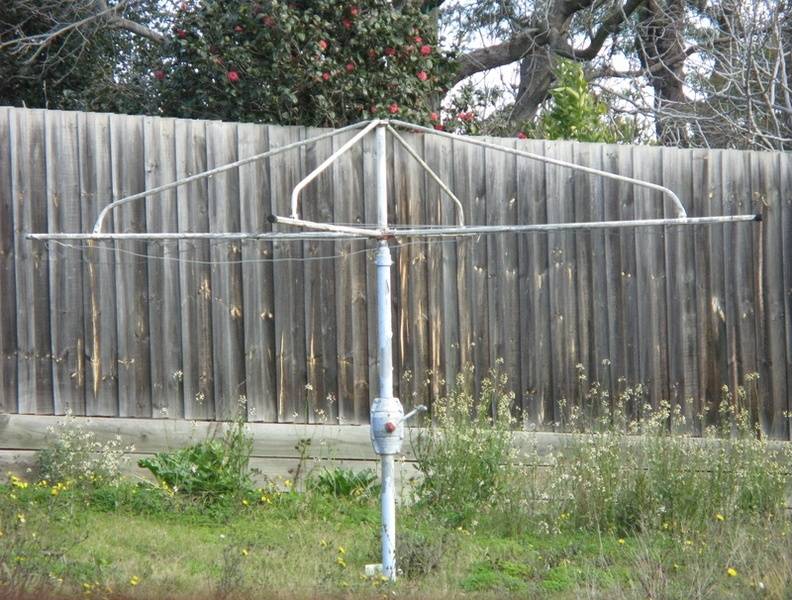
Hills_Hoist_Balwyn_Victoria.JPG


The handle can be turned in order to raise the clotheslines but from my googling, the mechanism is different to what I was expecting.

Would be greatly appreciated if someone were able to explain to me how systems such as the ones shown below function.
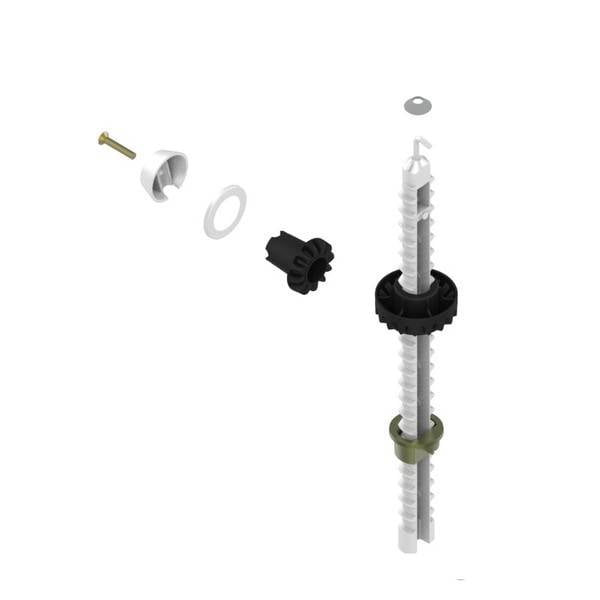
repair-kit-heritage-hoist.jpg

$_90.JPG


Does the entire handle assembly move along the central threaded rod, pushing up the upper section?

If so is there a way to achieve this with the handle assembly fixed?

Feel like it's probably quite a simple answer but haven't been able to find much specific information on it
 
Last edited by a moderator:
Engineering news on Phys.org
TheNarrator said:
Does the entire handle assembly move along the central threaded rod, pushing up the upper section?

No. In the top image, the only visibly moving parts are the crank handle rotating and everything above 2/3 the height of the fence moving upward (the photo shows it in it's lowermost position).

In your second image:
Only the threaded rod moves up or down,it doesn't rotate, all others parts rotate or are stationary.
The hand crank rotates the LH bevel gear which rotates the RH bevel gear whose internal threading drives the lead screw up or down. The lower brass coloured collar prevents the lead screw from rotating.
 
  • Like
Likes TheNarrator
Thanks for your response.

So that means the handle assembly is fastened to the exterior stationary pole in some way correct?

I need to make a system like this where the threaded rods extends but want it to rotate through 360deg (preferably only once) as it extends. is there a way to achieve this by modifying a hills hoist or am I on the wrong track completely?
 
The reason for lots of turns is: in general mechanical advantage increases as the rate of the extension per turn decreases.

Questions you need to answer:
So - how much extension or retraction is required for one revolution?
Diameter of the central shaft == ?
Mass of the "stuff" or payload at the top of the rod == ?
 
TheNarrator said:
Thanks for your response.

So that means the handle assembly is fastened to the exterior stationary pole in some way correct?
That's right.

I need to make a system like this where the threaded rods extends but want it to rotate through 360deg (preferably only once) as it extends. is there a way to achieve this by modifying a hills hoist or am I on the wrong track completely?
If you replaced the lead screw with one something like this:
Helix cut lead screw.PNG


It'd rotate once per full height extension. Though, that'd be very difficult/expensive to make.
If you give us details of what you're trying to do we may have better suggestions.
 
  • Like
Likes jim mcnamara
I have encountered a vertically oriented hydraulic cylinder that is designed to actuate and slice heavy cabling into sections with a blade. The cylinder is quite small (around 1.5 inches in diameter) and has an equally small stroke. The cylinder is single acting (i.e. it is pressurized from the bottom, and vented to atmosphere with a spring return, roughly 200lbs of force on the spring). The system operates at roughly 2500 psi. Interestingly, the cylinder has a pin that passes through its...

Similar threads

  • · Replies 1 ·
Replies
1
Views
3K
Replies
6
Views
6K
Replies
13
Views
4K
Replies
12
Views
2K
  • · Replies 46 ·
2
Replies
46
Views
5K
  • · Replies 12 ·
Replies
12
Views
4K
  • · Replies 19 ·
Replies
19
Views
8K
  • · Replies 1 ·
Replies
1
Views
4K
Replies
2
Views
10K
  • · Replies 3 ·
Replies
3
Views
5K